




How do you sketch the graph $y={{x}^{4}}-2{{x}^{3}}+2x$ using the first and second derivatives?
Answer
 Verified
598.5k+ views
Hint: We find the slope of the given function $f\left( x \right)=y={{x}^{4}}-2{{x}^{3}}+2x$ to find the extremum points. We equate it with 0. Extremum points in a curve have slope value 0. We solve the quadratic solution to find the X-axis intersects and the points.
Complete step by step answer:
We need to find the relative extrema of the function $f\left( x \right)={{x}^{4}}-2{{x}^{3}}+2x$.
To find the extremum points we need to find the slope of the function and also the value of the point where the slope will be 0.
Extremum points in a curve have slope value 0.
The slope of the function $f\left( x \right)={{x}^{4}}-2{{x}^{3}}+2x$ can be found from the derivative of the function ${{f}^{'}}\left( x \right)=\dfrac{d}{dx}\left[ f\left( x \right) \right]$.
We know that the differentiation form for ${{n}^{th}}$ power of $x$ is $\dfrac{d}{dx}\left[ {{x}^{n}} \right]=n{{x}^{n-1}}$.
$\begin{align}
& f\left( x \right)={{x}^{4}}-2{{x}^{3}}+2x \\
& \Rightarrow {{f}^{'}}\left( x \right)=\dfrac{d}{dx}\left[ f\left( x \right) \right]=4{{x}^{3}}-6{{x}^{2}}+2 \\
\end{align}$
To find the $x$ coordinates of the extremum points we take $4{{x}^{3}}-6{{x}^{2}}+2=0$.
So, $4{{x}^{3}}-6{{x}^{2}}+2={{\left( x-1 \right)}^{2}}\left( 4x+2 \right)$.
We put the values and get $x$ as $x=1,-\dfrac{1}{2}$.
We also can find which point is maxima and minima by finding ${{f}^{''}}\left( x \right)=\dfrac{d}{dx}\left[ {{f}^{'}}\left( x \right) \right]$. If for $x=a,b$, we find ${{f}^{''}}\left( x \right)$ being negative value then the point is maxima and ${{f}^{''}}\left( x \right)$ being positive value then the point is minima.
For ${{f}^{'}}\left( x \right)=4{{x}^{3}}-6{{x}^{2}}+2$, we get ${{f}^{''}}\left( x \right)=12{{x}^{2}}-12x$.
At $x=1$, ${{f}^{''}}\left( 1 \right)=0$. The point is neither maxima or minima.
At $x=-\dfrac{1}{2}$, ${{f}^{''}}\left( -\dfrac{1}{2} \right)=9>0$. The point $x=-\dfrac{1}{2}$ is minima.
Therefore, from the value of the $x$ coordinates of the extremum points, we find their $y$ coordinates.
For $x=-\dfrac{1}{2}$, the value of \[y=f\left( -\dfrac{1}{2} \right)={{\left( -\dfrac{1}{2} \right)}^{4}}-2{{\left( -\dfrac{1}{2} \right)}^{3}}+2\left( -\dfrac{1}{2} \right)=-\dfrac{11}{16}\].
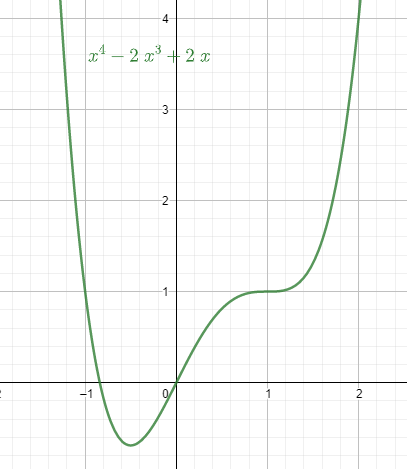
Note:
We also find the X-axis intersects and the points where ${{x}^{4}}-2{{x}^{3}}+2x=0$.
This gives $x=0$ as the only integer root. The other real root is fraction
The curve is open on the maximum side.
Complete step by step answer:
We need to find the relative extrema of the function $f\left( x \right)={{x}^{4}}-2{{x}^{3}}+2x$.
To find the extremum points we need to find the slope of the function and also the value of the point where the slope will be 0.
Extremum points in a curve have slope value 0.
The slope of the function $f\left( x \right)={{x}^{4}}-2{{x}^{3}}+2x$ can be found from the derivative of the function ${{f}^{'}}\left( x \right)=\dfrac{d}{dx}\left[ f\left( x \right) \right]$.
We know that the differentiation form for ${{n}^{th}}$ power of $x$ is $\dfrac{d}{dx}\left[ {{x}^{n}} \right]=n{{x}^{n-1}}$.
$\begin{align}
& f\left( x \right)={{x}^{4}}-2{{x}^{3}}+2x \\
& \Rightarrow {{f}^{'}}\left( x \right)=\dfrac{d}{dx}\left[ f\left( x \right) \right]=4{{x}^{3}}-6{{x}^{2}}+2 \\
\end{align}$
To find the $x$ coordinates of the extremum points we take $4{{x}^{3}}-6{{x}^{2}}+2=0$.
So, $4{{x}^{3}}-6{{x}^{2}}+2={{\left( x-1 \right)}^{2}}\left( 4x+2 \right)$.
We put the values and get $x$ as $x=1,-\dfrac{1}{2}$.
We also can find which point is maxima and minima by finding ${{f}^{''}}\left( x \right)=\dfrac{d}{dx}\left[ {{f}^{'}}\left( x \right) \right]$. If for $x=a,b$, we find ${{f}^{''}}\left( x \right)$ being negative value then the point is maxima and ${{f}^{''}}\left( x \right)$ being positive value then the point is minima.
For ${{f}^{'}}\left( x \right)=4{{x}^{3}}-6{{x}^{2}}+2$, we get ${{f}^{''}}\left( x \right)=12{{x}^{2}}-12x$.
At $x=1$, ${{f}^{''}}\left( 1 \right)=0$. The point is neither maxima or minima.
At $x=-\dfrac{1}{2}$, ${{f}^{''}}\left( -\dfrac{1}{2} \right)=9>0$. The point $x=-\dfrac{1}{2}$ is minima.
Therefore, from the value of the $x$ coordinates of the extremum points, we find their $y$ coordinates.
For $x=-\dfrac{1}{2}$, the value of \[y=f\left( -\dfrac{1}{2} \right)={{\left( -\dfrac{1}{2} \right)}^{4}}-2{{\left( -\dfrac{1}{2} \right)}^{3}}+2\left( -\dfrac{1}{2} \right)=-\dfrac{11}{16}\].
Note:
We also find the X-axis intersects and the points where ${{x}^{4}}-2{{x}^{3}}+2x=0$.
This gives $x=0$ as the only integer root. The other real root is fraction
The curve is open on the maximum side.
Recently Updated Pages
Basicity of sulphurous acid and sulphuric acid are

Master Class 12 Economics: Engaging Questions & Answers for Success
Master Class 12 Biology: Engaging Questions & Answers for Success
Master Class 11 English: Engaging Questions & Answers for Success
Master Class 11 Physics: Engaging Questions & Answers for Success
Master Class 11 Computer Science: Engaging Questions & Answers for Success
Trending doubts
Draw a labelled sketch of the human eye class 12 physics CBSE
The chemical formula of tear gas is A CO Cl 2 B C 10 class 12 chemistry CBSE
Draw ray diagrams each showing i myopic eye and ii class 12 physics CBSE
Which are the Top 10 Largest Countries of the World?
Differentiate between homogeneous and heterogeneous class 12 chemistry CBSE
Which is the correct genotypic ratio of mendel dihybrid class 12 biology CBSE