




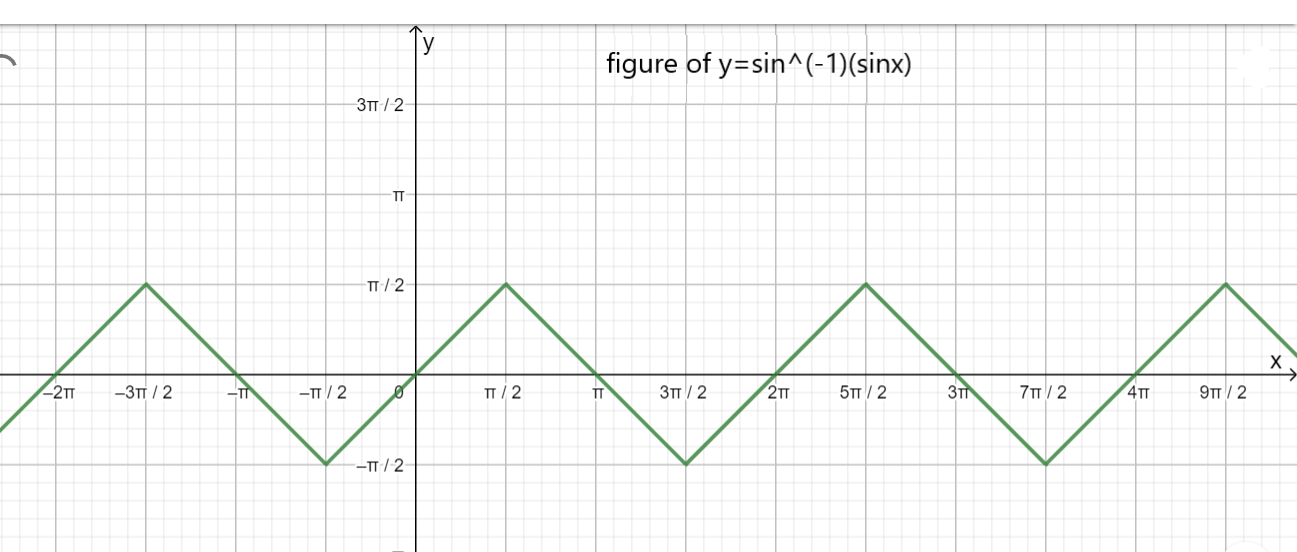
Sketch the graph for \[y = {\sin ^{ - 1}}\left( {\sin x} \right)\]
Answer
 Verified
539.4k+ views
Hint: In this question to draw the graph for \[y = {\sin ^{ - 1}}\left( {\sin x} \right)\] firstly find out the differentiation of the given function, then break the differential into intervals after that find out the second differential and break it in intervals and check concavity and you can make the graph of the given function.
Complete answer:
Trigonometry is a combination of the Greek word trigon and metron. Here, trigon refers to figures with three angles, and metron refers to the measurement, hence the definition of trigonometry is triangle measurement.
We know that the meaning of \[dx\] is the increment in \[x\] and it may be positive or negative. Similarly, \[dy\] means the increment in the value of \[y\]
If there is an increment in the value of \[x\] and \[y\] in the same direction either both positive or both negative then the value of \[\dfrac{{dy}}{{dx}}\] is always positive. On the other hand, if the increment in \[x\] and \[y\] are of positive direction that is one positive and other negative then the value of \[\dfrac{{dy}}{{dx}}\] will be negative.
Now according to the question:
We have to sketch the graph for \[y = {\sin ^{ - 1}}\left( {\sin x} \right)\] hence:
\[ \Rightarrow y = {\sin ^{ - 1}}\left( {\sin x} \right)\]
We will find out the differential of \[y\] :
\[ \Rightarrow y' = \dfrac{d}{{dx}}{\sin ^{ - 1}}\left( {\sin x} \right)\]
\[ \Rightarrow y' = \dfrac{1}{{\sqrt {1 - {{\sin }^2}x} }}\dfrac{d}{{dx}}\left( {\sin x} \right)\]
\[ \Rightarrow y' = \dfrac{{\cos x}}{{\sqrt {1 - {{\sin }^2}x} }}\]
As we know that \[1 - {\sin ^2}x = {\cos ^2}x\]
\[ \Rightarrow y' = \dfrac{{\cos x}}{{\sqrt {{{\cos }^2}x} }}\]
\[ \Rightarrow y' = \dfrac{{\cos x}}{{\left| {\cos x} \right|}}\]
Now break \[y'\] into intervals and simplify \[\left| {\cos x} \right|\]
$ \Rightarrow y' = \left\{ {\begin{array}{*{20}{c}} {\dfrac{{\cos x}}{{\cos x}} = 1}&{ > 0}&{0 \leqslant x < \dfrac{\pi }{2}} \\ {\dfrac{{cosx}}{{ - \cos x}} = - 1}&{ < 0}&{\dfrac{\pi }{2} < x < \dfrac{{3\pi }}{2}} \\ {\dfrac{{\cos x}}{{\cos x}} = 1}&{ > 0}&{\dfrac{{3\pi }}{2} < x \leqslant 2\pi } \end{array}} \right.$
Now we will again find out differentiation of \[y'\] :
\[ \Rightarrow y'' = 0\]
Now break \[y''\] into intervals:
$ \Rightarrow y' = \left\{ {\begin{array}{*{20}{c}} 0&{0 \leqslant x < \dfrac{\pi }{2}} \\ 0&{\dfrac{\pi }{2} < x < \dfrac{{3\pi }}{2}} \\ 0&{\dfrac{{3\pi }}{2} < x \leqslant 2\pi } \end{array}} \right.$
Here the concavity is neither increasing nor decreasing hence there will only be a straight line:
Now find out these points of the given function that is \[y = {\sin ^{ - 1}}\left( {\sin x} \right)\] hence:
\[ \Rightarrow y = {\sin ^{ - 1}}\left( {\sin 0} \right) = 0\]
\[ \Rightarrow y = {\sin ^{ - 1}}\left( {\sin \dfrac{\pi }{2}} \right) = \dfrac{\pi }{2}\]
\[ \Rightarrow y = {\sin ^{ - 1}}\left( {\sin \dfrac{{3\pi }}{2}} \right) = - \dfrac{\pi }{2}\]
\[ \Rightarrow y = {\sin ^{ - 1}}\left( {\sin 2\pi } \right) = 0\]
Now draw the graph from \[0\] to \[2\pi \]:
Note:
The word sine is derived from the Latin word sinus, which means 'bay' or 'fold.' This, in turn, is either derived from a bowstring-related phrase. Any trigonometric function of angle \[{\theta ^ \circ }\] is equal to the same trigonometric function of any angle \[n \times {360^ \circ } + \theta \] , where \[n\] is any integer.
Complete answer:
Trigonometry is a combination of the Greek word trigon and metron. Here, trigon refers to figures with three angles, and metron refers to the measurement, hence the definition of trigonometry is triangle measurement.
We know that the meaning of \[dx\] is the increment in \[x\] and it may be positive or negative. Similarly, \[dy\] means the increment in the value of \[y\]
If there is an increment in the value of \[x\] and \[y\] in the same direction either both positive or both negative then the value of \[\dfrac{{dy}}{{dx}}\] is always positive. On the other hand, if the increment in \[x\] and \[y\] are of positive direction that is one positive and other negative then the value of \[\dfrac{{dy}}{{dx}}\] will be negative.
Now according to the question:
We have to sketch the graph for \[y = {\sin ^{ - 1}}\left( {\sin x} \right)\] hence:
\[ \Rightarrow y = {\sin ^{ - 1}}\left( {\sin x} \right)\]
We will find out the differential of \[y\] :
\[ \Rightarrow y' = \dfrac{d}{{dx}}{\sin ^{ - 1}}\left( {\sin x} \right)\]
\[ \Rightarrow y' = \dfrac{1}{{\sqrt {1 - {{\sin }^2}x} }}\dfrac{d}{{dx}}\left( {\sin x} \right)\]
\[ \Rightarrow y' = \dfrac{{\cos x}}{{\sqrt {1 - {{\sin }^2}x} }}\]
As we know that \[1 - {\sin ^2}x = {\cos ^2}x\]
\[ \Rightarrow y' = \dfrac{{\cos x}}{{\sqrt {{{\cos }^2}x} }}\]
\[ \Rightarrow y' = \dfrac{{\cos x}}{{\left| {\cos x} \right|}}\]
Now break \[y'\] into intervals and simplify \[\left| {\cos x} \right|\]
$ \Rightarrow y' = \left\{ {\begin{array}{*{20}{c}} {\dfrac{{\cos x}}{{\cos x}} = 1}&{ > 0}&{0 \leqslant x < \dfrac{\pi }{2}} \\ {\dfrac{{cosx}}{{ - \cos x}} = - 1}&{ < 0}&{\dfrac{\pi }{2} < x < \dfrac{{3\pi }}{2}} \\ {\dfrac{{\cos x}}{{\cos x}} = 1}&{ > 0}&{\dfrac{{3\pi }}{2} < x \leqslant 2\pi } \end{array}} \right.$
Now we will again find out differentiation of \[y'\] :
\[ \Rightarrow y'' = 0\]
Now break \[y''\] into intervals:
$ \Rightarrow y' = \left\{ {\begin{array}{*{20}{c}} 0&{0 \leqslant x < \dfrac{\pi }{2}} \\ 0&{\dfrac{\pi }{2} < x < \dfrac{{3\pi }}{2}} \\ 0&{\dfrac{{3\pi }}{2} < x \leqslant 2\pi } \end{array}} \right.$
Here the concavity is neither increasing nor decreasing hence there will only be a straight line:
Now find out these points of the given function that is \[y = {\sin ^{ - 1}}\left( {\sin x} \right)\] hence:
\[ \Rightarrow y = {\sin ^{ - 1}}\left( {\sin 0} \right) = 0\]
\[ \Rightarrow y = {\sin ^{ - 1}}\left( {\sin \dfrac{\pi }{2}} \right) = \dfrac{\pi }{2}\]
\[ \Rightarrow y = {\sin ^{ - 1}}\left( {\sin \dfrac{{3\pi }}{2}} \right) = - \dfrac{\pi }{2}\]
\[ \Rightarrow y = {\sin ^{ - 1}}\left( {\sin 2\pi } \right) = 0\]
Now draw the graph from \[0\] to \[2\pi \]:
Note:
The word sine is derived from the Latin word sinus, which means 'bay' or 'fold.' This, in turn, is either derived from a bowstring-related phrase. Any trigonometric function of angle \[{\theta ^ \circ }\] is equal to the same trigonometric function of any angle \[n \times {360^ \circ } + \theta \] , where \[n\] is any integer.
Recently Updated Pages
Which of the following graphs shows the variation of class 12 physics CBSE

Draw a labelled diagram of the human male reproductive class 12 biology CBSE
Describe the experiment to compare the emf of two cells class 12 physics CBSE
What is standard hydrogen electrode
What is conventional current and electric current class 12 physics CBSE
2Bromopentane is treated with an alcoholic KOH solution class 12 chemistry CBSE
Trending doubts
Draw a labelled sketch of the human eye class 12 physics CBSE
Which are the Top 10 Largest Countries of the World?
Differentiate between homogeneous and heterogeneous class 12 chemistry CBSE
Draw ray diagrams each showing i myopic eye and ii class 12 physics CBSE
Which is the correct genotypic ratio of mendel dihybrid class 12 biology CBSE
What is the Full Form of PVC, PET, HDPE, LDPE, PP and PS ?