




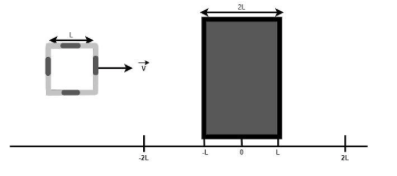
Sketch a graph of the induced current in the loop as a function of x. Take counter clockwise currents to be positive.
Answer
 Verified
633k+ views
Hint:The loop when entering the magnetic field will induce electric current in the loop and the loop while exiting the magnetic field will induce an current but when the loop (not moving) is inside the magnetic field and the magnetic field is uniform (assumption taken) there would be no current will induced in the coil.
Complete step by solution:
According to Faraday's law of electromagnetic induction the magnitude of the induced emf is directly proportional to the rate of change of magnetic flux.
$\varepsilon = \dfrac{{d\phi }}{{dt}}$ ;
Where:
$\varepsilon $= Electromotive force;
$\phi $= Magnetic flux;
t = time;
Now, flux is given as:
$\phi = Blx$;
Where:
$\phi $= Magnetic flux.
B = Magnetic Field;
l = Length;
x = Distance;
Put the value of flux in the equation$\varepsilon = \dfrac{{d\phi }}{{dt}}$:
$\varepsilon = \dfrac{{d\left( {Blx} \right)}}{{dt}}$;
$ \Rightarrow \varepsilon = \dfrac{{d\left( x \right)}}{{dt}}lB$;
Now, we know that the velocity ‘v’ is the change in distance with respect to time (dx/dt):
$ \Rightarrow \varepsilon = Blvd$; ….$\left( {\dfrac{{d\left( x \right)}}{{dt}} = v} \right)$;
Now, the force on a wire in a uniform magnetic field is given by:
$F = ilB$;
Where:
i = Current;
F = Force;
l = Length;
B = Magnetic Field;
Now, According to ohm’s Law:
$v = ir$;
Where:
v = Voltage Source;
i = Current;
r = Resistance;
Now, here the EMF “$\varepsilon $” is acting as a voltage source so,
$\varepsilon = ir$;
In terms of current:
$ \Rightarrow i = \dfrac{\varepsilon }{r}$;
Now, put the above relation in the equation$F = ilB$:
$F = \left( {\dfrac{\varepsilon }{r}} \right)lB$;
Now, put the value of emf $\varepsilon = - Blv$in the above equation:
\[F = \left( {\dfrac{{Blv}}{r}} \right)lB\];
\[ \Rightarrow F = \left( {\dfrac{{{B^2}{l^2}v}}{r}} \right);\]
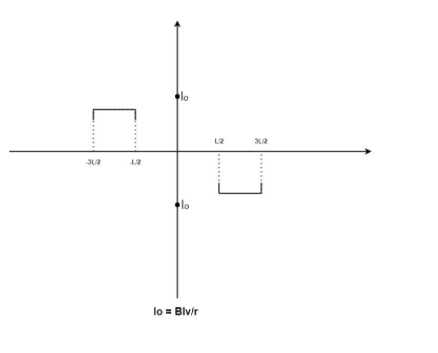
If the loop enters the magnetic field the magnetic force will induce electric current in the direction which is opposite to the direction of the magnetic field. Suppose, the magnetic field is inside \[\left( \otimes \right)\] the area then if the loop is entering the magnetic field then the direction of the induced current will be outside $\left( \bullet \right)$ the area and when the current carrying loop is exiting the magnetic field then the induced current would be inside \[\left( \otimes \right)\] the area.
Magnetic force will always remain positive.
Note:Here, we need to apply Faraday’s law, ohm’s law and lenz law and explain about the nature of the induced current in the coil due to the magnetic field. Here, the magnetic force will act only two times: one when the coil is entering the magnetic field and second when the coil is exiting the magnetic field.
Complete step by solution:
According to Faraday's law of electromagnetic induction the magnitude of the induced emf is directly proportional to the rate of change of magnetic flux.
$\varepsilon = \dfrac{{d\phi }}{{dt}}$ ;
Where:
$\varepsilon $= Electromotive force;
$\phi $= Magnetic flux;
t = time;
Now, flux is given as:
$\phi = Blx$;
Where:
$\phi $= Magnetic flux.
B = Magnetic Field;
l = Length;
x = Distance;
Put the value of flux in the equation$\varepsilon = \dfrac{{d\phi }}{{dt}}$:
$\varepsilon = \dfrac{{d\left( {Blx} \right)}}{{dt}}$;
$ \Rightarrow \varepsilon = \dfrac{{d\left( x \right)}}{{dt}}lB$;
Now, we know that the velocity ‘v’ is the change in distance with respect to time (dx/dt):
$ \Rightarrow \varepsilon = Blvd$; ….$\left( {\dfrac{{d\left( x \right)}}{{dt}} = v} \right)$;
Now, the force on a wire in a uniform magnetic field is given by:
$F = ilB$;
Where:
i = Current;
F = Force;
l = Length;
B = Magnetic Field;
Now, According to ohm’s Law:
$v = ir$;
Where:
v = Voltage Source;
i = Current;
r = Resistance;
Now, here the EMF “$\varepsilon $” is acting as a voltage source so,
$\varepsilon = ir$;
In terms of current:
$ \Rightarrow i = \dfrac{\varepsilon }{r}$;
Now, put the above relation in the equation$F = ilB$:
$F = \left( {\dfrac{\varepsilon }{r}} \right)lB$;
Now, put the value of emf $\varepsilon = - Blv$in the above equation:
\[F = \left( {\dfrac{{Blv}}{r}} \right)lB\];
\[ \Rightarrow F = \left( {\dfrac{{{B^2}{l^2}v}}{r}} \right);\]
If the loop enters the magnetic field the magnetic force will induce electric current in the direction which is opposite to the direction of the magnetic field. Suppose, the magnetic field is inside \[\left( \otimes \right)\] the area then if the loop is entering the magnetic field then the direction of the induced current will be outside $\left( \bullet \right)$ the area and when the current carrying loop is exiting the magnetic field then the induced current would be inside \[\left( \otimes \right)\] the area.
Magnetic force will always remain positive.
Note:Here, we need to apply Faraday’s law, ohm’s law and lenz law and explain about the nature of the induced current in the coil due to the magnetic field. Here, the magnetic force will act only two times: one when the coil is entering the magnetic field and second when the coil is exiting the magnetic field.
Recently Updated Pages
Master Class 12 Economics: Engaging Questions & Answers for Success

Master Class 12 Social Science: Engaging Questions & Answers for Success
Master Class 12 English: Engaging Questions & Answers for Success
Master Class 12 Maths: Engaging Questions & Answers for Success
Master Class 12 Physics: Engaging Questions & Answers for Success
Master Class 12 Biology: Engaging Questions & Answers for Success
Trending doubts
Draw a labelled sketch of the human eye class 12 physics CBSE
Which are the Top 10 Largest Countries of the World?
Draw ray diagrams each showing i myopic eye and ii class 12 physics CBSE
Which is the correct genotypic ratio of mendel dihybrid class 12 biology CBSE
Differentiate between homogeneous and heterogeneous class 12 chemistry CBSE
Give 10 examples of unisexual and bisexual flowers