




What is the size of an image when the position of the object is at \[F\], position of image is at infinity and image formed through a concave mirror?
A) Enlarged
B) Highly enlarged
C) Same size
D) Diminished
Answer
 Verified
587.4k+ views
Hint: In this question, we have given a concave lens. We have to identify that condition when the image will be formed too big. In a concave lens, there is a condition, in which the image becomes too large as we move towards the lens but clear image is only formed when the object is at the focus point.
Complete solution:
We know that if an object is placed in front of a concave lens at the point \[F\] which is the focus point of the concave lens then the image is formed at the infinity.
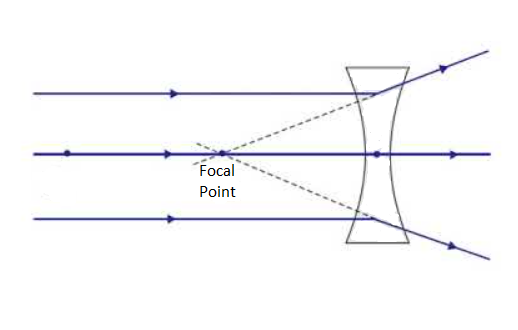
In the above diagram, the object is placed at the focus point \[F\]. Then the incident rays from the object incident on the concave lens and after refraction from the concave lens the refracted rays move outside the principal axis. So, the image is formed at infinity. As all the refracted rays are going outwards and there is no limit or boundary. So, the image becomes highly enlarged.
Additional Information:
A concave lens is a lens whose curved faces are curved inwards. While a convex lens is the lens whose curved faces are curved outwards. A concave lens diverges the rays while a convex lens converges the rays.
Note: In this question, we have to remember that the highly enlarged image will be formed when the object is placed at focus point. In a concave lens, as the object is moved towards the lens, the size of the image will increase.
Complete solution:
We know that if an object is placed in front of a concave lens at the point \[F\] which is the focus point of the concave lens then the image is formed at the infinity.
In the above diagram, the object is placed at the focus point \[F\]. Then the incident rays from the object incident on the concave lens and after refraction from the concave lens the refracted rays move outside the principal axis. So, the image is formed at infinity. As all the refracted rays are going outwards and there is no limit or boundary. So, the image becomes highly enlarged.
Additional Information:
A concave lens is a lens whose curved faces are curved inwards. While a convex lens is the lens whose curved faces are curved outwards. A concave lens diverges the rays while a convex lens converges the rays.
Note: In this question, we have to remember that the highly enlarged image will be formed when the object is placed at focus point. In a concave lens, as the object is moved towards the lens, the size of the image will increase.
Recently Updated Pages
Master Class 12 Business Studies: Engaging Questions & Answers for Success

Master Class 12 Biology: Engaging Questions & Answers for Success
Master Class 12 Chemistry: Engaging Questions & Answers for Success
Class 12 Question and Answer - Your Ultimate Solutions Guide
Master Class 11 Social Science: Engaging Questions & Answers for Success
Master Class 11 English: Engaging Questions & Answers for Success
Trending doubts
Which is more stable and why class 12 chemistry CBSE
Which are the Top 10 Largest Countries of the World?
Draw a labelled sketch of the human eye class 12 physics CBSE
Differentiate between homogeneous and heterogeneous class 12 chemistry CBSE
What are the major means of transport Explain each class 12 social science CBSE
Sulphuric acid is known as the king of acids State class 12 chemistry CBSE