




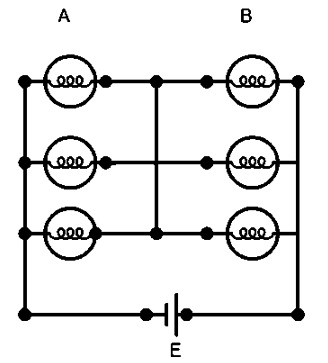
Six similar bulbs are connected as shown in the figure with a DC source of emf E and zero internal resistance. The ratio of the power consumption by the bulbs when all the bulbs are glowing to when the two from A and one from B are glowing will be –
A) 2:1
B) 4:9
C) 9:4
D) 1:2
Answer
 Verified
609k+ views
Hint: We are given a combination of bulbs connected in series and parallel to each other connected to an external source. We can find the power consumption ratios at the given conditions using the relation between the voltage and the resistance of the bulbs.
Complete step by step answer:
We know that the bulbs in a circuit constitute the loads or the resistances in the network. We can very easily approach this given case with this idea. So, six bulbs of equal resistance are connected as given below. Each bulb offers resistance of ‘R’. We need to find the equivalent resistance of the circuit including bulbs which glow in a given condition.

CASE I: All the bulbs are glowing. In this case, we can easily consider the Bulbs in section A parallel to each other and in series to the ones in B.
So, the parallel bulbs give the resistance as –
\[\begin{align}
& \dfrac{1}{{{R}_{A}}}=\dfrac{1}{{{R}_{B}}}=\dfrac{1}{R}+\dfrac{1}{R}+\dfrac{1}{R}=\dfrac{3}{R} \\
& {{R}_{A}}={{R}_{B}}=\dfrac{R}{3} \\
\end{align}\]
Now, the equivalent resistance is given by –
\[{{R}_{eq}}={{R}_{A}}+{{R}_{B}}=\dfrac{2R}{3}\]
The power consumed by the network in this case is given by –
\[\begin{align}
& P=\dfrac{{{E}^{2}}}{{{R}_{eq}}} \\
& {{P}_{1}}=\dfrac{3{{E}^{2}}}{2R}\text{ --(1)} \\
\end{align}\]
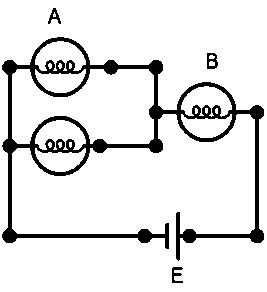
CASE II: Two bulbs in section A and just one bulb in section B glows. We can simplify the circuit ass shown below.
The equivalent resistance is given by –
\[\begin{align}
& \dfrac{1}{{{R}_{A}}}=\dfrac{1}{R}+\dfrac{1}{R}=\dfrac{2}{R} \\
& \Rightarrow {{R}_{A}}=\dfrac{R}{2} \\
& {{R}_{B}}=R \\
& {{R}_{eq}}={{R}_{A}}+{{R}_{B}}=\dfrac{3R}{2} \\
\end{align}\]
Now, we can calculate the power dissipation by the network as –
\[\begin{align}
& P=\dfrac{{{E}^{2}}}{{{R}_{eq}}} \\
& {{P}_{2}}=\dfrac{2{{E}^{2}}}{3R}\text{ --(2)} \\
\end{align}\]
We are asked to find the ratio of power consumptions in case I and case II. This is given by taking the ratios of (1) and (2) as -
\[\dfrac{{{P}_{1}}}{{{P}_{2}}}=\dfrac{\dfrac{3{{E}^{2}}}{2R}}{\dfrac{2{{E}^{2}}}{3R}}=\dfrac{9}{4}\]
The ratio of the power consumption for the two conditions are given by 9:4.
The correct answer is option C.
Note:
The power consumed by the electrical devices is not only dependent on its individual resistances. It is also dependent on the type of combination the circuit network is designed. This is an important point to be considered while designing a circuit.
Complete step by step answer:
We know that the bulbs in a circuit constitute the loads or the resistances in the network. We can very easily approach this given case with this idea. So, six bulbs of equal resistance are connected as given below. Each bulb offers resistance of ‘R’. We need to find the equivalent resistance of the circuit including bulbs which glow in a given condition.
CASE I: All the bulbs are glowing. In this case, we can easily consider the Bulbs in section A parallel to each other and in series to the ones in B.
So, the parallel bulbs give the resistance as –
\[\begin{align}
& \dfrac{1}{{{R}_{A}}}=\dfrac{1}{{{R}_{B}}}=\dfrac{1}{R}+\dfrac{1}{R}+\dfrac{1}{R}=\dfrac{3}{R} \\
& {{R}_{A}}={{R}_{B}}=\dfrac{R}{3} \\
\end{align}\]
Now, the equivalent resistance is given by –
\[{{R}_{eq}}={{R}_{A}}+{{R}_{B}}=\dfrac{2R}{3}\]
The power consumed by the network in this case is given by –
\[\begin{align}
& P=\dfrac{{{E}^{2}}}{{{R}_{eq}}} \\
& {{P}_{1}}=\dfrac{3{{E}^{2}}}{2R}\text{ --(1)} \\
\end{align}\]
CASE II: Two bulbs in section A and just one bulb in section B glows. We can simplify the circuit ass shown below.
The equivalent resistance is given by –
\[\begin{align}
& \dfrac{1}{{{R}_{A}}}=\dfrac{1}{R}+\dfrac{1}{R}=\dfrac{2}{R} \\
& \Rightarrow {{R}_{A}}=\dfrac{R}{2} \\
& {{R}_{B}}=R \\
& {{R}_{eq}}={{R}_{A}}+{{R}_{B}}=\dfrac{3R}{2} \\
\end{align}\]
Now, we can calculate the power dissipation by the network as –
\[\begin{align}
& P=\dfrac{{{E}^{2}}}{{{R}_{eq}}} \\
& {{P}_{2}}=\dfrac{2{{E}^{2}}}{3R}\text{ --(2)} \\
\end{align}\]
We are asked to find the ratio of power consumptions in case I and case II. This is given by taking the ratios of (1) and (2) as -
\[\dfrac{{{P}_{1}}}{{{P}_{2}}}=\dfrac{\dfrac{3{{E}^{2}}}{2R}}{\dfrac{2{{E}^{2}}}{3R}}=\dfrac{9}{4}\]
The ratio of the power consumption for the two conditions are given by 9:4.
The correct answer is option C.
Note:
The power consumed by the electrical devices is not only dependent on its individual resistances. It is also dependent on the type of combination the circuit network is designed. This is an important point to be considered while designing a circuit.
Recently Updated Pages
Master Class 12 Economics: Engaging Questions & Answers for Success

Master Class 12 English: Engaging Questions & Answers for Success
Master Class 12 Social Science: Engaging Questions & Answers for Success
Master Class 12 Maths: Engaging Questions & Answers for Success
Master Class 12 Physics: Engaging Questions & Answers for Success
Master Class 9 General Knowledge: Engaging Questions & Answers for Success
Trending doubts
Which are the Top 10 Largest Countries of the World?
Draw a labelled sketch of the human eye class 12 physics CBSE
Differentiate between homogeneous and heterogeneous class 12 chemistry CBSE
Sulphuric acid is known as the king of acids State class 12 chemistry CBSE
Why is the cell called the structural and functional class 12 biology CBSE
Draw ray diagrams each showing i myopic eye and ii class 12 physics CBSE