



How do you simplify \[\left( {1 + \cos x} \right)\left( {\cos ec x - \cot x} \right)\]?
Answer
 Verified
616.2k+ views
Hint: In this question, we have to simplify the given trigonometric expression.
First we remove the bracket and multiply all the terms with each other. Then we need to simplify each term with the help of trigonometric formulas for the second term .By simplifying the expression we will get the required solution.
Formula used: i)\[\cos ec x = \dfrac{1}{{\sin x}}\]
ii)\[\cot x = \dfrac{{\cos x}}{{\sin x}}\]
Complete step by step solution:
It is given that, \[\left( {1 + \cos x} \right)\left( {\cos ec x - \cot x} \right)\].
We need to simplify \[\left( {1 + \cos x} \right)\left( {\cos ec x - \cot x} \right)\].
To simplify the given expression we need to remove the bracket and multiply all the terms with each other.
\[ \Rightarrow \left( {1 + \cos x} \right)\left( {\cos ec x - \cot x} \right)\]
\[ \Rightarrow 1 \times \cos ec x - 1 \times \cot x + \cos x \times \cos ec x - \cos x \times \cot x\]
Now in the third and fourth term using the trigonometric formula \[\cos ec x = \dfrac{1}{{\sin x}}\] and \[\cot x = \dfrac{{\cos x}}{{\sin x}}\]we get,
\[ \Rightarrow \cos ec x - \cot x + \cos x \times \dfrac{1}{{\sin x}} - \cos x \times \dfrac{{\cos x}}{{\sin x}}\]
Again simplifying with the help of trigonometric formula \[\cot x = \dfrac{{\cos x}}{{\sin x}}\], we get,
\[ \Rightarrow \cos ec x - \cot x + \cot x - \dfrac{{{{\cos }^2}x}}{{\sin x}}\].
\[ \Rightarrow \dfrac{1}{{\sin x}} - \dfrac{{{{\cos }^2}x}}{{\sin x}}\]
On using the trigonometric formula \[\cos ec x = \dfrac{1}{{\sin x}}\]
\[ \Rightarrow \dfrac{{1 - {{\cos }^2}x}}{{\sin x}}\]
Also we know that,\[{\sin ^2}\theta + {\cos ^2}\theta = 1\], using this we get,
\[ \Rightarrow \dfrac{{{{\sin }^2}x}}{{\sin x}}\]
On cancel the term and we get,
\[ \Rightarrow \sin x\]
Hence simplifying \[\left( {1 + \cos x} \right)\left( {\cos ec x - \cot x} \right)\], we get \[\sin x\].
Note: Trigonometric expression:
Sin Cos formulas are based on sides of the right-angled triangle. Sin and Cos are basic trigonometric functions along with tan function, in trigonometry. Sine of angle is equal to the ratio of opposite side and hypotenuse whereas cosine of an angle is equal to ratio of adjacent side and hypotenuse.
\[{{sin\theta = }}\dfrac{{{\text{Opposite side}}}}{{{\text{Hypotenuse}}}}\]
\[{{cos\theta = }}\dfrac{{{\text{Adjacent}}}}{{{\text{Hypotenuse}}}}\]
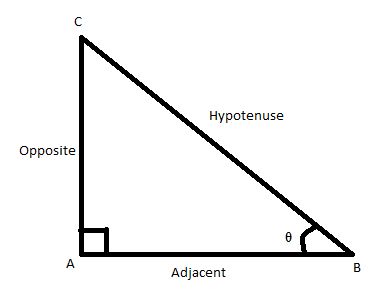
In mathematics, the trigonometric functions are real functions which relate an angle of a right-angled triangle to ratios of two side lengths. They are widely used in all sciences that are related to geometry, such as navigation, solid mechanics, celestial mechanics, geodesy, and many others. The most widely used trigonometric functions are the sine, the cosine, and the tangent.
First we remove the bracket and multiply all the terms with each other. Then we need to simplify each term with the help of trigonometric formulas for the second term .By simplifying the expression we will get the required solution.
Formula used: i)\[\cos ec x = \dfrac{1}{{\sin x}}\]
ii)\[\cot x = \dfrac{{\cos x}}{{\sin x}}\]
Complete step by step solution:
It is given that, \[\left( {1 + \cos x} \right)\left( {\cos ec x - \cot x} \right)\].
We need to simplify \[\left( {1 + \cos x} \right)\left( {\cos ec x - \cot x} \right)\].
To simplify the given expression we need to remove the bracket and multiply all the terms with each other.
\[ \Rightarrow \left( {1 + \cos x} \right)\left( {\cos ec x - \cot x} \right)\]
\[ \Rightarrow 1 \times \cos ec x - 1 \times \cot x + \cos x \times \cos ec x - \cos x \times \cot x\]
Now in the third and fourth term using the trigonometric formula \[\cos ec x = \dfrac{1}{{\sin x}}\] and \[\cot x = \dfrac{{\cos x}}{{\sin x}}\]we get,
\[ \Rightarrow \cos ec x - \cot x + \cos x \times \dfrac{1}{{\sin x}} - \cos x \times \dfrac{{\cos x}}{{\sin x}}\]
Again simplifying with the help of trigonometric formula \[\cot x = \dfrac{{\cos x}}{{\sin x}}\], we get,
\[ \Rightarrow \cos ec x - \cot x + \cot x - \dfrac{{{{\cos }^2}x}}{{\sin x}}\].
\[ \Rightarrow \dfrac{1}{{\sin x}} - \dfrac{{{{\cos }^2}x}}{{\sin x}}\]
On using the trigonometric formula \[\cos ec x = \dfrac{1}{{\sin x}}\]
\[ \Rightarrow \dfrac{{1 - {{\cos }^2}x}}{{\sin x}}\]
Also we know that,\[{\sin ^2}\theta + {\cos ^2}\theta = 1\], using this we get,
\[ \Rightarrow \dfrac{{{{\sin }^2}x}}{{\sin x}}\]
On cancel the term and we get,
\[ \Rightarrow \sin x\]
Hence simplifying \[\left( {1 + \cos x} \right)\left( {\cos ec x - \cot x} \right)\], we get \[\sin x\].
Note: Trigonometric expression:
Sin Cos formulas are based on sides of the right-angled triangle. Sin and Cos are basic trigonometric functions along with tan function, in trigonometry. Sine of angle is equal to the ratio of opposite side and hypotenuse whereas cosine of an angle is equal to ratio of adjacent side and hypotenuse.
\[{{sin\theta = }}\dfrac{{{\text{Opposite side}}}}{{{\text{Hypotenuse}}}}\]
\[{{cos\theta = }}\dfrac{{{\text{Adjacent}}}}{{{\text{Hypotenuse}}}}\]
In mathematics, the trigonometric functions are real functions which relate an angle of a right-angled triangle to ratios of two side lengths. They are widely used in all sciences that are related to geometry, such as navigation, solid mechanics, celestial mechanics, geodesy, and many others. The most widely used trigonometric functions are the sine, the cosine, and the tangent.
Recently Updated Pages
Which of the following graphs shows the variation of class 12 physics CBSE

Draw a labelled diagram of the human male reproductive class 12 biology CBSE
Describe the experiment to compare the emf of two cells class 12 physics CBSE
What is standard hydrogen electrode
What is conventional current and electric current class 12 physics CBSE
2Bromopentane is treated with an alcoholic KOH solution class 12 chemistry CBSE
Trending doubts
Draw a labelled sketch of the human eye class 12 physics CBSE
Which are the Top 10 Largest Countries of the World?
Differentiate between homogeneous and heterogeneous class 12 chemistry CBSE
Draw ray diagrams each showing i myopic eye and ii class 12 physics CBSE
Which is the correct genotypic ratio of mendel dihybrid class 12 biology CBSE
What is the Full Form of PVC, PET, HDPE, LDPE, PP and PS ?