




Silver articles become black on prolonged exposure to air. This is due to the formation of:
A) $A{{g}_{3}}N$
B) $A{{g}_{2}}O$
C) $A{{g}_{2}}S$
D) $A{{g}_{2}}S$and $A{{g}_{3}}N$
Answer
 Verified
609.6k+ views
Hint: Silver metal does not react with oxygen present in air. The articles we wear usually turn black after a long period of time. Thus, the answer lies in the fact that air also contains hydrogen sulphide gas where it reacts with silver.
Complete step-by-step answer:
It is clear from the basic concepts of chemistry that silver exists in earth’s crust in pure, free elemental form, as an alloy with other metals and in minerals such as argentite etc. Most silver is produced as a byproduct of copper, gold lead and zinc refining.
- Silver is a soft, white, lustrous transition metal which exhibits the highest electrical conductivity, thermal conductivity and reflectivity of any metal.
-It melts at 961.8$^{o}C$ and has density of about 10.49$g/c{{m}^{3}}$
-We know the fact that air is a mixture of several gases which includes even hydrogen sulphide.
- This hydrogen sulphide gas reacts with silver articles on prolonged exposure to air to form silver sulphide(which is of black colour) with liberation of hydrogen gas. The reaction is as shown,
$2Ag+{{H}_{2}}S\to A{{g}_{2}}S+{{H}_{2}}\uparrow $
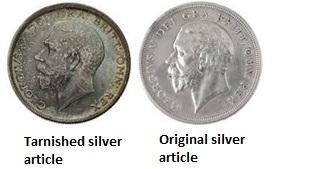
Thus, the correct option is C
Additional information:
-Silver is widely used in many industrial applications and also pharmacological applications. It was the 1st element in the form of complex used as a medicine for cancer which is widely known in its compound form as cis-platin. It is also used as an electrode in various electrochemical reactions.
-It is also used as nanoparticles for antimicrobial coatings and many textiles, keyboards and also some biomedical devices.
Note: Make sure that you use the word “Tarnishing” and not confuse it with the word “corrosion” as both these words refer to degradation. In case of silver tarnishing is used as the metal is not degraded completely.
Complete step-by-step answer:
It is clear from the basic concepts of chemistry that silver exists in earth’s crust in pure, free elemental form, as an alloy with other metals and in minerals such as argentite etc. Most silver is produced as a byproduct of copper, gold lead and zinc refining.
- Silver is a soft, white, lustrous transition metal which exhibits the highest electrical conductivity, thermal conductivity and reflectivity of any metal.
-It melts at 961.8$^{o}C$ and has density of about 10.49$g/c{{m}^{3}}$
-We know the fact that air is a mixture of several gases which includes even hydrogen sulphide.
- This hydrogen sulphide gas reacts with silver articles on prolonged exposure to air to form silver sulphide(which is of black colour) with liberation of hydrogen gas. The reaction is as shown,
$2Ag+{{H}_{2}}S\to A{{g}_{2}}S+{{H}_{2}}\uparrow $
Thus, the correct option is C
Additional information:
-Silver is widely used in many industrial applications and also pharmacological applications. It was the 1st element in the form of complex used as a medicine for cancer which is widely known in its compound form as cis-platin. It is also used as an electrode in various electrochemical reactions.
-It is also used as nanoparticles for antimicrobial coatings and many textiles, keyboards and also some biomedical devices.
Note: Make sure that you use the word “Tarnishing” and not confuse it with the word “corrosion” as both these words refer to degradation. In case of silver tarnishing is used as the metal is not degraded completely.
Recently Updated Pages
Master Class 12 Economics: Engaging Questions & Answers for Success

Master Class 12 English: Engaging Questions & Answers for Success
Master Class 12 Social Science: Engaging Questions & Answers for Success
Master Class 12 Maths: Engaging Questions & Answers for Success
Master Class 12 Physics: Engaging Questions & Answers for Success
Master Class 9 General Knowledge: Engaging Questions & Answers for Success
Trending doubts
Which are the Top 10 Largest Countries of the World?
Draw a labelled sketch of the human eye class 12 physics CBSE
Differentiate between homogeneous and heterogeneous class 12 chemistry CBSE
Sulphuric acid is known as the king of acids State class 12 chemistry CBSE
Why is the cell called the structural and functional class 12 biology CBSE
Draw ray diagrams each showing i myopic eye and ii class 12 physics CBSE