




Siliqua fruit occurs in
(a)Hibiscus rosa-sinensis
(b)Solanum nigrum
(c)Brassica campestris
(d)Althaea rosea
Answer
 Verified
601.2k+ views
Hint: Siliqua is a dry, dehiscent fruit, developed from bicarpellary, syncarpous, and superior ovary with parietal placentation. Siliqua is the characteristic of Cruciferae. Siliques are present in many members of the mustard family.
Complete answer:
This type of fruit is commonly found in Brassicaceae. This is a long, narrow, many-seeded fruit that develops from a superior bicarpellary ovary with two parietal placentae. It dehisces from below upwards by both the sutures Here the ovary is one-chambered at first, but later on, it becomes two-chambered because of the development of a false septum, which extends from one placenta to another. Siliqua is a dry fruit that separates at maturity into two or four segments called valves, leaving a persistent partition that bears the seeds. A typical silique is an elongated capsule, such as in cabbage. A silicle, or silicula, is a short and broad silique, as in the shepherd's purse. The outer walls of the ovary usually separate when ripe, then being named dehiscent, and leaving a persistent partition.
Additional Information: -Hibiscus rosa-sinensis has an accessory fruit developing from the thalamus.
-Solanum nigrum has a simple, dehiscent fruit known as a legume. It is developed from the monocarpellary, superior, and unilocular ovary.
-Althaea rosea has Carcerulas type of fruit. It is a dry schizocarp that develops from the bicarpellary, syncarpous, superior ovary.
So, the correct answer is 'Brassica campestris'.
Note: -Siliques are present in many members of the mustard family, Brassicaceae, but some species have silicles instead.
-Some species closely related to plants with true siliques have fruits with a similar structure that do not open when ripe; these are usually called indehiscent siliques.
-When a siliqua fruit becomes much shorter and flattened and as broad as it is long with a few seeds, it is called silicula, e.g., Capsella and candytuft.
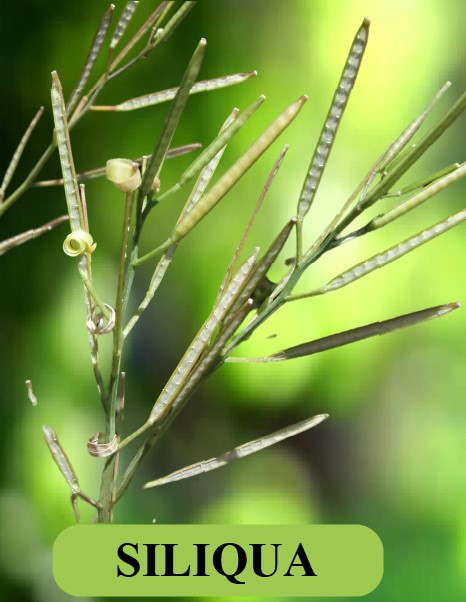
Complete answer:
This type of fruit is commonly found in Brassicaceae. This is a long, narrow, many-seeded fruit that develops from a superior bicarpellary ovary with two parietal placentae. It dehisces from below upwards by both the sutures Here the ovary is one-chambered at first, but later on, it becomes two-chambered because of the development of a false septum, which extends from one placenta to another. Siliqua is a dry fruit that separates at maturity into two or four segments called valves, leaving a persistent partition that bears the seeds. A typical silique is an elongated capsule, such as in cabbage. A silicle, or silicula, is a short and broad silique, as in the shepherd's purse. The outer walls of the ovary usually separate when ripe, then being named dehiscent, and leaving a persistent partition.
Additional Information: -Hibiscus rosa-sinensis has an accessory fruit developing from the thalamus.
-Solanum nigrum has a simple, dehiscent fruit known as a legume. It is developed from the monocarpellary, superior, and unilocular ovary.
-Althaea rosea has Carcerulas type of fruit. It is a dry schizocarp that develops from the bicarpellary, syncarpous, superior ovary.
So, the correct answer is 'Brassica campestris'.
Note: -Siliques are present in many members of the mustard family, Brassicaceae, but some species have silicles instead.
-Some species closely related to plants with true siliques have fruits with a similar structure that do not open when ripe; these are usually called indehiscent siliques.
-When a siliqua fruit becomes much shorter and flattened and as broad as it is long with a few seeds, it is called silicula, e.g., Capsella and candytuft.
Recently Updated Pages
Master Class 11 English: Engaging Questions & Answers for Success

Master Class 11 Maths: Engaging Questions & Answers for Success
Class 11 Question and Answer - Your Ultimate Solutions Guide
Master Class 11 Biology: Engaging Questions & Answers for Success
Master Class 11 Physics: Engaging Questions & Answers for Success
Master Class 11 Accountancy: Engaging Questions & Answers for Success
Trending doubts
Differentiate between an exothermic and an endothermic class 11 chemistry CBSE
One Metric ton is equal to kg A 10000 B 1000 C 100 class 11 physics CBSE
In what year Guru Nanak Dev ji was born A15 April 1469 class 11 social science CBSE
Difference Between Prokaryotic Cells and Eukaryotic Cells
There are 720 permutations of the digits 1 2 3 4 5 class 11 maths CBSE
Draw a diagram of a plant cell and label at least eight class 11 biology CBSE