




What is the significance of this organism?
Answer
 Verified
637.5k+ views
Hint: This plankton-like structure is a larval form that is characteristic of marine mollusks and marine annelids, echiurans, and sipunculans.
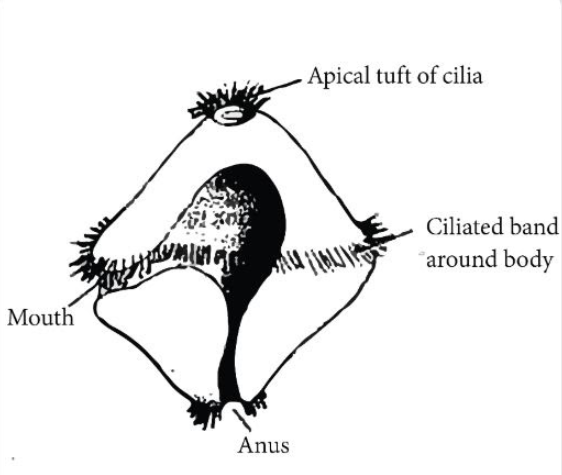
The above-drawn figure is of Trochophore larva.
Complete answer:
Trochophore larva has a prominent status in the evolutionary context. Studies are suggestive of the Trochophore larva as a bridge between radial and bilateral symmetry. The larval form shows similarities with many invertebrate groups.
Many studies claimed that the trochophore is an evident transitional stage in the line of the emergence of the bilateral groups (e.g., Rotifers) from the radial groups (Ctenophores). Similarities between the trochophore and the echinoderm larva (Bipinnaria and Pluteus) and Tornaria larva of Balanoglossus further enriched this fact.
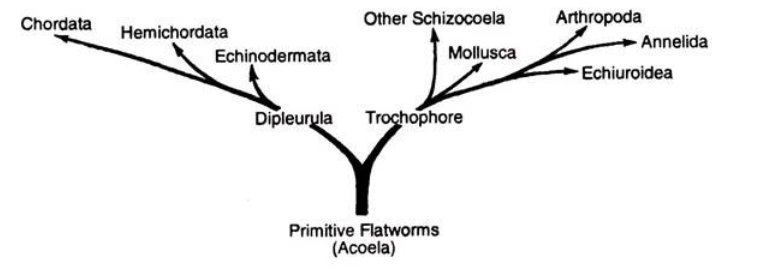
Fig: Significance of trochophore larva
Characteristics of the larva: Trochophore larva is a free-swimming larva having a spherical or pear-shaped body. The anterior part of their body is broader than the posterior part. It possesses bilateral symmetry. The body consists of the mouth, alimentary canal, and anus. The mouth is located at the midventral line and it opens into the alimentary canal through the stomach. The canal ends at the anus. They possess a round wheel-shaped band of cilia that helps in movement and ingestion of food.
Note: 1. The term ‘trochophore' is derived from the Greek word ‘trokhos’ meaning ‘wheel' and ‘phero' meaning ‘to bear or to carry'.
2. In some trochophore larva, an additional ring of cilia can be present which is known as the telotroch.
3. Some of the trochophores bear Ocelli or eyespots that help in sensory reception.
4. The larva was first discovered by the Swedish naturalist Loven in 1840. So, it is sometimes also known as the ‘Loven’s larvae.
The above-drawn figure is of Trochophore larva.
Complete answer:
Trochophore larva has a prominent status in the evolutionary context. Studies are suggestive of the Trochophore larva as a bridge between radial and bilateral symmetry. The larval form shows similarities with many invertebrate groups.
Many studies claimed that the trochophore is an evident transitional stage in the line of the emergence of the bilateral groups (e.g., Rotifers) from the radial groups (Ctenophores). Similarities between the trochophore and the echinoderm larva (Bipinnaria and Pluteus) and Tornaria larva of Balanoglossus further enriched this fact.
Fig: Significance of trochophore larva
Characteristics of the larva: Trochophore larva is a free-swimming larva having a spherical or pear-shaped body. The anterior part of their body is broader than the posterior part. It possesses bilateral symmetry. The body consists of the mouth, alimentary canal, and anus. The mouth is located at the midventral line and it opens into the alimentary canal through the stomach. The canal ends at the anus. They possess a round wheel-shaped band of cilia that helps in movement and ingestion of food.
Note: 1. The term ‘trochophore' is derived from the Greek word ‘trokhos’ meaning ‘wheel' and ‘phero' meaning ‘to bear or to carry'.
2. In some trochophore larva, an additional ring of cilia can be present which is known as the telotroch.
3. Some of the trochophores bear Ocelli or eyespots that help in sensory reception.
4. The larva was first discovered by the Swedish naturalist Loven in 1840. So, it is sometimes also known as the ‘Loven’s larvae.
Recently Updated Pages
Master Class 12 Business Studies: Engaging Questions & Answers for Success

Master Class 12 Chemistry: Engaging Questions & Answers for Success
Master Class 12 Biology: Engaging Questions & Answers for Success
Class 12 Question and Answer - Your Ultimate Solutions Guide
Master Class 11 English: Engaging Questions & Answers for Success
Master Class 11 Social Science: Engaging Questions & Answers for Success
Trending doubts
Which are the Top 10 Largest Countries of the World?
Draw a labelled sketch of the human eye class 12 physics CBSE
Differentiate between homogeneous and heterogeneous class 12 chemistry CBSE
In order to find out the different types of gametes class 12 biology NEET_UG
Why is the cell called the structural and functional class 12 biology CBSE
Draw ray diagrams each showing i myopic eye and ii class 12 physics CBSE