




How many sigma and pi bonds do sp, $s{p^2}$, $s{p^3}$, $s{p^3}d$, $s{p^3}{d^2}$ have?
Answer
 Verified
597.3k+ views
Hint: A single bond formed between the two atoms containing one sigma bond, a double bond formed between the two atoms containing one sigma and one pi bond. A triple bond formed between the two atoms containing one sigma and two pi bonds.
Complete step by step answer:
The property by which the atomic orbitals fuse with each other to form new hybridized orbitals is known as hybridization.
From the hybridization of the central atom, one can know the number of sigma bonds around the central atom.
In acetylene molecules, the sp hybridization is seen which contains two sigma bonds around one carbon atom and two pi bonds around one carbon atom.
The structure of acetylene is shown below.
$H - C \equiv C - H$
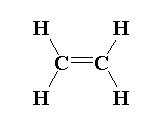
In ethene molecules, $s{p^2}$ hybridization is seen where three sigma bonds are present around one carbon and one pi bond is present around one carbon atom.
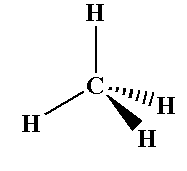
The methane molecule shows $s{p^3}$ hybridization where four sigma bonds are present around one carbon and no pi bond present.
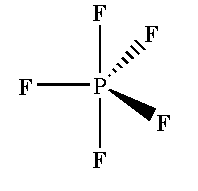
In phosphorus pentafluoride $P{F_5}$ molecule $s{p^3}d$ hybridization is seen where five sigma bonds are present around one phosphorus atom and no pi bonds are present.
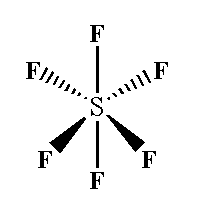
In sulfur hexafluoride $S{F_6}$, $s{p^3}{d^2}$ hybridization is seen where six sigma bonds are present around the sulfur atom and no pi bonds are present.
Note:
The number of orbitals taking part in hybridization is the number of sigma bonds made around the central atom. In $s{p^3}$, $s{p^3}d$ and $s{p^3}{d^2}$ no pi bond is present as it contains only a single covalent bond.
Complete step by step answer:
The property by which the atomic orbitals fuse with each other to form new hybridized orbitals is known as hybridization.
From the hybridization of the central atom, one can know the number of sigma bonds around the central atom.
In acetylene molecules, the sp hybridization is seen which contains two sigma bonds around one carbon atom and two pi bonds around one carbon atom.
The structure of acetylene is shown below.
$H - C \equiv C - H$
In ethene molecules, $s{p^2}$ hybridization is seen where three sigma bonds are present around one carbon and one pi bond is present around one carbon atom.
The methane molecule shows $s{p^3}$ hybridization where four sigma bonds are present around one carbon and no pi bond present.
In phosphorus pentafluoride $P{F_5}$ molecule $s{p^3}d$ hybridization is seen where five sigma bonds are present around one phosphorus atom and no pi bonds are present.
In sulfur hexafluoride $S{F_6}$, $s{p^3}{d^2}$ hybridization is seen where six sigma bonds are present around the sulfur atom and no pi bonds are present.
Note:
The number of orbitals taking part in hybridization is the number of sigma bonds made around the central atom. In $s{p^3}$, $s{p^3}d$ and $s{p^3}{d^2}$ no pi bond is present as it contains only a single covalent bond.
Recently Updated Pages
Master Class 12 Business Studies: Engaging Questions & Answers for Success

Master Class 12 Chemistry: Engaging Questions & Answers for Success
Master Class 12 Biology: Engaging Questions & Answers for Success
Class 12 Question and Answer - Your Ultimate Solutions Guide
Master Class 11 English: Engaging Questions & Answers for Success
Master Class 11 Social Science: Engaging Questions & Answers for Success
Trending doubts
Which are the Top 10 Largest Countries of the World?
Draw a labelled sketch of the human eye class 12 physics CBSE
Differentiate between homogeneous and heterogeneous class 12 chemistry CBSE
Differentiate between Pyramid of energy and pyramid class 12 biology CBSE
Why is the cell called the structural and functional class 12 biology CBSE
Draw the diagram of the pyramid of energy Explain In class 12 biology CBSE