



How many sides does a regular nonagon have?
Answer
 Verified
591.6k+ views
Hint: We first describe the sides, vertices of a nonagon. Then we explain the vertices and linearity.
Complete step by step answer:
We define the concept of a n-sided polygon. We also find the relation between its sides, angles and vertices. We place the value of 9 in place of n to find the nonagon. We also define the concept of a regular polygon and regular nonagon.
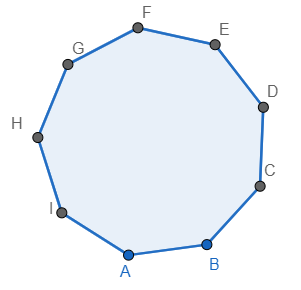
A nonagon has 9 vertices and 9 sides.
We know that to form a triangle we need three points which are non-linear.
We also have that no three points out of those 9 vertices are non-linear.
The nonagon is a 9-sided polygon. In general, a polygon is termed an n-sided polygon.
The number of sides of a polygon is equal to the number of vertices and number of angles.
Therefore, nonagon has 9 vertices and 9 angles.
Note:
In case of a regular polygon the value of the interior angles is $\dfrac{\pi \left( n-2 \right)}{n}$ and the exterior angle is $\dfrac{2\pi }{n}$. The lengths can be different to each other and the same goes the angles. They are not bound to be equal. But if they are equal then the both of them go together to be equal. In that case the polygon is called a regular polygon.
Complete step by step answer:
We define the concept of a n-sided polygon. We also find the relation between its sides, angles and vertices. We place the value of 9 in place of n to find the nonagon. We also define the concept of a regular polygon and regular nonagon.
A nonagon has 9 vertices and 9 sides.
We know that to form a triangle we need three points which are non-linear.
We also have that no three points out of those 9 vertices are non-linear.
The nonagon is a 9-sided polygon. In general, a polygon is termed an n-sided polygon.
The number of sides of a polygon is equal to the number of vertices and number of angles.
Therefore, nonagon has 9 vertices and 9 angles.
Note:
In case of a regular polygon the value of the interior angles is $\dfrac{\pi \left( n-2 \right)}{n}$ and the exterior angle is $\dfrac{2\pi }{n}$. The lengths can be different to each other and the same goes the angles. They are not bound to be equal. But if they are equal then the both of them go together to be equal. In that case the polygon is called a regular polygon.
Recently Updated Pages
Master Class 12 Economics: Engaging Questions & Answers for Success

Master Class 12 English: Engaging Questions & Answers for Success
Master Class 12 Social Science: Engaging Questions & Answers for Success
Master Class 12 Maths: Engaging Questions & Answers for Success
Master Class 12 Physics: Engaging Questions & Answers for Success
Master Class 9 General Knowledge: Engaging Questions & Answers for Success
Trending doubts
Find the sum of series 1 + 2 + 3 + 4 + 5 + + 100 class 9 maths CBSE
Difference Between Plant Cell and Animal Cell
Fill the blanks with the suitable prepositions 1 The class 9 english CBSE
What is pollution? How many types of pollution? Define it
What is the Full Form of ICSE / ISC ?
Name 10 Living and Non living things class 9 biology CBSE