




Show that the lines \[\dfrac{5-x}{-4}=\dfrac{y-7}{4}=\dfrac{z+3}{-5}\] and \[\dfrac{x-8}{7}=\dfrac{2y-8}{2}=\dfrac{z-5}{3}\] are coplanar.
Answer
 Verified
585k+ views
Hint: In this question, we are given with two lines given by \[\dfrac{5-x}{-4}=\dfrac{y-7}{4}=\dfrac{z+3}{-5}\] and \[\dfrac{x-8}{7}=\dfrac{2y-8}{2}=\dfrac{z-5}{3}\]. We will compare both the equations of line with the general equation \[\dfrac{x-{{x}_{0}}}{p}=\dfrac{y-{{y}_{0}}}{q}=\dfrac{z-{{z}_{0}}}{r}\]. Now the equation of the plane passing through the point \[\left( {{x}_{0}},{{y}_{0}},{{z}_{0}} \right)\] is given by \[a\left( x-{{x}_{0}} \right)+b\left( y-{{y}_{0}} \right)+c\left( z-{{z}_{0}} \right)=0\] and the equation of the normal to the plane \[a\left( x-{{x}_{0}} \right)+b\left( y-{{y}_{0}} \right)+c\left( z-{{z}_{0}} \right)=0\] at point \[\left( {{x}_{0}},{{y}_{0}},{{z}_{0}} \right)\] is given by \[pa+qb+rc=0\] which is also perpendicular to the line given by \[\dfrac{x-{{x}_{0}}}{p}=\dfrac{y-{{y}_{0}}}{q}=\dfrac{z-{{z}_{0}}}{r}\]. Now we say that two lines in three-dimensional space are coplanar if there exists a plane which includes both the lines. This happens when the lines are parallel, or if they intersect each other. So in order two show that the given linear are coplanar we have to show that either there exists a plane which includes both the lines. This happens when the lines are parallel, or if they intersect each other.
Complete step by step answer:
Let us suppose that \[l\] denotes the line given by the equation \[\dfrac{5-x}{-4}=\dfrac{y-7}{4}=\dfrac{z+3}{-5}\] and
\[k\] denotes the line given by the equation \[\dfrac{x-8}{7}=\dfrac{2y-8}{2}=\dfrac{z-5}{3}\].
Now we will evaluate both the lines in the form of \[\dfrac{x-{{x}_{0}}}{p}=\dfrac{y-{{y}_{0}}}{q}=\dfrac{z-{{z}_{0}}}{r}\].
So we have
\[\dfrac{x-5}{4}=\dfrac{y-7}{4}=\dfrac{z-\left( -3 \right)}{-5}...........(1)\] and
\[\dfrac{x-8}{7}=\dfrac{y-4}{1}=\dfrac{z-5}{3}..........(2)\]
Since we know that the equation of the plane passing through the point \[\left( {{x}_{0}},{{y}_{0}},{{z}_{0}} \right)\] is given by \[a\left( x-{{x}_{0}} \right)+b\left( y-{{y}_{0}} \right)+c\left( z-{{z}_{0}} \right)=0\]
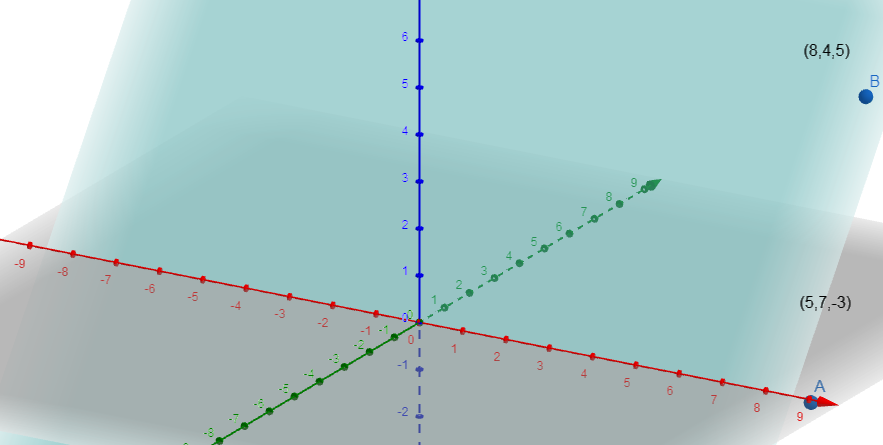
Now let \[P\left( 5,7,-3 \right)\] be a point.
Then the equation of the plane passing through the point \[P\left( 5,7,-3 \right)\] is given by
\[a\left( x-5 \right)+b\left( y-7 \right)+c\left( z-\left( -3 \right) \right)=0\]
Also we know that if \[\dfrac{x-{{x}_{0}}}{p}=\dfrac{y-{{y}_{0}}}{q}=\dfrac{z-{{z}_{0}}}{r}\] denotes an equation of the line, then the equation of normal to the plane \[a\left( x-{{x}_{0}} \right)+b\left( y-{{y}_{0}} \right)+c\left( z-{{z}_{0}} \right)=0\] at point \[\left( {{x}_{0}},{{y}_{0}},{{z}_{0}} \right)\] is given by \[pa+qb+rc=0\] which is also perpendicular to the line given by \[\dfrac{x-{{x}_{0}}}{p}=\dfrac{y-{{y}_{0}}}{q}=\dfrac{z-{{z}_{0}}}{r}\].
Thus the equation of normal to the plane \[a\left( x-5 \right)+b\left( y-7 \right)+c\left( z-\left( -3 \right) \right)=0\] at point \[P\left( 5,7,-3 \right)\] which is also perpendicular to the line given by \[\dfrac{x-5}{4}=\dfrac{y-7}{4}=\dfrac{z-\left( -3 \right)}{-5}\] is given by
\[4a+4b-5c=0..........(3)\]
Similarly the equation of normal to the plane \[a\left( x-5 \right)+b\left( y-7 \right)+c\left( z-\left( -3 \right) \right)=0\] at point \[P\left( 5,7,-3 \right)\] which is also perpendicular to the line given by \[\dfrac{x-8}{7}=\dfrac{y-4}{1}=\dfrac{z-5}{3}\] is given by
\[7a+b+3c=0............(4)\]
Since we know that if we have two equations \[{{a}_{1}}x+{{b}_{1}}y+{{c}_{1}}z=0\] and \[{{a}_{2}}x+{{b}_{2}}y+{{c}_{2}}z=0\] then we have \[\dfrac{x}{{{b}_{1}}{{c}_{2}}-{{b}_{2}}{{c}_{1}}}=\dfrac{y}{{{a}_{1}}{{c}_{2}}-{{a}_{2}}{{c}_{1}}}=\dfrac{z}{{{a}_{1}}{{b}_{2}}-{{a}_{2}}{{b}_{1}}}\] .
On solving equation (3) and equation (4) using the above result we get
\[\begin{align}
& \dfrac{a}{12+5}=\dfrac{b}{-35-12}=\dfrac{c}{4-28} \\
& \Rightarrow \dfrac{a}{17}=\dfrac{b}{-47}=\dfrac{c}{-24}
\end{align}\]
Hence we have the following values
\[a=17,b=-47,c=-24\]
Substituting the above values in the equation of the plane \[a\left( x-5 \right)+b\left( y-7 \right)+c\left( z-\left( -3 \right) \right)=0\], we get
\[17\left( x-5 \right)-47\left( y-7 \right)-24\left( z-\left( -3 \right) \right)=0\]
Now we will check whether point \[\left( 8,4,5 \right)\] lies on the above plane by substituting \[x=8,y=4,z=5\] in the above equation.
Then we get
\[\begin{align}
& 17\left( x-5 \right)-47\left( y-7 \right)-24\left( z-\left( -3 \right) \right)=17\left( 8-5 \right)-47\left( 4-7 \right)-24\left( 5-\left( -3 \right) \right) \\
& =17\left( 3 \right)-47\left( -3 \right)-24\left( 8 \right) \\
& =51+141-192 \\
& =0
\end{align}\]
Thus there exist a plane given by \[17\left( x-5 \right)-47\left( y-7 \right)-24\left( z-\left( -3 \right) \right)=0\] on which both the given lines \[l\] and \[k\] lie.
Thus both the lines \[\dfrac{5-x}{-4}=\dfrac{y-7}{4}=\dfrac{z+3}{-5}\] and \[\dfrac{x-8}{7}=\dfrac{2y-8}{2}=\dfrac{z-5}{3}\] are coplanar.
Note:
In this problem, we are using the fact that if there exists a plane containing both the given lines, then the lines are coplanar. So in order two show that the given linear are coplanar we have shown that there exists a plane which includes both the lines. This happens when the lines are parallel, or if they intersect each other. In this solution we have shown that there exists a plane containing both the given lines. Hence the lines are collinear.
Complete step by step answer:
Let us suppose that \[l\] denotes the line given by the equation \[\dfrac{5-x}{-4}=\dfrac{y-7}{4}=\dfrac{z+3}{-5}\] and
\[k\] denotes the line given by the equation \[\dfrac{x-8}{7}=\dfrac{2y-8}{2}=\dfrac{z-5}{3}\].
Now we will evaluate both the lines in the form of \[\dfrac{x-{{x}_{0}}}{p}=\dfrac{y-{{y}_{0}}}{q}=\dfrac{z-{{z}_{0}}}{r}\].
So we have
\[\dfrac{x-5}{4}=\dfrac{y-7}{4}=\dfrac{z-\left( -3 \right)}{-5}...........(1)\] and
\[\dfrac{x-8}{7}=\dfrac{y-4}{1}=\dfrac{z-5}{3}..........(2)\]
Since we know that the equation of the plane passing through the point \[\left( {{x}_{0}},{{y}_{0}},{{z}_{0}} \right)\] is given by \[a\left( x-{{x}_{0}} \right)+b\left( y-{{y}_{0}} \right)+c\left( z-{{z}_{0}} \right)=0\]
Now let \[P\left( 5,7,-3 \right)\] be a point.
Then the equation of the plane passing through the point \[P\left( 5,7,-3 \right)\] is given by
\[a\left( x-5 \right)+b\left( y-7 \right)+c\left( z-\left( -3 \right) \right)=0\]
Also we know that if \[\dfrac{x-{{x}_{0}}}{p}=\dfrac{y-{{y}_{0}}}{q}=\dfrac{z-{{z}_{0}}}{r}\] denotes an equation of the line, then the equation of normal to the plane \[a\left( x-{{x}_{0}} \right)+b\left( y-{{y}_{0}} \right)+c\left( z-{{z}_{0}} \right)=0\] at point \[\left( {{x}_{0}},{{y}_{0}},{{z}_{0}} \right)\] is given by \[pa+qb+rc=0\] which is also perpendicular to the line given by \[\dfrac{x-{{x}_{0}}}{p}=\dfrac{y-{{y}_{0}}}{q}=\dfrac{z-{{z}_{0}}}{r}\].
Thus the equation of normal to the plane \[a\left( x-5 \right)+b\left( y-7 \right)+c\left( z-\left( -3 \right) \right)=0\] at point \[P\left( 5,7,-3 \right)\] which is also perpendicular to the line given by \[\dfrac{x-5}{4}=\dfrac{y-7}{4}=\dfrac{z-\left( -3 \right)}{-5}\] is given by
\[4a+4b-5c=0..........(3)\]
Similarly the equation of normal to the plane \[a\left( x-5 \right)+b\left( y-7 \right)+c\left( z-\left( -3 \right) \right)=0\] at point \[P\left( 5,7,-3 \right)\] which is also perpendicular to the line given by \[\dfrac{x-8}{7}=\dfrac{y-4}{1}=\dfrac{z-5}{3}\] is given by
\[7a+b+3c=0............(4)\]
Since we know that if we have two equations \[{{a}_{1}}x+{{b}_{1}}y+{{c}_{1}}z=0\] and \[{{a}_{2}}x+{{b}_{2}}y+{{c}_{2}}z=0\] then we have \[\dfrac{x}{{{b}_{1}}{{c}_{2}}-{{b}_{2}}{{c}_{1}}}=\dfrac{y}{{{a}_{1}}{{c}_{2}}-{{a}_{2}}{{c}_{1}}}=\dfrac{z}{{{a}_{1}}{{b}_{2}}-{{a}_{2}}{{b}_{1}}}\] .
On solving equation (3) and equation (4) using the above result we get
\[\begin{align}
& \dfrac{a}{12+5}=\dfrac{b}{-35-12}=\dfrac{c}{4-28} \\
& \Rightarrow \dfrac{a}{17}=\dfrac{b}{-47}=\dfrac{c}{-24}
\end{align}\]
Hence we have the following values
\[a=17,b=-47,c=-24\]
Substituting the above values in the equation of the plane \[a\left( x-5 \right)+b\left( y-7 \right)+c\left( z-\left( -3 \right) \right)=0\], we get
\[17\left( x-5 \right)-47\left( y-7 \right)-24\left( z-\left( -3 \right) \right)=0\]
Now we will check whether point \[\left( 8,4,5 \right)\] lies on the above plane by substituting \[x=8,y=4,z=5\] in the above equation.
Then we get
\[\begin{align}
& 17\left( x-5 \right)-47\left( y-7 \right)-24\left( z-\left( -3 \right) \right)=17\left( 8-5 \right)-47\left( 4-7 \right)-24\left( 5-\left( -3 \right) \right) \\
& =17\left( 3 \right)-47\left( -3 \right)-24\left( 8 \right) \\
& =51+141-192 \\
& =0
\end{align}\]
Thus there exist a plane given by \[17\left( x-5 \right)-47\left( y-7 \right)-24\left( z-\left( -3 \right) \right)=0\] on which both the given lines \[l\] and \[k\] lie.
Thus both the lines \[\dfrac{5-x}{-4}=\dfrac{y-7}{4}=\dfrac{z+3}{-5}\] and \[\dfrac{x-8}{7}=\dfrac{2y-8}{2}=\dfrac{z-5}{3}\] are coplanar.
Note:
In this problem, we are using the fact that if there exists a plane containing both the given lines, then the lines are coplanar. So in order two show that the given linear are coplanar we have shown that there exists a plane which includes both the lines. This happens when the lines are parallel, or if they intersect each other. In this solution we have shown that there exists a plane containing both the given lines. Hence the lines are collinear.
Recently Updated Pages
Master Class 12 Economics: Engaging Questions & Answers for Success

Master Class 12 Physics: Engaging Questions & Answers for Success
Master Class 12 English: Engaging Questions & Answers for Success
Master Class 12 Social Science: Engaging Questions & Answers for Success
Master Class 12 Maths: Engaging Questions & Answers for Success
Master Class 12 Business Studies: Engaging Questions & Answers for Success
Trending doubts
Which are the Top 10 Largest Countries of the World?
What are the major means of transport Explain each class 12 social science CBSE
Draw a labelled sketch of the human eye class 12 physics CBSE
Why cannot DNA pass through cell membranes class 12 biology CBSE
Differentiate between insitu conservation and exsitu class 12 biology CBSE
Draw a neat and well labeled diagram of TS of ovary class 12 biology CBSE