




Show that the function \[f:R \cdot \to R \cdot \] defined by \[f(x) = \dfrac{1}{x}\] is one-one and onto, where ‘\[R \cdot \]’ is the set of all non-zero real numbers. Is the result true, if the domain ‘\[R \cdot \]’ is replaced by \[N\] with a co-domain being the same as ‘\[R \cdot \]’?
Answer
 Verified
563.4k+ views
Hint: To find whether the given function is one-one or not, we will take two elements \[{x_1}\] and \[{x_2}\] in the set of the domain of the given function and the we will substitute \[f\left( {{x_1}} \right) = f\left( {{x_2}} \right)\]. If \[{x_1} = {x_2}\], then \[f(x)\] is a one-one function. To check that the given function is onto or not, we will check if the range of \[f(x)\] is equal to the co-domain or not.
Complete step-by-step solution:
It is given that the function is defined for all non-zero real numbers and over all non-zero real numbers. Therefore, both domain and co-domain of the given function consist of the set of all non-zero real numbers.
Assume two elements \[{x_1}\] and \[{x_2}\] in the set of the domain of the given function. Therefore,
\[f\left( {{x_1}} \right) = f\left( {{x_2}} \right)\]
Substituting \[{x_1}\] and \[{x_2}\] in the function, we get
\[ \Rightarrow \dfrac{1}{{{x_1}}} = \dfrac{1}{{{x_2}}}\]
On cross multiplying, we get
\[ \Rightarrow {x_2} = {x_1}\]
On rewriting we get
\[ \Rightarrow {x_1} = {x_2}\]
Hence, we can see that, when \[f\left( {{x_1}} \right) = f\left( {{x_2}} \right)\] then \[{x_1} = {x_2}\]. Therefore, \[f\] is one-one.
Now we will check whether \[f\] is onto or not.
Given, \[f:R \cdot \to R \cdot \] where ‘\[R \cdot \]’ is the set of all non-zero real numbers defined by \[f(x) = \dfrac{1}{x}\].
Let \[y = f(x)\], such that \[y \in R \cdot \]. Therefore, we can write
\[ \Rightarrow y = \dfrac{1}{x}\]
On cross multiplying we get
\[ \Rightarrow x = \dfrac{1}{y}\]
Since, the denominator can’t be zero.
\[\therefore y \ne 0\]
Therefore, we can say that if \[y \in R - \left\{ 0 \right\}\], then \[x \in R - \left\{ 0 \right\}\] also.
Now, we will check for \[y = f(x)\].
Putting the value of \[x\] in \[f(x)\], we get
\[ \Rightarrow f(x) = f\left( {\dfrac{1}{y}} \right)\]
Substituting \[\dfrac{1}{y}\] in the function, we get
\[ \Rightarrow f(x) = \dfrac{1}{{\dfrac{1}{y}}}\]
On simplification,
\[ \Rightarrow f(x) = y\]
Thus, for every \[y \in R \cdot \], there exists \[x \in R \cdot \] such that \[f(x) = y\].
Hence, \[f\] is onto.
Now, when the domain \[R \cdot \] is replaced by \[N\] with co-domain being same as ‘\[R \cdot \]’
So, we get \[f:N \to R \cdot \]
Again, we will check if \[f:N \to R \cdot \] defined by \[f(x) = \dfrac{1}{x}\] is one-one or not.
Assume two elements \[{x_1}\] and \[{x_2}\] in the set of the domain of the given function. Therefore,
\[f\left( {{x_1}} \right) = f\left( {{x_2}} \right)\]
Substituting \[{x_1}\] and \[{x_2}\] in the function, we get
\[ \Rightarrow \dfrac{1}{{{x_1}}} = \dfrac{1}{{{x_2}}}\]
On cross multiplying, we get
\[ \Rightarrow {x_2} = {x_1}\]
On rewriting we get
\[ \Rightarrow {x_1} = {x_2}\]
Hence, we can see that, when \[f\left( {{x_1}} \right) = f\left( {{x_2}} \right)\] then \[{x_1} = {x_2}\]. Therefore, \[f\] is one-one.
Now, we will check that \[f\] is onto or not.
We have, \[f:N \to R \cdot \] defined by \[f(x) = \dfrac{1}{x}\].
Let \[y = f(x)\], such that \[y \in R \cdot \]. Therefore, we can write
\[ \Rightarrow y = \dfrac{1}{x}\]
On cross multiplying we get
\[ \Rightarrow x = \dfrac{1}{y}\]
Here, \[x\] cannot always be a natural number because \[y\] is a real number except zero.
For example, let \[y = 3\] then \[x = \dfrac{1}{3}\], which is not a natural number.
Hence, \[f\] is not onto.
Note: We can also show that \[f:R \cdot \to R \cdot \] defined by \[f(x) = \dfrac{1}{x}\] is onto by a graphical method.
Consider the graph of \[f(x) = \dfrac{1}{x}\] as shown below,
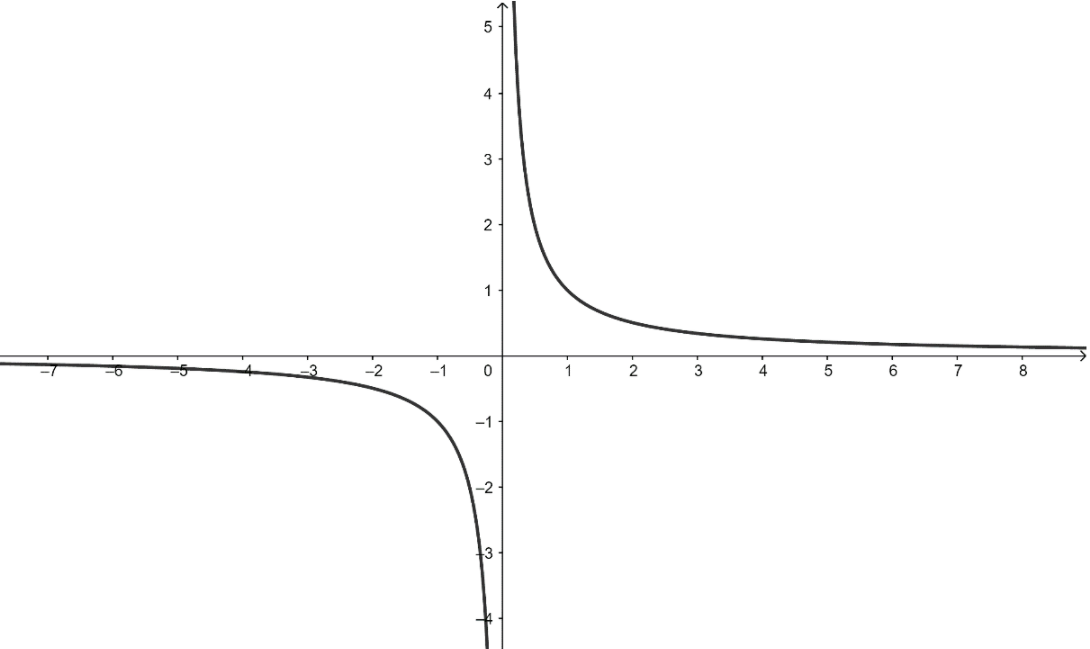
Clearly, we can see that the range of the function \[f:R \cdot \to R \cdot \] defined by \[f(x) = \dfrac{1}{x}\] is \[R - \left\{ 0 \right\}\].
The range of the given function is all real numbers except zero. Hence, the range and codomain of the function are equal.
Therefore, \[f\] is not onto.
Complete step-by-step solution:
It is given that the function is defined for all non-zero real numbers and over all non-zero real numbers. Therefore, both domain and co-domain of the given function consist of the set of all non-zero real numbers.
Assume two elements \[{x_1}\] and \[{x_2}\] in the set of the domain of the given function. Therefore,
\[f\left( {{x_1}} \right) = f\left( {{x_2}} \right)\]
Substituting \[{x_1}\] and \[{x_2}\] in the function, we get
\[ \Rightarrow \dfrac{1}{{{x_1}}} = \dfrac{1}{{{x_2}}}\]
On cross multiplying, we get
\[ \Rightarrow {x_2} = {x_1}\]
On rewriting we get
\[ \Rightarrow {x_1} = {x_2}\]
Hence, we can see that, when \[f\left( {{x_1}} \right) = f\left( {{x_2}} \right)\] then \[{x_1} = {x_2}\]. Therefore, \[f\] is one-one.
Now we will check whether \[f\] is onto or not.
Given, \[f:R \cdot \to R \cdot \] where ‘\[R \cdot \]’ is the set of all non-zero real numbers defined by \[f(x) = \dfrac{1}{x}\].
Let \[y = f(x)\], such that \[y \in R \cdot \]. Therefore, we can write
\[ \Rightarrow y = \dfrac{1}{x}\]
On cross multiplying we get
\[ \Rightarrow x = \dfrac{1}{y}\]
Since, the denominator can’t be zero.
\[\therefore y \ne 0\]
Therefore, we can say that if \[y \in R - \left\{ 0 \right\}\], then \[x \in R - \left\{ 0 \right\}\] also.
Now, we will check for \[y = f(x)\].
Putting the value of \[x\] in \[f(x)\], we get
\[ \Rightarrow f(x) = f\left( {\dfrac{1}{y}} \right)\]
Substituting \[\dfrac{1}{y}\] in the function, we get
\[ \Rightarrow f(x) = \dfrac{1}{{\dfrac{1}{y}}}\]
On simplification,
\[ \Rightarrow f(x) = y\]
Thus, for every \[y \in R \cdot \], there exists \[x \in R \cdot \] such that \[f(x) = y\].
Hence, \[f\] is onto.
Now, when the domain \[R \cdot \] is replaced by \[N\] with co-domain being same as ‘\[R \cdot \]’
So, we get \[f:N \to R \cdot \]
Again, we will check if \[f:N \to R \cdot \] defined by \[f(x) = \dfrac{1}{x}\] is one-one or not.
Assume two elements \[{x_1}\] and \[{x_2}\] in the set of the domain of the given function. Therefore,
\[f\left( {{x_1}} \right) = f\left( {{x_2}} \right)\]
Substituting \[{x_1}\] and \[{x_2}\] in the function, we get
\[ \Rightarrow \dfrac{1}{{{x_1}}} = \dfrac{1}{{{x_2}}}\]
On cross multiplying, we get
\[ \Rightarrow {x_2} = {x_1}\]
On rewriting we get
\[ \Rightarrow {x_1} = {x_2}\]
Hence, we can see that, when \[f\left( {{x_1}} \right) = f\left( {{x_2}} \right)\] then \[{x_1} = {x_2}\]. Therefore, \[f\] is one-one.
Now, we will check that \[f\] is onto or not.
We have, \[f:N \to R \cdot \] defined by \[f(x) = \dfrac{1}{x}\].
Let \[y = f(x)\], such that \[y \in R \cdot \]. Therefore, we can write
\[ \Rightarrow y = \dfrac{1}{x}\]
On cross multiplying we get
\[ \Rightarrow x = \dfrac{1}{y}\]
Here, \[x\] cannot always be a natural number because \[y\] is a real number except zero.
For example, let \[y = 3\] then \[x = \dfrac{1}{3}\], which is not a natural number.
Hence, \[f\] is not onto.
Note: We can also show that \[f:R \cdot \to R \cdot \] defined by \[f(x) = \dfrac{1}{x}\] is onto by a graphical method.
Consider the graph of \[f(x) = \dfrac{1}{x}\] as shown below,
Clearly, we can see that the range of the function \[f:R \cdot \to R \cdot \] defined by \[f(x) = \dfrac{1}{x}\] is \[R - \left\{ 0 \right\}\].
The range of the given function is all real numbers except zero. Hence, the range and codomain of the function are equal.
Therefore, \[f\] is not onto.
Recently Updated Pages
Which of the following graphs shows the variation of class 12 physics CBSE

Draw a labelled diagram of the human male reproductive class 12 biology CBSE
Describe the experiment to compare the emf of two cells class 12 physics CBSE
What is standard hydrogen electrode
What is conventional current and electric current class 12 physics CBSE
2Bromopentane is treated with an alcoholic KOH solution class 12 chemistry CBSE
Trending doubts
Draw a labelled sketch of the human eye class 12 physics CBSE
Which are the Top 10 Largest Countries of the World?
Differentiate between homogeneous and heterogeneous class 12 chemistry CBSE
Draw ray diagrams each showing i myopic eye and ii class 12 physics CBSE
Which is the correct genotypic ratio of mendel dihybrid class 12 biology CBSE
What is the Full Form of PVC, PET, HDPE, LDPE, PP and PS ?