




Show that the expression \[{{\tan }^{-1}}\dfrac{1}{2}+{{\tan }^{-1}}\dfrac{2}{11}={{\tan }^{-1}}\dfrac{3}{4}\] .
Answer
 Verified
657k+ views
Hint: In the question, both LHS, as well as RHS, have the inverse of tan. First, we need to simplify it into simpler terms. Here, we consider \[A=\dfrac{1}{2}\] and \[B=\dfrac{2}{11}\]. For its simplification, we also know the formula \[{{\tan }^{-1}}A+{{\tan }^{-1}}B={{\tan }^{-1}}\left( \dfrac{A+B}{1-AB} \right)\] . Using this formula, we can transform these two inverse tan functions into a single tan inverse function as shown in RHS of the formula.
Complete step-by-step answer:
Now, according to the question, we have \[{{\tan }^{-1}}\dfrac{1}{2}+{{\tan }^{-1}}\dfrac{2}{11}\] in LHS.
Both terms in LHS have the inverse of tan.
Solving these two terms of inverse tan function by using the formula, we get
We know the formula, \[{{\tan }^{-1}}A+{{\tan }^{-1}}B={{\tan }^{-1}}\left( \dfrac{A+B}{1-AB} \right)\] .
In this formula, we have a single term in RHS. Also, according to the question, we have a single term in RHS. Here, this formula is best to be applied for simplification. So, this formula would be best here to get applied to obtain the required result.
Applying the above formula, we get
\[{{\tan }^{-1}}\dfrac{1}{2}+{{\tan }^{-1}}\dfrac{2}{11}\]
Now, transforming these two inverse tan functions into a single inverse tan function.
\[={{\tan }^{-1}}\left( \dfrac{\dfrac{1}{2}+\dfrac{2}{11}}{1-\dfrac{1}{2}.\dfrac{2}{11}} \right)\]
Taking 22 as LCM in numerator and denominator, we get
\[\begin{align}
& {{\tan }^{-1}}\dfrac{1}{2}+{{\tan }^{-1}}\dfrac{2}{11} \\
& ={{\tan }^{-1}}\left( \dfrac{\dfrac{1}{2}+\dfrac{2}{11}}{1-\dfrac{1}{2}.\dfrac{2}{11}} \right) \\
& ={{\tan }^{-1}}\left( \dfrac{\dfrac{11+4}{22}}{\dfrac{22-2}{22}} \right) \\
& ={{\tan }^{-1}}\left( \dfrac{15}{20} \right) \\
& ={{\tan }^{-1}}\left( \dfrac{3}{4} \right). \\
\end{align}\]
Therefore, LHS=RHS.
So, \[{{\tan }^{-1}}\dfrac{1}{2}+{{\tan }^{-1}}\dfrac{2}{11}={{\tan }^{-1}}\dfrac{3}{4}\].
Hence, proved.
Note: In this question, one can think to find the principal values of the terms present in the LHS side. We don’t need to do that here. There is no need to find principal value. This question involves some calculations in the formula \[{{\tan }^{-1}}A+{{\tan }^{-1}}B={{\tan }^{-1}}\left( \dfrac{A+B}{1-AB} \right)\] , so we have to be attentive towards the calculation mistake.
We can also solve this question by converting the inverse of tan into the inverse of sine.
Assume,
\[{{\tan }^{-1}}\left( \dfrac{2}{11} \right)=y\] , \[{{\tan }^{-1}}\left( \dfrac{1}{2} \right)=x\] .
\[\begin{align}
& {{\tan }^{-1}}\left( \dfrac{1}{2} \right)=x \\
& \Rightarrow \tan x=\dfrac{1}{2} \\
\end{align}\]
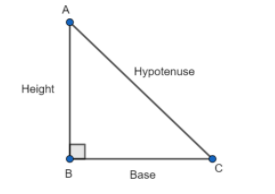
Using Pythagora's theorem, we can find the hypotenuse.
Hyptenuse = \[\sqrt{{{\left( Height \right)}^{2}}+{{\left( base \right)}^{2}}}\]
\[\begin{align}
& =\sqrt{{{1}^{2}}+{{2}^{2}}} \\
& =\sqrt{1+4} \\
& =\sqrt{5} \\
\end{align}\]
\[\sin x=\dfrac{height}{hypotenuse}=\dfrac{1}{\sqrt{5}}\]
\[\cos x=\dfrac{base}{hypotenuse}=\dfrac{2}{\sqrt{5}}\]
Similarly,
\[\begin{align}
& {{\tan }^{-1}}\left( \dfrac{2}{11} \right)=y \\
& \Rightarrow \dfrac{2}{11}=\tan y \\
\end{align}\]
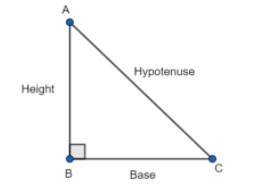
Using Pythagora's theorem, we can find the hypotenuse.
Hyptenuse = \[\sqrt{{{\left( Height \right)}^{2}}+{{\left( base \right)}^{2}}}\]
\[\begin{align}
& =\sqrt{{{2}^{2}}+{{11}^{2}}} \\
& =\sqrt{4+121} \\
& =\sqrt{125} \\
\end{align}\]
\[\sin y=\dfrac{height}{hypotenuse}=\dfrac{2}{\sqrt{125}}\]
\[\cos y=\dfrac{base}{hypotenuse}=\dfrac{11}{\sqrt{125}}\]
We know the formula, \[\sin \left( x+y \right)=\sin x\cos y+\cos x\sin y\] .
Putting the value of \[\sin x\] , \[\cos x\] , \[\sin y\] , and \[\cos y\] in the above formula, we get
\[\sin \left( x+y \right)=\sin x\cos y+\cos x\sin y\]
\[\begin{align}
& \Rightarrow \sin \left( x+y \right)=\dfrac{1}{\sqrt{5}}.\dfrac{11}{\sqrt{125}}+\dfrac{2}{\sqrt{5}}.\dfrac{2}{\sqrt{125}} \\
& \Rightarrow \sin \left( x+y \right)=\dfrac{11+4}{\sqrt{625}} \\
& \Rightarrow \sin \left( x+y \right)=\dfrac{15}{25} \\
& \Rightarrow \sin \left( x+y \right)=\dfrac{3}{5} \\
& \Rightarrow \left( x+y \right)={{\sin }^{-}}\left( \dfrac{3}{5} \right) \\
\end{align}\]
Now, converting inverse of sine to inverse of tan.
Assume,
\[\begin{align}
& z={{\sin }^{-1}}\left( \dfrac{3}{5} \right) \\
& \Rightarrow \sin z=\dfrac{3}{5} \\
\end{align}\]
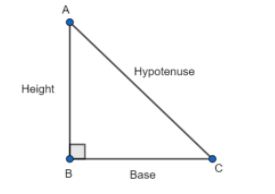
Using Pythagora's theorem, we can find the base.
Base = \[\sqrt{{{\left( hypotenuse \right)}^{2}}-{{\left( height \right)}^{2}}}\]
\[\begin{align}
& =\sqrt{{{5}^{2}}-{{3}^{2}}} \\
& =\sqrt{25-9} \\
& =\sqrt{16} \\
& =4 \\
\end{align}\]
\[\tan z=\dfrac{height}{base}=\dfrac{3}{4}\]
\[\begin{align}
& \tan z=\dfrac{3}{4} \\
& \Rightarrow z={{\tan }^{-1}}\left( \dfrac{3}{4} \right) \\
\end{align}\]
We have assumed, \[z={{\sin }^{-1}}\left( \dfrac{3}{5} \right)\] .
We can say that, \[z={{\sin }^{-1}}\left( \dfrac{3}{5} \right)={{\tan }^{-1}}\left( \dfrac{3}{4} \right)\] .
Also, we have, \[\left( x+y \right)={{\sin }^{-}}\left( \dfrac{3}{5} \right)\] .
So, \[\left( x+y \right)={{\tan }^{-1}}\left( \dfrac{3}{4} \right)\] .
Initially, we have assumed that \[{{\tan }^{-1}}\left( \dfrac{2}{11} \right)=y\] , \[{{\tan }^{-1}}\left( \dfrac{1}{2} \right)=x\] .
Therefore, \[{{\tan }^{-1}}\dfrac{1}{2}+{{\tan }^{-1}}\dfrac{2}{11}={{\tan }^{-1}}\dfrac{3}{4}\] .
Hence, proved.
Complete step-by-step answer:
Now, according to the question, we have \[{{\tan }^{-1}}\dfrac{1}{2}+{{\tan }^{-1}}\dfrac{2}{11}\] in LHS.
Both terms in LHS have the inverse of tan.
Solving these two terms of inverse tan function by using the formula, we get
We know the formula, \[{{\tan }^{-1}}A+{{\tan }^{-1}}B={{\tan }^{-1}}\left( \dfrac{A+B}{1-AB} \right)\] .
In this formula, we have a single term in RHS. Also, according to the question, we have a single term in RHS. Here, this formula is best to be applied for simplification. So, this formula would be best here to get applied to obtain the required result.
Applying the above formula, we get
\[{{\tan }^{-1}}\dfrac{1}{2}+{{\tan }^{-1}}\dfrac{2}{11}\]
Now, transforming these two inverse tan functions into a single inverse tan function.
\[={{\tan }^{-1}}\left( \dfrac{\dfrac{1}{2}+\dfrac{2}{11}}{1-\dfrac{1}{2}.\dfrac{2}{11}} \right)\]
Taking 22 as LCM in numerator and denominator, we get
\[\begin{align}
& {{\tan }^{-1}}\dfrac{1}{2}+{{\tan }^{-1}}\dfrac{2}{11} \\
& ={{\tan }^{-1}}\left( \dfrac{\dfrac{1}{2}+\dfrac{2}{11}}{1-\dfrac{1}{2}.\dfrac{2}{11}} \right) \\
& ={{\tan }^{-1}}\left( \dfrac{\dfrac{11+4}{22}}{\dfrac{22-2}{22}} \right) \\
& ={{\tan }^{-1}}\left( \dfrac{15}{20} \right) \\
& ={{\tan }^{-1}}\left( \dfrac{3}{4} \right). \\
\end{align}\]
Therefore, LHS=RHS.
So, \[{{\tan }^{-1}}\dfrac{1}{2}+{{\tan }^{-1}}\dfrac{2}{11}={{\tan }^{-1}}\dfrac{3}{4}\].
Hence, proved.
Note: In this question, one can think to find the principal values of the terms present in the LHS side. We don’t need to do that here. There is no need to find principal value. This question involves some calculations in the formula \[{{\tan }^{-1}}A+{{\tan }^{-1}}B={{\tan }^{-1}}\left( \dfrac{A+B}{1-AB} \right)\] , so we have to be attentive towards the calculation mistake.
We can also solve this question by converting the inverse of tan into the inverse of sine.
Assume,
\[{{\tan }^{-1}}\left( \dfrac{2}{11} \right)=y\] , \[{{\tan }^{-1}}\left( \dfrac{1}{2} \right)=x\] .
\[\begin{align}
& {{\tan }^{-1}}\left( \dfrac{1}{2} \right)=x \\
& \Rightarrow \tan x=\dfrac{1}{2} \\
\end{align}\]
Using Pythagora's theorem, we can find the hypotenuse.
Hyptenuse = \[\sqrt{{{\left( Height \right)}^{2}}+{{\left( base \right)}^{2}}}\]
\[\begin{align}
& =\sqrt{{{1}^{2}}+{{2}^{2}}} \\
& =\sqrt{1+4} \\
& =\sqrt{5} \\
\end{align}\]
\[\sin x=\dfrac{height}{hypotenuse}=\dfrac{1}{\sqrt{5}}\]
\[\cos x=\dfrac{base}{hypotenuse}=\dfrac{2}{\sqrt{5}}\]
Similarly,
\[\begin{align}
& {{\tan }^{-1}}\left( \dfrac{2}{11} \right)=y \\
& \Rightarrow \dfrac{2}{11}=\tan y \\
\end{align}\]
Using Pythagora's theorem, we can find the hypotenuse.
Hyptenuse = \[\sqrt{{{\left( Height \right)}^{2}}+{{\left( base \right)}^{2}}}\]
\[\begin{align}
& =\sqrt{{{2}^{2}}+{{11}^{2}}} \\
& =\sqrt{4+121} \\
& =\sqrt{125} \\
\end{align}\]
\[\sin y=\dfrac{height}{hypotenuse}=\dfrac{2}{\sqrt{125}}\]
\[\cos y=\dfrac{base}{hypotenuse}=\dfrac{11}{\sqrt{125}}\]
We know the formula, \[\sin \left( x+y \right)=\sin x\cos y+\cos x\sin y\] .
Putting the value of \[\sin x\] , \[\cos x\] , \[\sin y\] , and \[\cos y\] in the above formula, we get
\[\sin \left( x+y \right)=\sin x\cos y+\cos x\sin y\]
\[\begin{align}
& \Rightarrow \sin \left( x+y \right)=\dfrac{1}{\sqrt{5}}.\dfrac{11}{\sqrt{125}}+\dfrac{2}{\sqrt{5}}.\dfrac{2}{\sqrt{125}} \\
& \Rightarrow \sin \left( x+y \right)=\dfrac{11+4}{\sqrt{625}} \\
& \Rightarrow \sin \left( x+y \right)=\dfrac{15}{25} \\
& \Rightarrow \sin \left( x+y \right)=\dfrac{3}{5} \\
& \Rightarrow \left( x+y \right)={{\sin }^{-}}\left( \dfrac{3}{5} \right) \\
\end{align}\]
Now, converting inverse of sine to inverse of tan.
Assume,
\[\begin{align}
& z={{\sin }^{-1}}\left( \dfrac{3}{5} \right) \\
& \Rightarrow \sin z=\dfrac{3}{5} \\
\end{align}\]
Using Pythagora's theorem, we can find the base.
Base = \[\sqrt{{{\left( hypotenuse \right)}^{2}}-{{\left( height \right)}^{2}}}\]
\[\begin{align}
& =\sqrt{{{5}^{2}}-{{3}^{2}}} \\
& =\sqrt{25-9} \\
& =\sqrt{16} \\
& =4 \\
\end{align}\]
\[\tan z=\dfrac{height}{base}=\dfrac{3}{4}\]
\[\begin{align}
& \tan z=\dfrac{3}{4} \\
& \Rightarrow z={{\tan }^{-1}}\left( \dfrac{3}{4} \right) \\
\end{align}\]
We have assumed, \[z={{\sin }^{-1}}\left( \dfrac{3}{5} \right)\] .
We can say that, \[z={{\sin }^{-1}}\left( \dfrac{3}{5} \right)={{\tan }^{-1}}\left( \dfrac{3}{4} \right)\] .
Also, we have, \[\left( x+y \right)={{\sin }^{-}}\left( \dfrac{3}{5} \right)\] .
So, \[\left( x+y \right)={{\tan }^{-1}}\left( \dfrac{3}{4} \right)\] .
Initially, we have assumed that \[{{\tan }^{-1}}\left( \dfrac{2}{11} \right)=y\] , \[{{\tan }^{-1}}\left( \dfrac{1}{2} \right)=x\] .
Therefore, \[{{\tan }^{-1}}\dfrac{1}{2}+{{\tan }^{-1}}\dfrac{2}{11}={{\tan }^{-1}}\dfrac{3}{4}\] .
Hence, proved.
Recently Updated Pages
Master Class 12 Business Studies: Engaging Questions & Answers for Success

Master Class 12 Biology: Engaging Questions & Answers for Success
Master Class 12 Chemistry: Engaging Questions & Answers for Success
Class 12 Question and Answer - Your Ultimate Solutions Guide
Master Class 12 Economics: Engaging Questions & Answers for Success
Basicity of sulphurous acid and sulphuric acid are
Trending doubts
Draw a labelled sketch of the human eye class 12 physics CBSE
Which are the Top 10 Largest Countries of the World?
Draw ray diagrams each showing i myopic eye and ii class 12 physics CBSE
Which is the correct genotypic ratio of mendel dihybrid class 12 biology CBSE
Differentiate between homogeneous and heterogeneous class 12 chemistry CBSE
Give 10 examples of unisexual and bisexual flowers