




Show that the derivative of a constant function on an interval is zero.
Answer
 Verified
539.4k+ views
Hint: In the given question, we are required to evaluate the derivative of a constant function on an interval. So, we have to show that differentiation of a constant function on an interval yields zero. Now, we first assume a constant function and then try to find its derivative using the basic definition of derivative. Derivative of a function gives the rate of change of that particular function.
Complete step by step answer:
Differentiation provides us with the rate of change of a variable with respect to some other variable. Derivative of a function at a point gives the instantaneous slope of the function at that particular point. The slope of function describes the steepness of a straight line. Slope is also denoted by the symbol ‘$m$’.
Now, we know that a constant function always gives the same output for every input value of a variable. So, there is no change in the slope of a constant function. Hence, the derivative of a constant function on an interval is zero. For example: Let $f\left( x \right) = 5$. Then, as we can see in the graph of the function, for every real value of x, the value of the function remains $5$.
Now, we see that the slope of the constant function $f\left( x \right) = 5$ remains the same throughout the real number line.
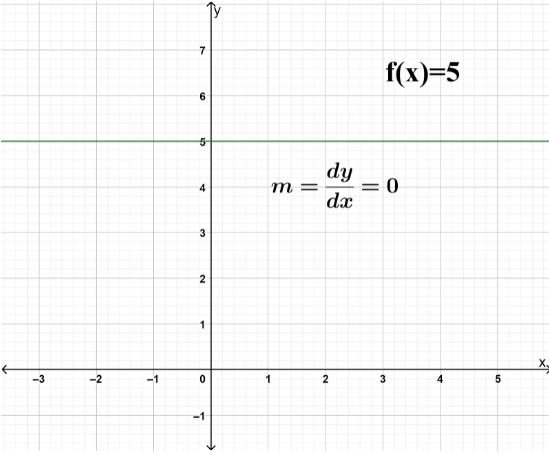
Now, we know that the derivative of a function represents the slope of the function at a particular point. So, the derivative of the constant function over an interval is zero.
Note:We must know the basics of differentiation and limits in order to solve the given question. We can also calculate the derivative of a constant function by using the power rule of differentiation $\dfrac{{d\left( {{x^n}} \right)}}{{dx}} = n{x^{\left( {n - 1} \right)}}$. We should always remember the result of this problem as it can be used in many other complex problems directly.
Complete step by step answer:
Differentiation provides us with the rate of change of a variable with respect to some other variable. Derivative of a function at a point gives the instantaneous slope of the function at that particular point. The slope of function describes the steepness of a straight line. Slope is also denoted by the symbol ‘$m$’.
Now, we know that a constant function always gives the same output for every input value of a variable. So, there is no change in the slope of a constant function. Hence, the derivative of a constant function on an interval is zero. For example: Let $f\left( x \right) = 5$. Then, as we can see in the graph of the function, for every real value of x, the value of the function remains $5$.
Now, we see that the slope of the constant function $f\left( x \right) = 5$ remains the same throughout the real number line.
Now, we know that the derivative of a function represents the slope of the function at a particular point. So, the derivative of the constant function over an interval is zero.
Note:We must know the basics of differentiation and limits in order to solve the given question. We can also calculate the derivative of a constant function by using the power rule of differentiation $\dfrac{{d\left( {{x^n}} \right)}}{{dx}} = n{x^{\left( {n - 1} \right)}}$. We should always remember the result of this problem as it can be used in many other complex problems directly.
Recently Updated Pages
Master Class 12 Business Studies: Engaging Questions & Answers for Success

Master Class 12 Biology: Engaging Questions & Answers for Success
Master Class 12 Chemistry: Engaging Questions & Answers for Success
Class 12 Question and Answer - Your Ultimate Solutions Guide
Master Class 11 Social Science: Engaging Questions & Answers for Success
Master Class 11 English: Engaging Questions & Answers for Success
Trending doubts
Which are the Top 10 Largest Countries of the World?
Draw a labelled sketch of the human eye class 12 physics CBSE
Differentiate between homogeneous and heterogeneous class 12 chemistry CBSE
Sulphuric acid is known as the king of acids State class 12 chemistry CBSE
Why is the cell called the structural and functional class 12 biology CBSE
Which is the correct genotypic ratio of mendel dihybrid class 12 biology CBSE