




Sequence of covering of the eye, outer to inner is
A. Sclerotic, choroid, and retina
B. Choroid, retina, and sclerotic
C. Retina, choroid, and sclerotic
D. Conjunction, choroid, and sclerotic
Answer
 Verified
591.3k+ views
Hint:Human eye is the visual sensory organ. It is one of the most complex and sensitive organs of the body. The eye consists of three major layers that constitute it. The external layer is formed by the sclera and cornea. The middle layer is made of two parts which are anterior and posterior. The last layer is the sensory layer.
Complete answer:The eye is one of the five sensory organs that receive visual signals from environments and sends them for further processing to the brain. The human eye consists of various parts and units that work together and make us capable of seeing the beautiful world around us. The eye is a sensitive organ and is protected from mechanical injury by the socket in which it is enclosed. The eyeball stays intact in the eye socket and the movement of the eyeball is regulated by 6 extraocular muscles. The optic foramen which is the opening behind the eyeball holds the optic nerve which provides signals to the brain.
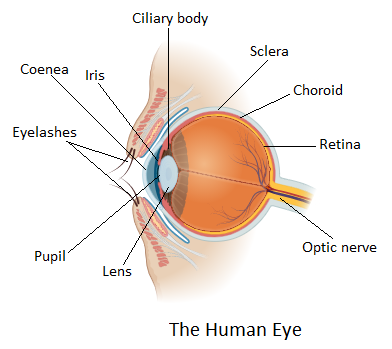
The front surface of the eye or the external layer of the eye is made of sclera and cornea. The front visible white part of the eye is sclera and the cornea is a glassy transparent moist covering of the eye. After the external layer, iris, pupil, choroid, and conjunctiva are present in the middle layer. This intermediate layer is divided into two parts. The anterior part consists of the iris and ciliary body. The posterior part consists of a choroid. The internal layer of the eye or the sensory layer of the eye is made of the retina. The retina is the key visual sensory surface that consists of rods and cones. These are cells that detect light and dark.
Thus, from the above discussion, we can conclude that the right answer is option A.
Note: The outer or external layer of the eye is also called a fibrous tunic. It is responsible to provide shape and support to the eye. The middle layer is called the vascular tunic. The anterior spaces of the eye are filled with a liquid called aqueous humor. The posterior cavity of the eye is filled by the vitreous body which is a jelly-like substance.
Complete answer:The eye is one of the five sensory organs that receive visual signals from environments and sends them for further processing to the brain. The human eye consists of various parts and units that work together and make us capable of seeing the beautiful world around us. The eye is a sensitive organ and is protected from mechanical injury by the socket in which it is enclosed. The eyeball stays intact in the eye socket and the movement of the eyeball is regulated by 6 extraocular muscles. The optic foramen which is the opening behind the eyeball holds the optic nerve which provides signals to the brain.
The front surface of the eye or the external layer of the eye is made of sclera and cornea. The front visible white part of the eye is sclera and the cornea is a glassy transparent moist covering of the eye. After the external layer, iris, pupil, choroid, and conjunctiva are present in the middle layer. This intermediate layer is divided into two parts. The anterior part consists of the iris and ciliary body. The posterior part consists of a choroid. The internal layer of the eye or the sensory layer of the eye is made of the retina. The retina is the key visual sensory surface that consists of rods and cones. These are cells that detect light and dark.
Thus, from the above discussion, we can conclude that the right answer is option A.
Note: The outer or external layer of the eye is also called a fibrous tunic. It is responsible to provide shape and support to the eye. The middle layer is called the vascular tunic. The anterior spaces of the eye are filled with a liquid called aqueous humor. The posterior cavity of the eye is filled by the vitreous body which is a jelly-like substance.
Recently Updated Pages
Master Class 11 Social Science: Engaging Questions & Answers for Success

Master Class 11 English: Engaging Questions & Answers for Success
Master Class 11 Maths: Engaging Questions & Answers for Success
Master Class 11 Chemistry: Engaging Questions & Answers for Success
Master Class 11 Biology: Engaging Questions & Answers for Success
Master Class 11 Physics: Engaging Questions & Answers for Success
Trending doubts
One Metric ton is equal to kg A 10000 B 1000 C 100 class 11 physics CBSE
Difference Between Prokaryotic Cells and Eukaryotic Cells
Draw a diagram of a plant cell and label at least eight class 11 biology CBSE
Two of the body parts which do not appear in MRI are class 11 biology CBSE
Which gas is abundant in air class 11 chemistry CBSE
10 examples of friction in our daily life