




Why is self induction called inertia of electricity?
Answer
 Verified
606k+ views
Hint: Induction in general is a process of inducing a change into something due to something else. Self induction is the property of an inductor to induce a current, opposite to the direction of the emf applied when there is a change in magnetic field across the inductor. Whereas speaking about the inertia , it is defined as a resistance in change in state of an object i.e. either rest or motion. Hence we can easily conclude the answer of the above question.
Complete answer:
To begin with let us understand how a inductor induces current in the circuit
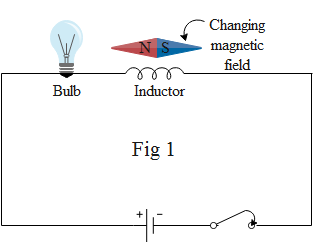
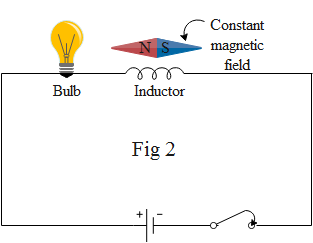
In the above diagram i.e. fig 1, the inductor and the bulb are connected in series and the key is closed. To understand induction, the value of current in the circuit initially when the key is just plugged in, its value does not reach directly to its maximum .It takes some time let us say t. In this time t the value of current in the circuit keeps on changing.
An inductor can basically be considered as a solenoid . Hence, magnetic field B produced when the current is passed through the inductor is given by $B={{\mu }_{\centerdot }}ni$ where i is the current through the inductor, n is the number of turns per unit length and ${{\mu }_{\centerdot }}$ is the permeability of free space.
By law of electromagnetic induction we can say that,
Change in flux across a coil i.e.$\text{Emf =}\dfrac{d\phi }{dt}=\dfrac{dBA\operatorname{Cos}\theta }{dt}$ where B is the magnetic field across the coil A is the area of cross section and $\theta $ is the angle between the coil and B. in the above case that is our inductor $B={{\mu }_{\centerdot }}ni$ and $\theta ={{0}^{\centerdot }}$, hence the emf induced is given by $A{{\mu }_{\centerdot }}n\dfrac{di}{dt}$. From this equation we can conclude that as current changes emf will be induced in the circuit opposite to the direction of the applied emf. This induced emf is equal to the applied emf and hence till there is a change of current in the circuit the bulb will not glow. Once the circuit current reaches a maximum steady value the bulb will start glowing as shown in fig 2.
Since the self induction of the inductor resists the change of current in the circuit, this property is also called inertia of electricity.
Note:
It is to be noted that when the key in the circuit is opened, the value of the current in the circuit will tend to zero. Since during this time there will also be change in the current, emf will be induced in the same direction of the applied emf. Hence the bulb will still glow for some time even though the circuit is open.
Complete answer:
To begin with let us understand how a inductor induces current in the circuit
In the above diagram i.e. fig 1, the inductor and the bulb are connected in series and the key is closed. To understand induction, the value of current in the circuit initially when the key is just plugged in, its value does not reach directly to its maximum .It takes some time let us say t. In this time t the value of current in the circuit keeps on changing.
An inductor can basically be considered as a solenoid . Hence, magnetic field B produced when the current is passed through the inductor is given by $B={{\mu }_{\centerdot }}ni$ where i is the current through the inductor, n is the number of turns per unit length and ${{\mu }_{\centerdot }}$ is the permeability of free space.
By law of electromagnetic induction we can say that,
Change in flux across a coil i.e.$\text{Emf =}\dfrac{d\phi }{dt}=\dfrac{dBA\operatorname{Cos}\theta }{dt}$ where B is the magnetic field across the coil A is the area of cross section and $\theta $ is the angle between the coil and B. in the above case that is our inductor $B={{\mu }_{\centerdot }}ni$ and $\theta ={{0}^{\centerdot }}$, hence the emf induced is given by $A{{\mu }_{\centerdot }}n\dfrac{di}{dt}$. From this equation we can conclude that as current changes emf will be induced in the circuit opposite to the direction of the applied emf. This induced emf is equal to the applied emf and hence till there is a change of current in the circuit the bulb will not glow. Once the circuit current reaches a maximum steady value the bulb will start glowing as shown in fig 2.
Since the self induction of the inductor resists the change of current in the circuit, this property is also called inertia of electricity.
Note:
It is to be noted that when the key in the circuit is opened, the value of the current in the circuit will tend to zero. Since during this time there will also be change in the current, emf will be induced in the same direction of the applied emf. Hence the bulb will still glow for some time even though the circuit is open.
Recently Updated Pages
Basicity of sulphurous acid and sulphuric acid are

Master Class 12 Economics: Engaging Questions & Answers for Success
Master Class 12 Biology: Engaging Questions & Answers for Success
Master Class 11 English: Engaging Questions & Answers for Success
Master Class 11 Physics: Engaging Questions & Answers for Success
Master Class 11 Computer Science: Engaging Questions & Answers for Success
Trending doubts
Draw a diagram of a plant cell and label at least eight class 11 biology CBSE
Proton was discovered by A Thomson B Rutherford C Chadwick class 11 chemistry CBSE
What is the purity of pure gold in carat class 11 chemistry CBSE
Can anyone list 10 advantages and disadvantages of friction
Lysosomes are known as suicidal bags of cell why class 11 biology CBSE
Derive the equation of motion by the calculus method class 11 physics CBSE