




Select the correct option with respect to age pyramids.
 A. a) expanding b) stable c) declining
B. a) stable b) expanding c) declining
C. a) stable b) declining c) expanding
D. a) declining b) stable c) expanding
Answer
 Verified
608.7k+ views
Hint: The age pyramid, also known as the population pyramid is a graphical representation of various age groups distributed within a population, forming a pyramid when the population keeps increasing.
Complete answer:
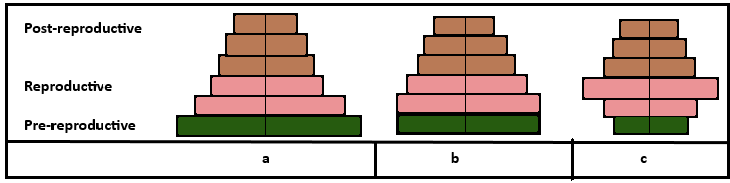
In the above image (a), the population of pre-reproductive individuals are more when compared to reproductive and post-reproductive individuals. This shows an expanding age pyramid. Whereas in the bell-shaped image (b) the reproductive and pre-reproductive population are almost equal. Post reproductive individuals seem to be very less. This represents a stable age pyramid. The final image (c) depicts that the rate of pre productive and post-reproductive populations are diminishing. The rate of development counts upon the size of the pre-reproductive population. Since the pre-reproductive population is less than the reproductive population, it is the declining phase. Thus, there is an expanding, stable, and declining pattern of the population concerning the above age pyramid. This depiction is often employed in biodiversity to decide a population's cumulative age distribution; a measure of the reproduction potential and likelihood of a species' continuity. The population's shape depends on how the economy is doing in the country. More developed countries are located in stages three, four, and five, whereas the low - income countries have a demographic represented in phases one and two by the pyramids.
So, the correct option is (A)
Note: The shape of the projected population expresses vital information adequately about the age-sex composition of a population group. A big pyramid suggests that a comparatively large part of the population is composed of people in the younger groups, and a narrow or peaked top implies that elderly adults make up a fairly tiny fraction of the population.
Complete answer:
In the above image (a), the population of pre-reproductive individuals are more when compared to reproductive and post-reproductive individuals. This shows an expanding age pyramid. Whereas in the bell-shaped image (b) the reproductive and pre-reproductive population are almost equal. Post reproductive individuals seem to be very less. This represents a stable age pyramid. The final image (c) depicts that the rate of pre productive and post-reproductive populations are diminishing. The rate of development counts upon the size of the pre-reproductive population. Since the pre-reproductive population is less than the reproductive population, it is the declining phase. Thus, there is an expanding, stable, and declining pattern of the population concerning the above age pyramid. This depiction is often employed in biodiversity to decide a population's cumulative age distribution; a measure of the reproduction potential and likelihood of a species' continuity. The population's shape depends on how the economy is doing in the country. More developed countries are located in stages three, four, and five, whereas the low - income countries have a demographic represented in phases one and two by the pyramids.
So, the correct option is (A)
Note: The shape of the projected population expresses vital information adequately about the age-sex composition of a population group. A big pyramid suggests that a comparatively large part of the population is composed of people in the younger groups, and a narrow or peaked top implies that elderly adults make up a fairly tiny fraction of the population.
Recently Updated Pages
Master Class 12 Business Studies: Engaging Questions & Answers for Success

Master Class 12 Biology: Engaging Questions & Answers for Success
Master Class 12 Chemistry: Engaging Questions & Answers for Success
Class 12 Question and Answer - Your Ultimate Solutions Guide
Master Class 11 English: Engaging Questions & Answers for Success
Master Class 11 Social Science: Engaging Questions & Answers for Success
Trending doubts
Which are the Top 10 Largest Countries of the World?
Draw a labelled sketch of the human eye class 12 physics CBSE
Differentiate between homogeneous and heterogeneous class 12 chemistry CBSE
Why is the cell called the structural and functional class 12 biology CBSE
Draw ray diagrams each showing i myopic eye and ii class 12 physics CBSE
Which is the correct genotypic ratio of mendel dihybrid class 12 biology CBSE