



Select the correct match
A. ${\left[ {{\text{Mn}}{{\left( {{\text{N}}{{\text{H}}_{\text{3}}}} \right)}_{\text{6}}}} \right]^{{\text{2 + }}}}$ inner orbital complex
B. ${\left[ {{\text{Co}}{{\left( {{{\text{H}}_2}{\text{O}}} \right)}_{\text{6}}}} \right]^{{\text{3 + }}}}$ outer orbital complex
C. ${\left[ {{\text{Pt}}{{\left( {{\text{Cl}}} \right)}_4}} \right]^{{\text{2 + }}}}$ diamagnetic complex
D. ${{\text{K}}_{\text{3}}}\left[ {{\text{Cu}}{{\left( {{\text{CN}}} \right)}_4}} \right]$ paramagnetic complex
Answer
 Verified
594k+ views
Hint: To determine the answer we should to determine the hybridization of complex. We will determine the valence electronic configuration of metal ions and we will check if the ligand is strong or weak. Based on the metal charge and ligand strength we will determine the vacant d orbital. If inner d-orbitals are involved in hybridization, the complex will be inner if not then outer. If the complex has unpaired electrons, the complex will be paramagnetic if not then the complex will be diamagnetic.
Complete solution:
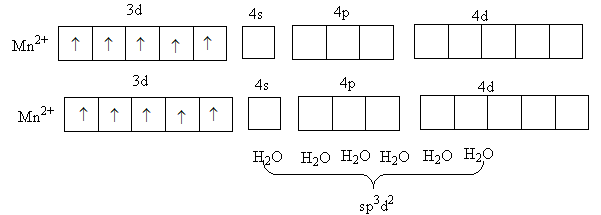
In the complex, ${\left[ {{\text{Mn}}{{\left( {{\text{N}}{{\text{H}}_{\text{3}}}} \right)}_{\text{6}}}} \right]^{{\text{2 + }}}}$ metal manganese is in +$2$ oxidation state and ammonia is a weak field ligand. So, it will not cause the paring of d-electrons of metal.
The valence electronic configuration of ${\text{M}}{{\text{n}}^{{\text{2 + }}}}$is ${\text{3}}{{\text{d}}^{\text{5}}}$ .
So, each of the five d-orbital has one electrons so, no vacant $3$ d orbital is available for hybridization so, ${\text{M}}{{\text{n}}^{{\text{2 + }}}}$ will use its outer $4$ d orbital for the hybridization and this the hybridization in ${\left[ {{\text{Mn}}{{\left( {{\text{N}}{{\text{H}}_{\text{3}}}} \right)}_{\text{6}}}} \right]^{{\text{2 + }}}}$ will be ${\text{s}}{{\text{p}}^{\text{3}}}{{\text{d}}^{\text{2}}}$ so, ${\left[ {{\text{Mn}}{{\left( {{\text{N}}{{\text{H}}_{\text{3}}}} \right)}_{\text{6}}}} \right]^{{\text{2 + }}}}$ is a outer orbital complex.
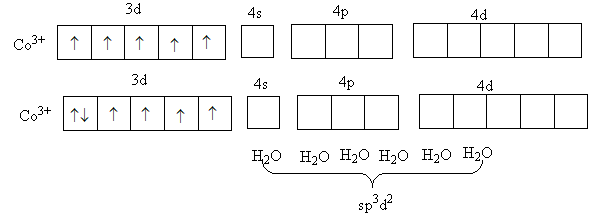
In the complex, ${\left[ {{\text{Co}}{{\left( {{{\text{H}}_2}{\text{O}}} \right)}_{\text{6}}}} \right]^{{\text{3 + }}}}$metal cobalt is in +$3$ oxidation state and water is a weak field ligand. So, it will not cause the paring of d-electrons of metal.
The valance electronic configuration of ${\text{C}}{{\text{o}}^{{\text{3 + }}}}$is ${\text{3}}{{\text{d}}^6}$ .
So, four d-orbital has one electron and one d-orbital has two electrons so, no vacant $3$ d orbital is available for hybridization so, ${\text{C}}{{\text{o}}^{{\text{3 + }}}}$will use its outer $4$ d orbital for the hybridization and this the hybridization in ${\left[ {{\text{Co}}{{\left( {{{\text{H}}_2}{\text{O}}} \right)}_{\text{6}}}} \right]^{{\text{3 + }}}}$ will be ${\text{s}}{{\text{p}}^{\text{3}}}{{\text{d}}^{\text{2}}}$ so, ${\left[ {{\text{Co}}{{\left( {{{\text{H}}_2}{\text{O}}} \right)}_{\text{6}}}} \right]^{{\text{3 + }}}}$is a outer orbital complex.
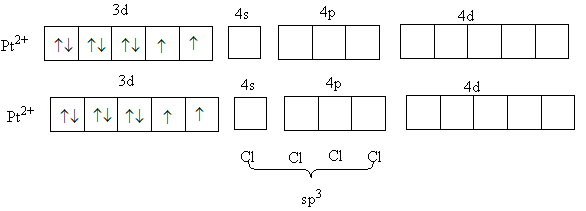
In the complex, ${\left[ {{\text{Pt}}{{\left( {{\text{Cl}}} \right)}_4}} \right]^{{\text{2 + }}}}$metal platinum is in +$2$ oxidation state and chloro is a weak field ligand. So, it will not cause the paring of d-electrons of metal.
The valence electronic configuration of ${\text{P}}{{\text{t}}^{{\text{2 + }}}}$is ${\text{3}}{{\text{d}}^8}$ .
So, three d-orbital will have two electrons in each and two d-orbital will have one electron in each. So, two unpaired electrons are present in platinum (II) metal so the complex will be paramagnetic.
$3$
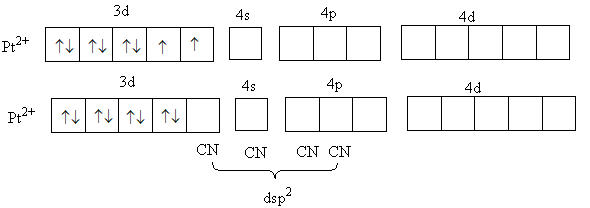
In the complex, ${{\text{K}}_{\text{3}}}\left[ {{\text{Cu}}{{\left( {{\text{CN}}} \right)}_4}} \right]$metal copper is in + oxidation state and cyanide is a strong field ligand. So, it will cause the paring of d-electrons of metal.
The valence electronic configuration of ${\text{C}}{{\text{u}}^{{\text{2 + }}}}$is ${\text{3}}{{\text{d}}^8}$ .
So, four d-orbital will have two electrons in each. So, no unpaired electrons are present in copper (IiI) metal so the complex will be diamagnetic.
Therefore, option (B) ${\left[ {{\text{Co}}{{\left( {{{\text{H}}_2}{\text{O}}} \right)}_{\text{6}}}} \right]^{{\text{3 + }}}}$ outer orbital complex, is correct.
Note:Inner orbital complexes are also known as low spin complexes and outer orbital complexes are also known as high spin complexes. In an octahedral complex, strong ligands cause the low spin or inner orbital complex. The weak ligand causes the high spin or outer orbital complex. In coordination number six, ligand strength affects the hybridization only whereas in coordination number four ligand strength affects the hybridization as well as the geometry. The strong ligand favours the square planar complex whereas the weak ligand favours the tetrahedral complex.
Complete solution:
In the complex, ${\left[ {{\text{Mn}}{{\left( {{\text{N}}{{\text{H}}_{\text{3}}}} \right)}_{\text{6}}}} \right]^{{\text{2 + }}}}$ metal manganese is in +$2$ oxidation state and ammonia is a weak field ligand. So, it will not cause the paring of d-electrons of metal.
The valence electronic configuration of ${\text{M}}{{\text{n}}^{{\text{2 + }}}}$is ${\text{3}}{{\text{d}}^{\text{5}}}$ .
So, each of the five d-orbital has one electrons so, no vacant $3$ d orbital is available for hybridization so, ${\text{M}}{{\text{n}}^{{\text{2 + }}}}$ will use its outer $4$ d orbital for the hybridization and this the hybridization in ${\left[ {{\text{Mn}}{{\left( {{\text{N}}{{\text{H}}_{\text{3}}}} \right)}_{\text{6}}}} \right]^{{\text{2 + }}}}$ will be ${\text{s}}{{\text{p}}^{\text{3}}}{{\text{d}}^{\text{2}}}$ so, ${\left[ {{\text{Mn}}{{\left( {{\text{N}}{{\text{H}}_{\text{3}}}} \right)}_{\text{6}}}} \right]^{{\text{2 + }}}}$ is a outer orbital complex.
In the complex, ${\left[ {{\text{Co}}{{\left( {{{\text{H}}_2}{\text{O}}} \right)}_{\text{6}}}} \right]^{{\text{3 + }}}}$metal cobalt is in +$3$ oxidation state and water is a weak field ligand. So, it will not cause the paring of d-electrons of metal.
The valance electronic configuration of ${\text{C}}{{\text{o}}^{{\text{3 + }}}}$is ${\text{3}}{{\text{d}}^6}$ .
So, four d-orbital has one electron and one d-orbital has two electrons so, no vacant $3$ d orbital is available for hybridization so, ${\text{C}}{{\text{o}}^{{\text{3 + }}}}$will use its outer $4$ d orbital for the hybridization and this the hybridization in ${\left[ {{\text{Co}}{{\left( {{{\text{H}}_2}{\text{O}}} \right)}_{\text{6}}}} \right]^{{\text{3 + }}}}$ will be ${\text{s}}{{\text{p}}^{\text{3}}}{{\text{d}}^{\text{2}}}$ so, ${\left[ {{\text{Co}}{{\left( {{{\text{H}}_2}{\text{O}}} \right)}_{\text{6}}}} \right]^{{\text{3 + }}}}$is a outer orbital complex.
In the complex, ${\left[ {{\text{Pt}}{{\left( {{\text{Cl}}} \right)}_4}} \right]^{{\text{2 + }}}}$metal platinum is in +$2$ oxidation state and chloro is a weak field ligand. So, it will not cause the paring of d-electrons of metal.
The valence electronic configuration of ${\text{P}}{{\text{t}}^{{\text{2 + }}}}$is ${\text{3}}{{\text{d}}^8}$ .
So, three d-orbital will have two electrons in each and two d-orbital will have one electron in each. So, two unpaired electrons are present in platinum (II) metal so the complex will be paramagnetic.
$3$
In the complex, ${{\text{K}}_{\text{3}}}\left[ {{\text{Cu}}{{\left( {{\text{CN}}} \right)}_4}} \right]$metal copper is in + oxidation state and cyanide is a strong field ligand. So, it will cause the paring of d-electrons of metal.
The valence electronic configuration of ${\text{C}}{{\text{u}}^{{\text{2 + }}}}$is ${\text{3}}{{\text{d}}^8}$ .
So, four d-orbital will have two electrons in each. So, no unpaired electrons are present in copper (IiI) metal so the complex will be diamagnetic.
Therefore, option (B) ${\left[ {{\text{Co}}{{\left( {{{\text{H}}_2}{\text{O}}} \right)}_{\text{6}}}} \right]^{{\text{3 + }}}}$ outer orbital complex, is correct.
Note:Inner orbital complexes are also known as low spin complexes and outer orbital complexes are also known as high spin complexes. In an octahedral complex, strong ligands cause the low spin or inner orbital complex. The weak ligand causes the high spin or outer orbital complex. In coordination number six, ligand strength affects the hybridization only whereas in coordination number four ligand strength affects the hybridization as well as the geometry. The strong ligand favours the square planar complex whereas the weak ligand favours the tetrahedral complex.
Recently Updated Pages
Master Class 12 Economics: Engaging Questions & Answers for Success

Master Class 12 English: Engaging Questions & Answers for Success
Master Class 12 Social Science: Engaging Questions & Answers for Success
Master Class 12 Maths: Engaging Questions & Answers for Success
Master Class 12 Physics: Engaging Questions & Answers for Success
Master Class 9 General Knowledge: Engaging Questions & Answers for Success
Trending doubts
Which are the Top 10 Largest Countries of the World?
Draw a labelled sketch of the human eye class 12 physics CBSE
Differentiate between homogeneous and heterogeneous class 12 chemistry CBSE
Sulphuric acid is known as the king of acids State class 12 chemistry CBSE
Why is the cell called the structural and functional class 12 biology CBSE
Draw ray diagrams each showing i myopic eye and ii class 12 physics CBSE