




Secondary nucleus is formed by
(a) Egg apparatus
(b) The fusion of two polar nuclei
(c) Degenerating synergids
(d) Antipodal cells
Answer
 Verified
617.1k+ views
Hint: When the other sperm fuses with them, it forms a triploid cell that develops into the endosperm. The endosperm is a tissue initiated within the seeds of most of the flowering plants following fertilization.
Complete answer:
The secondary nucleus is formed by the fusion of two polar nuclei in the embryo sac of a seed plant preceding fertilization. The secondary nucleus is also known as the primary endosperm nucleus. It is triploid (meaning three chromosome sets per nucleus) in most species. It borders the embryo and supplies nutrition in the form of starch, though it can also contain oils and protein.
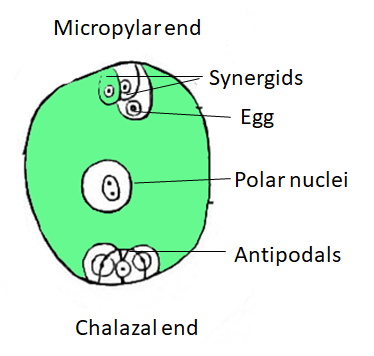
The cells of an unfertilized ovule are 8 in number and arranged within the type of 3+2+3 (from top to bottom) i.e. 3 antipodal cells, 2 polar central cells, 2 synergids & 1 ovum. One sperm fertilizes the ovum and the other sperm combines with the 2 polar nuclei of the big central cell of the megagametophyte. The haploid sperm and haploid egg combine to make a diploid zygote, the method being called syngamy, while the other sperm and therefore the two haploid polar nuclei of the big central cell of the megagametophyte organize a triploid nucleus (triple fusion) . Some plants may form polyploid nuclei.
So, the correct answer is ‘Fusion of two polar nuclei’.
Note: The female gametophyte is also called the embryo sac in angiosperms. The large cell of the gametophyte will then become the endosperm, a nutrient-rich tissue that provides nourishment to the developing embryo. The ovary, surrounding the ovules, develops into the fruit, which protects the seeds and should function to disperse them.
Complete answer:
The secondary nucleus is formed by the fusion of two polar nuclei in the embryo sac of a seed plant preceding fertilization. The secondary nucleus is also known as the primary endosperm nucleus. It is triploid (meaning three chromosome sets per nucleus) in most species. It borders the embryo and supplies nutrition in the form of starch, though it can also contain oils and protein.
The cells of an unfertilized ovule are 8 in number and arranged within the type of 3+2+3 (from top to bottom) i.e. 3 antipodal cells, 2 polar central cells, 2 synergids & 1 ovum. One sperm fertilizes the ovum and the other sperm combines with the 2 polar nuclei of the big central cell of the megagametophyte. The haploid sperm and haploid egg combine to make a diploid zygote, the method being called syngamy, while the other sperm and therefore the two haploid polar nuclei of the big central cell of the megagametophyte organize a triploid nucleus (triple fusion) . Some plants may form polyploid nuclei.
So, the correct answer is ‘Fusion of two polar nuclei’.
Note: The female gametophyte is also called the embryo sac in angiosperms. The large cell of the gametophyte will then become the endosperm, a nutrient-rich tissue that provides nourishment to the developing embryo. The ovary, surrounding the ovules, develops into the fruit, which protects the seeds and should function to disperse them.
Recently Updated Pages
Master Class 12 Economics: Engaging Questions & Answers for Success

Master Class 12 English: Engaging Questions & Answers for Success
Master Class 12 Social Science: Engaging Questions & Answers for Success
Master Class 12 Maths: Engaging Questions & Answers for Success
Master Class 12 Physics: Engaging Questions & Answers for Success
Master Class 9 General Knowledge: Engaging Questions & Answers for Success
Trending doubts
Which are the Top 10 Largest Countries of the World?
Draw a labelled sketch of the human eye class 12 physics CBSE
Differentiate between homogeneous and heterogeneous class 12 chemistry CBSE
Why is the cell called the structural and functional class 12 biology CBSE
Draw ray diagrams each showing i myopic eye and ii class 12 physics CBSE
Which is the correct genotypic ratio of mendel dihybrid class 12 biology CBSE