




Secondary nucleus is also called as
(a)Generative nucleus
(b)Tube nucleus
(c)Definitive nucleus
(d)Primary endosperm nucleus
Answer
 Verified
608.7k+ views
Hint: The pollen tube releases the two male gametes into the cytoplasm of the synergid, after entering one of them, fuse with two nuclei present in the synergid.
Complete Answer:
The secondary nucleus is a diploid nucleus formed by the fusion of two polar nuclei. It is also called the primary endosperm nucleus.
Additional information:
-One of the male gametes from the pollen grains moves towards the egg cell and fuses with its nucleus thus completing the syngamy. This leads to the formation of a diploid cell, the zygote.
-The second male gamete travels towards the two polar nuclei located in the central cell and fuses with them to produce the secondary nucleus or triploid primary endosperm nucleus.
-As such fertilizations involve the fusion of three haploid nuclei it is called triple fusion.
-Both two types of fusions, syngamy and triple fusion take place in an embryo sac the phenomenon is termed double fertilization, a process unique to flowering plants.
-The central cell after the fertilization is complete becomes the primary endosperm cell (PEC) and develops into the endosperm that later nourishes the embryo while the zygote develops into an embryo.
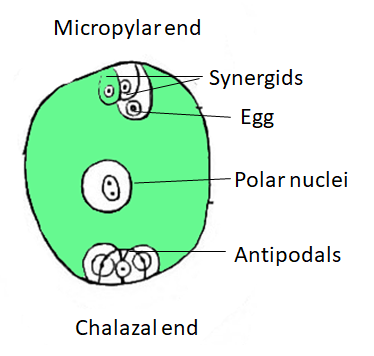
Note: The triploid endosperm tissue is formed by the repeated divisions of the primary endosperm cell. The cells of the endosperm tissue are filled with reserve food materials which are used for the nutrition of the developing embryo when the seed germinates.
Complete Answer:
The secondary nucleus is a diploid nucleus formed by the fusion of two polar nuclei. It is also called the primary endosperm nucleus.
Additional information:
-One of the male gametes from the pollen grains moves towards the egg cell and fuses with its nucleus thus completing the syngamy. This leads to the formation of a diploid cell, the zygote.
-The second male gamete travels towards the two polar nuclei located in the central cell and fuses with them to produce the secondary nucleus or triploid primary endosperm nucleus.
-As such fertilizations involve the fusion of three haploid nuclei it is called triple fusion.
-Both two types of fusions, syngamy and triple fusion take place in an embryo sac the phenomenon is termed double fertilization, a process unique to flowering plants.
-The central cell after the fertilization is complete becomes the primary endosperm cell (PEC) and develops into the endosperm that later nourishes the embryo while the zygote develops into an embryo.
Note: The triploid endosperm tissue is formed by the repeated divisions of the primary endosperm cell. The cells of the endosperm tissue are filled with reserve food materials which are used for the nutrition of the developing embryo when the seed germinates.
Recently Updated Pages
How is Abiogenesis Theory Disproved Experimentally?

In a plane electromagnetic wave the electric field class 12 physics CBSE
A plane electromagnetic wave travels in vacuum along class 12 physics CBSE
The branch of science which deals with nature and natural class 10 physics CBSE
Understanding the Sun's Density: Exploring the Mass Density of a Hot Plasma - FAQs and Data Analysis
Where is the Centre for Environmental Education Located?
Trending doubts
Which are the Top 10 Largest Countries of the World?
Draw a labelled sketch of the human eye class 12 physics CBSE
Which state in the country is at the forefront in controlling class 12 social science CBSE
Mention the role of cyanobacteria as a biofertiliz class 12 biology ICSE
Where is the largest hydroelectric power station located class 12 biology CBSE
An example of C4 plant is A Maize B Rice C Wheat D class 12 biology CBSE