




Sea flowers are
a) Corals
b) Red corals
c) Sea anemones
d) Jellyfish
Answer
 Verified
628.5k+ views
Hint: Sea flowers are the tentacles having animals of the water that have a distinct variety of colors present on their body that they seem to be flowers. These sea flowers are the predators and feed on the fishes which are present near them. They are usually found on the rocky bottom or on the surface of the corals.
Complete answer:
The sea flowers are the sea anemones which have a body resembling that of a flower. They have unique attractive colors present on their body. Their tentacles resemble the colorful petals of the flower. Their tentacles have a venom containing cells known as nematocysts.
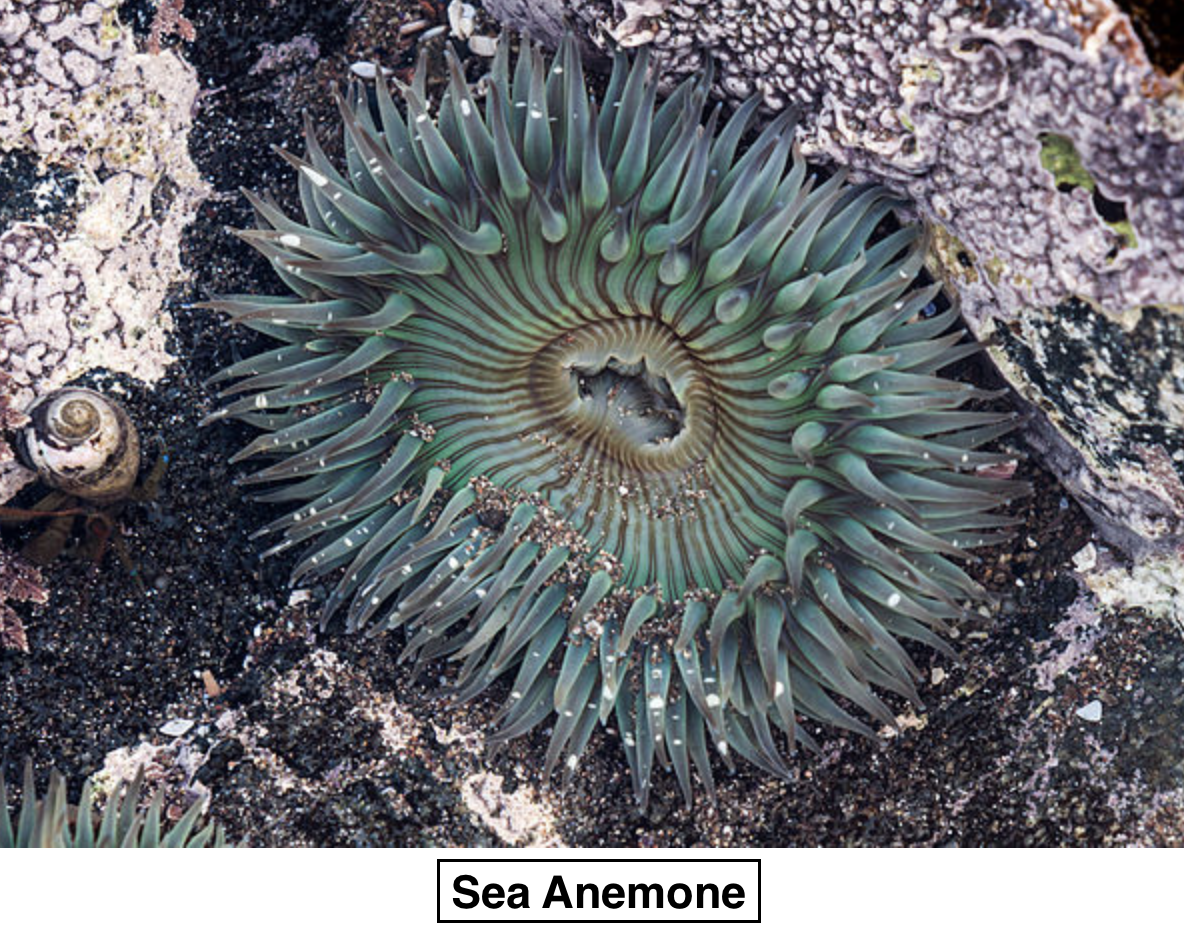
This venom usually paralyzes their prey fishes and makes them unable to move. Thus, making it easy for them to feed on them.
Additional information: Red algae consist of coralline algae which are responsible for the production of the coral reefs. The thallus is hard due to the presence of the calcareous deposits which is present on their cell wall. They give a characteristic color pink and some shades of red color to the coral reef. They play an important role in maintaining the ecology of the coral reefs. Due to the accumulation and deposition of the calcium-containing exoskeleton the coral reefs are formed through the sea animals. The red algae also contain calcium deposition. These depositions are the foundation of the reefs. They provide protection to the coral polyps living in the reefs.
So, the answer is 'c) Aea Anemone'.
Note: The sea flowers only resemble flowers because of their tentacles having the characteristic color like the petals of the flower. They are predatory in nature. They belong to the cnidarians and are present in the polyp forms. Their body is attached to the rocky substratum or the coral reefs.
Complete answer:
The sea flowers are the sea anemones which have a body resembling that of a flower. They have unique attractive colors present on their body. Their tentacles resemble the colorful petals of the flower. Their tentacles have a venom containing cells known as nematocysts.
This venom usually paralyzes their prey fishes and makes them unable to move. Thus, making it easy for them to feed on them.
Additional information: Red algae consist of coralline algae which are responsible for the production of the coral reefs. The thallus is hard due to the presence of the calcareous deposits which is present on their cell wall. They give a characteristic color pink and some shades of red color to the coral reef. They play an important role in maintaining the ecology of the coral reefs. Due to the accumulation and deposition of the calcium-containing exoskeleton the coral reefs are formed through the sea animals. The red algae also contain calcium deposition. These depositions are the foundation of the reefs. They provide protection to the coral polyps living in the reefs.
So, the answer is 'c) Aea Anemone'.
Note: The sea flowers only resemble flowers because of their tentacles having the characteristic color like the petals of the flower. They are predatory in nature. They belong to the cnidarians and are present in the polyp forms. Their body is attached to the rocky substratum or the coral reefs.
Recently Updated Pages
If x a + bt + ct2 where x is in meters and t is in class 11 physics CBSE

A car covers the first half distance between two places class 11 physics CBSE
The resultant of two vectors overrightarrow P and overrightarrow class 11 physics CBSE
Find the value of cos 135 class 11 maths CBSE
A mass M is held in place by an applied force F and class 11 physics CBSE
A solution of glucose in water is labelled as 10 dfracwv class 11 chemistry CBSE
Trending doubts
One Metric ton is equal to kg A 10000 B 1000 C 100 class 11 physics CBSE
Find the value of the expression given below sin 30circ class 11 maths CBSE
What do you mean by retardation What is its SI uni class 11 physics CBSE
Draw a diagram of nephron and explain its structur class 11 biology CBSE
10 examples of friction in our daily life
Difference between physical and chemical change class 11 chemistry CBSE