




Sclereids and stone cells are modified
(a)Collenchyma
(b) Sclerenchyma
(c)Fibres
(d) Xylem vessels
Answer
 Verified
651k+ views
Hint: Sclereids are spherical oval or cylindrical cells that are present in various plant tissues such as cortex, xylem, phloem, leaves, fruits, and pith. Stone cells are of various shapes and are shorter than the fibers and provide strength and support to the plant.
Complete answer:
Sclereids and stone cells are modified sclerenchyma. Sclerenchyma consists of dead tissues that act as a protective coating on the fruits and nuts. They have highly thick and lignified cellular wales which are known as sclereids. The form of small bundles of durable layers of tissue in most of the plants. Stone cells are a type of sclerenchyma which differs from the fiber cell as they are not greatly elongated. They occur in a small group or single. It gives rise to a gritty texture such as the pear fruit where it is known as the stone cell. Some occur in the layers as in the hard seed coats. a secondary cell wall is deposited by sclerenchyma between the primary cell wall and the plasma membrane. It loses its protoplast at maturity. It provides strength and support to the soft tissues such as the ground tissues.
Additional Information:
Collenchyma: Collenchyma provides irregular cell walls to the living elongated cells in plants. They have thick deposits of cellulose in their cell walls and appear as polygonal in cross-section. They form longitudinal interlocking of the cells and form cylindrical strands or discrete strands with parenchyma and sclerenchyma. It is found in the cortex of stems and acts as the primary supporting tissues for herbaceous plants. It functions temporarily and becomes crushed as woody tissue develops.
Fibers: Fibres are the elongated cells that provide maximum support to a plant and consist of tapering ends interlock. They occur in bundles or strands and found almost everywhere in the plant body which includes the stem, vascular bundles in leaves, and the roots. Some fibers are an important source of raw materials for textile and other woven goods. They vary in shape and present in various tissues of the plant such as cortex, periderm, xylem, phloem, and pith.
Xylem vessels: Xylem vessels consist of two cell types which are tracheary elements and tracheids. They conduct water in the vascular plants. The pteridophytes and gymnosperms contain only tracheids whereas the angiosperms have both xylem vessels and tracheids. Xylem vessels play a major role in the conductive element.
So, the correct answer is 'Sclerenchyma'.
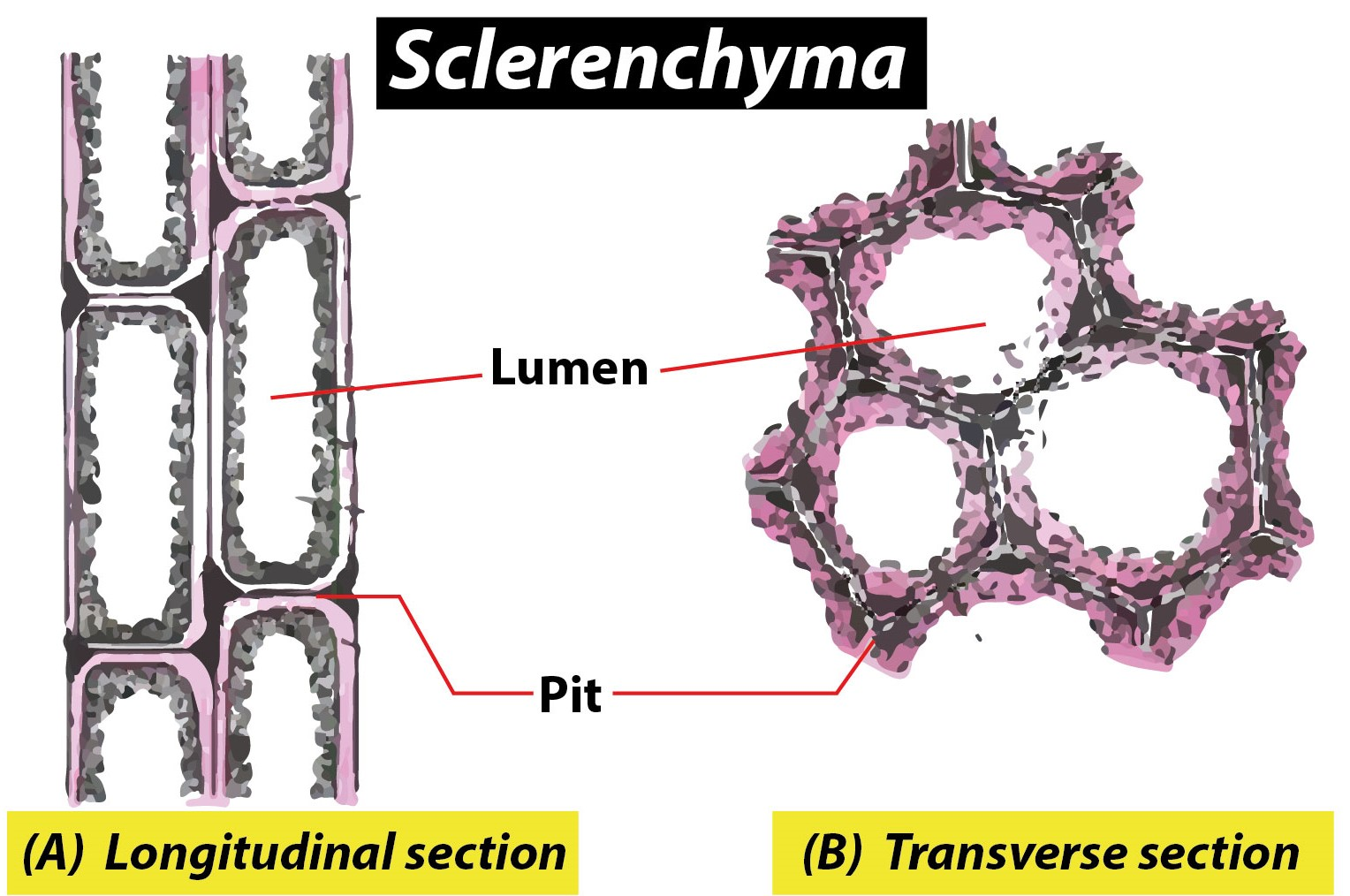
Note: Sclerenchyma is present in some human cells but not the full cell. It is useful in providing support to the plant parts and the mature sclerenchyma cells are dead. Collenchyma is responsible for the crunch in the celery. It provides stiffness to the plant.
Complete answer:
Sclereids and stone cells are modified sclerenchyma. Sclerenchyma consists of dead tissues that act as a protective coating on the fruits and nuts. They have highly thick and lignified cellular wales which are known as sclereids. The form of small bundles of durable layers of tissue in most of the plants. Stone cells are a type of sclerenchyma which differs from the fiber cell as they are not greatly elongated. They occur in a small group or single. It gives rise to a gritty texture such as the pear fruit where it is known as the stone cell. Some occur in the layers as in the hard seed coats. a secondary cell wall is deposited by sclerenchyma between the primary cell wall and the plasma membrane. It loses its protoplast at maturity. It provides strength and support to the soft tissues such as the ground tissues.
Additional Information:
Collenchyma: Collenchyma provides irregular cell walls to the living elongated cells in plants. They have thick deposits of cellulose in their cell walls and appear as polygonal in cross-section. They form longitudinal interlocking of the cells and form cylindrical strands or discrete strands with parenchyma and sclerenchyma. It is found in the cortex of stems and acts as the primary supporting tissues for herbaceous plants. It functions temporarily and becomes crushed as woody tissue develops.
Fibers: Fibres are the elongated cells that provide maximum support to a plant and consist of tapering ends interlock. They occur in bundles or strands and found almost everywhere in the plant body which includes the stem, vascular bundles in leaves, and the roots. Some fibers are an important source of raw materials for textile and other woven goods. They vary in shape and present in various tissues of the plant such as cortex, periderm, xylem, phloem, and pith.
Xylem vessels: Xylem vessels consist of two cell types which are tracheary elements and tracheids. They conduct water in the vascular plants. The pteridophytes and gymnosperms contain only tracheids whereas the angiosperms have both xylem vessels and tracheids. Xylem vessels play a major role in the conductive element.
So, the correct answer is 'Sclerenchyma'.
Note: Sclerenchyma is present in some human cells but not the full cell. It is useful in providing support to the plant parts and the mature sclerenchyma cells are dead. Collenchyma is responsible for the crunch in the celery. It provides stiffness to the plant.
Recently Updated Pages
Which will be the least stable resonating structure class 11 chemistry CBSE

How many 5 digit telephone numbers can be construc-class-11-maths-CBSE
How do you find the angle of the resultant vector class 11 physics CBSE
Draw labelled diagram of the following i Gram seed class 11 biology CBSE
1 Quintal is equal to a 110 kg b 10 kg c 100kg d 1000 class 11 physics CBSE
What is the need and importance of classification class 11 biology CBSE
Trending doubts
Find the value of the expression given below sin 30circ class 11 maths CBSE
One Metric ton is equal to kg A 10000 B 1000 C 100 class 11 physics CBSE
10 examples of friction in our daily life
Draw a diagram of a plant cell and label at least eight class 11 biology CBSE
Difference between physical and chemical change class 11 chemistry CBSE
Proton was discovered by A Thomson B Rutherford C Chadwick class 11 chemistry CBSE