




when we can say that a p-n-p transistor is in its active region of operation?
(A) Both emitter junction and collector junction are forward biased.
(B) Both emitter junction and collector junction are reversed biased.
(C) Emitter junction is forward biased and collector junction is reverse biased.
(D) Emitter junction is reverse biased and collector junction is forward biased.
Answer
 Verified
604.5k+ views
Hint
There are many types of transistors but the most popular transistor is Bipolar junction transistor (BJT). It has a three terminal semiconductor device used to regulate current, or to amplify an input signal into a greater output signal. Transistors are also used to switch electronic signals. The circulation of electrical current through all types of transistors is adjusted by electron addition. This process creates variations in voltage to cause proportionally larger variations in output current, creating amplification.
Complete step by step answer
The transistors are too small and they sealed by a plastic coating for protect from water vapor and climate change.There are two types of transistor (1) p-n-p (2) n-p-n
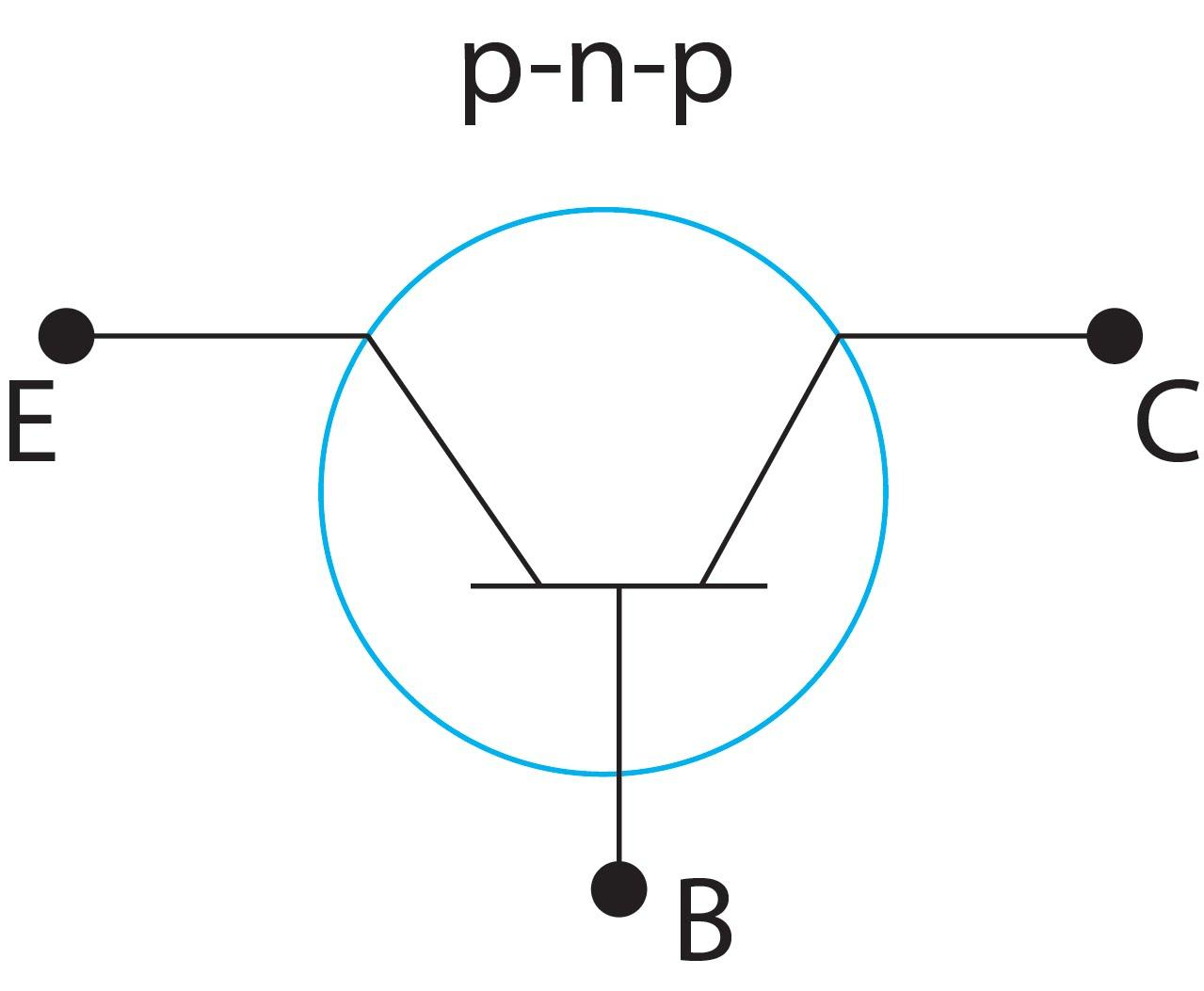
This is the symbol of the p-n-p transistor.
A p-n-p transistor is said to be in active region of operation when emitter junction is forward biased and collector junction is reverse biased. When a p-n-p transistor is operated in a saturation region, then its in active and saturation modes, current in a PNP flows from emitter to collector which implies that the emitter must generally be at a higher voltage than the collector. Both Emitter Base and Base Collector junctions of the transistor are forward biased
Note
The transistor was invented in 1947 by John Bardeen, William Shockly, Walter Brattain. It used to amplify or switch electronic signals and electrical power. It is composed of semiconductor material usually with at least three terminals for connection to an external circuit.
There are many types of transistors but the most popular transistor is Bipolar junction transistor (BJT). It has a three terminal semiconductor device used to regulate current, or to amplify an input signal into a greater output signal. Transistors are also used to switch electronic signals. The circulation of electrical current through all types of transistors is adjusted by electron addition. This process creates variations in voltage to cause proportionally larger variations in output current, creating amplification.
Complete step by step answer
The transistors are too small and they sealed by a plastic coating for protect from water vapor and climate change.There are two types of transistor (1) p-n-p (2) n-p-n
This is the symbol of the p-n-p transistor.
A p-n-p transistor is said to be in active region of operation when emitter junction is forward biased and collector junction is reverse biased. When a p-n-p transistor is operated in a saturation region, then its in active and saturation modes, current in a PNP flows from emitter to collector which implies that the emitter must generally be at a higher voltage than the collector. Both Emitter Base and Base Collector junctions of the transistor are forward biased
Note
The transistor was invented in 1947 by John Bardeen, William Shockly, Walter Brattain. It used to amplify or switch electronic signals and electrical power. It is composed of semiconductor material usually with at least three terminals for connection to an external circuit.
Recently Updated Pages
Master Class 12 Business Studies: Engaging Questions & Answers for Success

Master Class 12 Chemistry: Engaging Questions & Answers for Success
Master Class 12 Biology: Engaging Questions & Answers for Success
Class 12 Question and Answer - Your Ultimate Solutions Guide
Master Class 11 English: Engaging Questions & Answers for Success
Master Class 11 Maths: Engaging Questions & Answers for Success
Trending doubts
Which is more stable and why class 12 chemistry CBSE
Which are the Top 10 Largest Countries of the World?
Draw a labelled sketch of the human eye class 12 physics CBSE
Differentiate between homogeneous and heterogeneous class 12 chemistry CBSE
What are the major means of transport Explain each class 12 social science CBSE
Sulphuric acid is known as the king of acids State class 12 chemistry CBSE