




Same current ‘I’ is flowing in the three infinitely long wire along positive x, y and z directions. The magnetic field at a point (0, 0, -a) would be:
$\begin{align}
& A.\text{ }\dfrac{{{\mu }_{0}}i}{2\pi a}\left( \widehat{j}-\widehat{i} \right) \\
& B.\text{ }\dfrac{{{\mu }_{0}}i}{2\pi a}\left( \widehat{i}+\widehat{j} \right) \\
& C.\text{ }\dfrac{{{\mu }_{0}}i}{2\pi a}\left( \widehat{i}-\widehat{j} \right) \\
& D.\text{ }\dfrac{{{\mu }_{0}}i}{2\pi a}\left( \widehat{i}+\widehat{j}+\widehat{k} \right) \\
\end{align}$
Answer
 Verified
621.3k+ views
Hint: First locate point (0, 0, -a) and then apply magnetic field formula along X, Y and Z axis. This will give us the solution for the three infinitely long wires along the 3 – axis given in the question.
Formula used:
$B=\dfrac{{{\mu }_{o}}I}{2\pi r}$
Complete step by step solution:
First let’s locate point A (0, 0, -a) on the axis as shown in the figure.
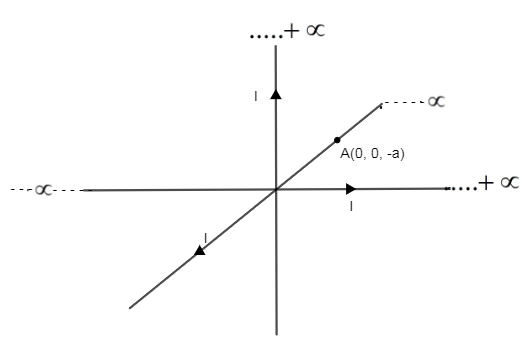
As we can say in the figure point A is located on the -Z- axis
Current directions are in +Z -axis as shown in the figure.
Now the magnitude field at point A is,
$\overrightarrow{{{B}_{A}}}=\overrightarrow{{{B}_{X}}}+\overrightarrow{{{B}_{Y}}}+\overrightarrow{{{B}_{Z}}}...\left( 1 \right)$
Where, $\overrightarrow{{{B}_{A}}}$ = magnetic field at point A.
$\overrightarrow{{{B}_{X}}}$= magnetic field due to X- axis
$\overrightarrow{{{B}_{Y}}}$= magnetic field due to Y-axis
$\overrightarrow{{{B}_{Z}}}$= magnetic field due to Z-axis
Now let’s find$\overrightarrow{{{B}_{X}}}$,
Formula for the magnetic field is,
$\Rightarrow B=\dfrac{{{\mu }_{o}}I}{2\pi r}$
Where, B = magnetic field
${{\mu }_{o}}=$ Permeability of the free space
r = distance from the wire to the point.
Here r will be taken as ‘a’ for $\overrightarrow{{{B}_{X}}}$
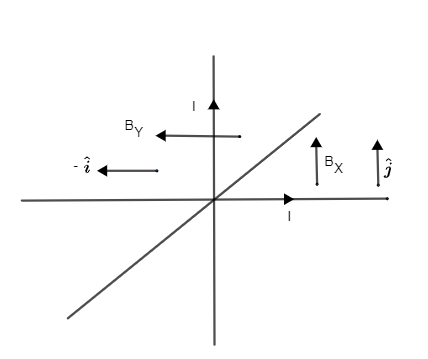
$\overrightarrow{{{B}_{X}}}=\left( \dfrac{{{\mu }_{o}}I}{2\pi a} \right)\widehat{j}$
Direction of $\overrightarrow{{{B}_{X}}}$is in $\widehat{j}$ direction.
Now similarly,
$\overrightarrow{{{B}_{Y}}}=\left( \dfrac{{{\mu }_{o}}I}{2\pi a} \right)\left( -\widehat{i} \right)$
Direction of $\overrightarrow{{{B}_{Y}}}$will be $\left( -\widehat{i} \right)$direction.
Now, $\overrightarrow{{{B}_{Z}}}$will be zero because the point A (0, 0, -a) lies on the Z-axis itself.
${{B}_{Z}}=O$
Now let’s put all the values in equation (1)
$\begin{align}
& \Rightarrow \overrightarrow{{{B}_{A}}}=\left( \dfrac{{{\mu }_{o}}I}{2\pi a} \right)\widehat{j}+\left( \dfrac{{{\mu }_{o}}I}{2\pi a} \right)\widehat{i}+o \\
& \therefore \overrightarrow{{{B}_{A}}}=\left( \dfrac{{{\mu }_{o}}I}{2\pi a} \right)\left( \widehat{j}-\widehat{i} \right) \\
\end{align}$
Hence the correct option is (A) $\left( \dfrac{{{\mu }_{o}}I}{2\pi a} \right)\left( \widehat{j}-\widehat{i} \right)$,
Note:
When we are giving direction for the magnitude fields don’t mistake directions given for $\widehat{i}$ as ${{B}_{X}}$ because it is in the X direction use the thumb rule for the direction of the magnetic field as shown in figure.
Formula used:
$B=\dfrac{{{\mu }_{o}}I}{2\pi r}$
Complete step by step solution:
First let’s locate point A (0, 0, -a) on the axis as shown in the figure.
As we can say in the figure point A is located on the -Z- axis
Current directions are in +Z -axis as shown in the figure.
Now the magnitude field at point A is,
$\overrightarrow{{{B}_{A}}}=\overrightarrow{{{B}_{X}}}+\overrightarrow{{{B}_{Y}}}+\overrightarrow{{{B}_{Z}}}...\left( 1 \right)$
Where, $\overrightarrow{{{B}_{A}}}$ = magnetic field at point A.
$\overrightarrow{{{B}_{X}}}$= magnetic field due to X- axis
$\overrightarrow{{{B}_{Y}}}$= magnetic field due to Y-axis
$\overrightarrow{{{B}_{Z}}}$= magnetic field due to Z-axis
Now let’s find$\overrightarrow{{{B}_{X}}}$,
Formula for the magnetic field is,
$\Rightarrow B=\dfrac{{{\mu }_{o}}I}{2\pi r}$
Where, B = magnetic field
${{\mu }_{o}}=$ Permeability of the free space
r = distance from the wire to the point.
Here r will be taken as ‘a’ for $\overrightarrow{{{B}_{X}}}$
$\overrightarrow{{{B}_{X}}}=\left( \dfrac{{{\mu }_{o}}I}{2\pi a} \right)\widehat{j}$
Direction of $\overrightarrow{{{B}_{X}}}$is in $\widehat{j}$ direction.
Now similarly,
$\overrightarrow{{{B}_{Y}}}=\left( \dfrac{{{\mu }_{o}}I}{2\pi a} \right)\left( -\widehat{i} \right)$
Direction of $\overrightarrow{{{B}_{Y}}}$will be $\left( -\widehat{i} \right)$direction.
Now, $\overrightarrow{{{B}_{Z}}}$will be zero because the point A (0, 0, -a) lies on the Z-axis itself.
${{B}_{Z}}=O$
Now let’s put all the values in equation (1)
$\begin{align}
& \Rightarrow \overrightarrow{{{B}_{A}}}=\left( \dfrac{{{\mu }_{o}}I}{2\pi a} \right)\widehat{j}+\left( \dfrac{{{\mu }_{o}}I}{2\pi a} \right)\widehat{i}+o \\
& \therefore \overrightarrow{{{B}_{A}}}=\left( \dfrac{{{\mu }_{o}}I}{2\pi a} \right)\left( \widehat{j}-\widehat{i} \right) \\
\end{align}$
Hence the correct option is (A) $\left( \dfrac{{{\mu }_{o}}I}{2\pi a} \right)\left( \widehat{j}-\widehat{i} \right)$,
Note:
When we are giving direction for the magnitude fields don’t mistake directions given for $\widehat{i}$ as ${{B}_{X}}$ because it is in the X direction use the thumb rule for the direction of the magnetic field as shown in figure.
Recently Updated Pages
Master Class 12 Economics: Engaging Questions & Answers for Success

Master Class 12 Social Science: Engaging Questions & Answers for Success
Master Class 12 English: Engaging Questions & Answers for Success
Master Class 12 Maths: Engaging Questions & Answers for Success
Master Class 12 Physics: Engaging Questions & Answers for Success
Master Class 12 Biology: Engaging Questions & Answers for Success
Trending doubts
Differentiate between homogeneous and heterogeneous class 12 chemistry CBSE
Draw a ray diagram of compound microscope when the class 12 physics CBSE
Suicide bags of cells are aEndoplasmic reticulum bLysosome class 12 biology CBSE
Derive an expression for the electric field intensity class 12 physics CBSE
Which animal never drinks water in its entire life class 12 biology CBSE
Calculate the equivalent resistance between a and b class 12 physics CBSE