




Root hair absorbs water from the soil through
A. Turgor pressure
B. Ion exchange
C. Osmosis
D. DPD
Answer
 Verified
642.6k+ views
Hint: Absorption of water is related to the process of transpiration.
Complete answer:
Root hairs are present in the zone of maturation of roots. They absorb water from the soil by the simple process of osmosis. It is a passive mechanism and no energy expenditure is required.
The mechanism of passive absorption of water is as follows:
- This process is seen in rapidly transpiring plants.
- Due to transpiration which is the loss of water vapor from the leaf surface, a pull is generated that acts along the length of xylem bundles. This pull acts as a force of water absorption and is known as transpirational pull.
- Due to this pull, the water present between soil particles (capillary water) is pulled through the root system of plants.
- It is a completely passive procedure and 96-98% of water reabsorption takes place by this procedure.
- Transpiration pull is also the fastest method of water absorption in plants.
Additional Information:
The water moves through the roots in the following two pathways:
- Symplastic Pathway: The movement of water occurs through the protoplasm of the plant cell. The cytoplasm and plasmodesmata connection are associated with symplastic transport.
- Apoplastic pathway: Transport of water occurs through the cell walls and intercellular spaces of the plant cell. It does not involve any living component like cytoplasm.
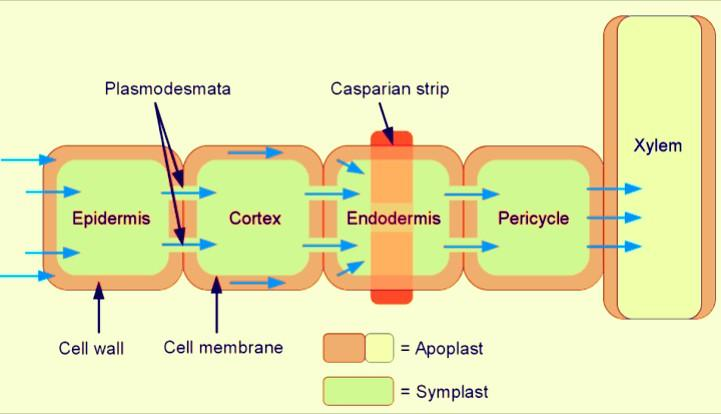
So, the correct answer is, “ Root hair absorbs water from the soil through osmosis.”
Note: Even though a maximum of the water absorption occurs by passive method, a small percentage of 2-4% of water absorption takes place by active method (osmotic active and non-osmotic active absorption)So, the correct answer is, "Herbivorous animals can digest cellulose because of bacteria present in their caecum help in the digestion of cellulose."
Complete answer:
Root hairs are present in the zone of maturation of roots. They absorb water from the soil by the simple process of osmosis. It is a passive mechanism and no energy expenditure is required.
The mechanism of passive absorption of water is as follows:
- This process is seen in rapidly transpiring plants.
- Due to transpiration which is the loss of water vapor from the leaf surface, a pull is generated that acts along the length of xylem bundles. This pull acts as a force of water absorption and is known as transpirational pull.
- Due to this pull, the water present between soil particles (capillary water) is pulled through the root system of plants.
- It is a completely passive procedure and 96-98% of water reabsorption takes place by this procedure.
- Transpiration pull is also the fastest method of water absorption in plants.
Additional Information:
The water moves through the roots in the following two pathways:
- Symplastic Pathway: The movement of water occurs through the protoplasm of the plant cell. The cytoplasm and plasmodesmata connection are associated with symplastic transport.
- Apoplastic pathway: Transport of water occurs through the cell walls and intercellular spaces of the plant cell. It does not involve any living component like cytoplasm.
So, the correct answer is, “ Root hair absorbs water from the soil through osmosis.”
Note: Even though a maximum of the water absorption occurs by passive method, a small percentage of 2-4% of water absorption takes place by active method (osmotic active and non-osmotic active absorption)So, the correct answer is, "Herbivorous animals can digest cellulose because of bacteria present in their caecum help in the digestion of cellulose."
Recently Updated Pages
Master Class 11 English: Engaging Questions & Answers for Success

Master Class 11 Social Science: Engaging Questions & Answers for Success
Master Class 11 Maths: Engaging Questions & Answers for Success
Master Class 11 Biology: Engaging Questions & Answers for Success
Master Class 11 Physics: Engaging Questions & Answers for Success
Master Class 11 Chemistry: Engaging Questions & Answers for Success
Trending doubts
What are hard magnetic materials class 11 physics CBSE
Draw a diagram of nephron and explain its structur class 11 biology CBSE
1 Quintal is equal to a 110 kg b 10 kg c 100kg d 1000 class 11 physics CBSE
Name the Largest and the Smallest Cell in the Human Body ?
Draw a diagram showing the external features of fish class 11 biology CBSE
What organs are located on the left side of your body class 11 biology CBSE