




What is the role of agrobacterium for gene transfer in plants?
Answer
 Verified
603.3k+ views
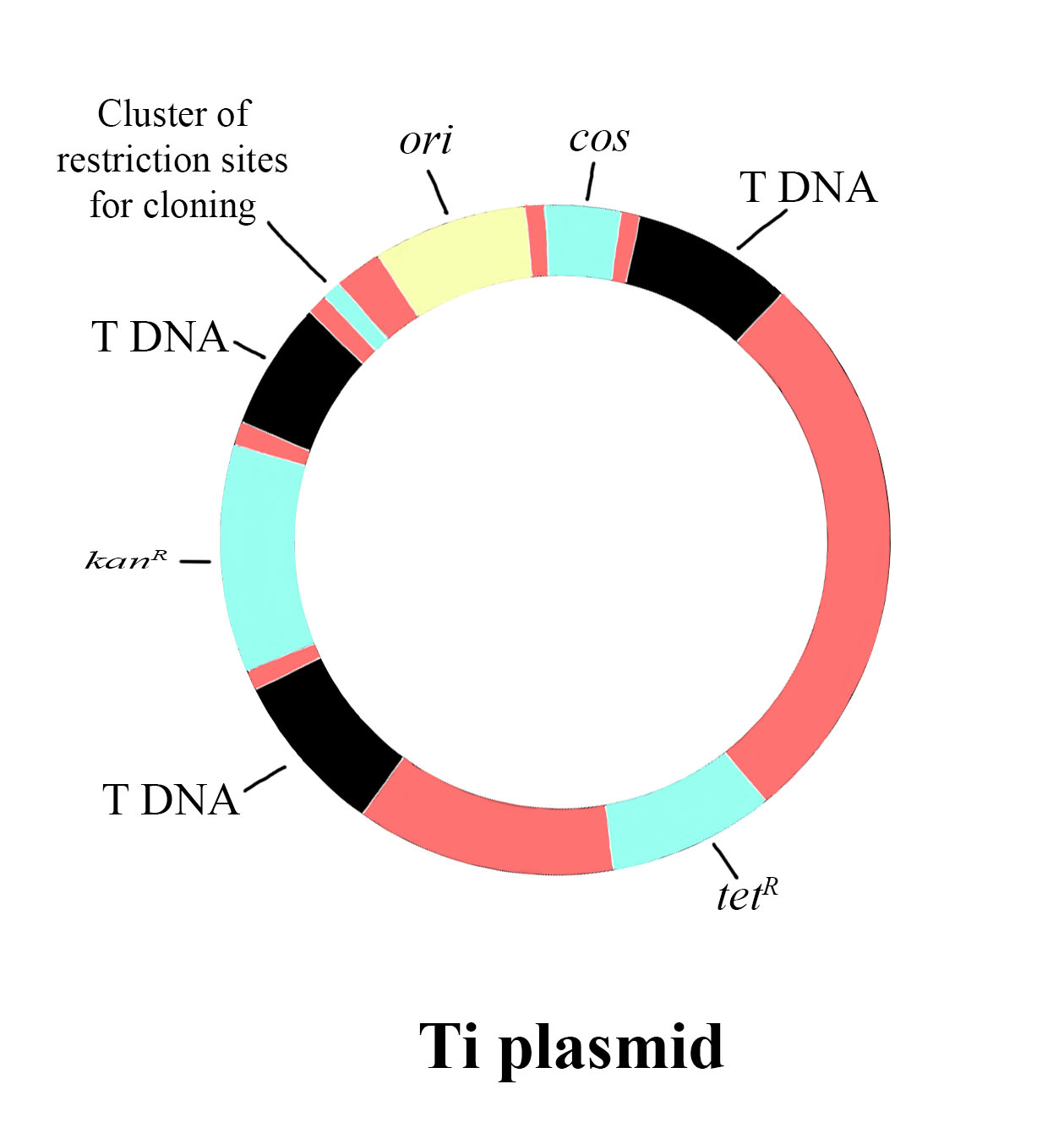
Hint: Agrobacterium tumefaciens is a common natural soil bacterium that causes crown gall and has the ability to introduce new genetic material into plant cells. The added genetic material is called T DNA (transferred DNA), which is housed on a Ti plasmid.
Complete answer:
The cornerstone of plant transformation using Agrobacterium was this inherent ability to modify the genetic composition of the plant. Agrobacterium-mediated transformation is currently the most widely used technique for plant genetic engineering due to its relatively high performance.
Several components of the Ti plasmid enable the successful transfer of the genes of interest into the plant cells during transformation. They include:
-Border sequences of T-DNA that demarcate the portion of DNA (T-DNA) to be transferred to the plant genome
-Virulence genes (virulence genes) that are necessary to transfer the T-DNA region to the plant but are not transferred on their own, and
- A altered region of T-DNA where the genes that induce the formation of crown galls are removed and replaced with the genes of interest.
Additional Information: The process of transformation mediated by Agrobacterium involves a number of steps:
-Isolation from the source organism of the genes of interest;
-Creation of a functional transgenic construct including the gene of interest;
-Promoters of expression; alteration of codons if required to increase the efficient production of the protein; and marker genes to allow monitoring of the inserted genes in the host plant
- Introduction of T-DNA-containing plasmid into Agrobacterium;
-Mixture of transformed Agrobacterium with plant cells to allow T-DNA to be transferred to plant chromosomes;
-Regeneration of transformed cells into genetically modified (GM) plants; and
-Laboratory, greenhouse, and field-level testing of trait output or transgene expression
Note: - A Ti plasmid is present in almost all bacteria as a circular piece of DNA.
- It was initially thought that this agrobacterium only infects dicotyledonous plants, but it was later identified that it could also be used for the conversion of monocotyledonous plants, such as rice.
- The overall benefits of using Agrobacterium-mediated transformation over other methods of transformation are: a decrease in the number of transgene copies and intact and stable transgene (newly inserted gene) incorporation into the plant genome.
Complete answer:
The cornerstone of plant transformation using Agrobacterium was this inherent ability to modify the genetic composition of the plant. Agrobacterium-mediated transformation is currently the most widely used technique for plant genetic engineering due to its relatively high performance.
Several components of the Ti plasmid enable the successful transfer of the genes of interest into the plant cells during transformation. They include:
-Border sequences of T-DNA that demarcate the portion of DNA (T-DNA) to be transferred to the plant genome
-Virulence genes (virulence genes) that are necessary to transfer the T-DNA region to the plant but are not transferred on their own, and
- A altered region of T-DNA where the genes that induce the formation of crown galls are removed and replaced with the genes of interest.
Additional Information: The process of transformation mediated by Agrobacterium involves a number of steps:
-Isolation from the source organism of the genes of interest;
-Creation of a functional transgenic construct including the gene of interest;
-Promoters of expression; alteration of codons if required to increase the efficient production of the protein; and marker genes to allow monitoring of the inserted genes in the host plant
- Introduction of T-DNA-containing plasmid into Agrobacterium;
-Mixture of transformed Agrobacterium with plant cells to allow T-DNA to be transferred to plant chromosomes;
-Regeneration of transformed cells into genetically modified (GM) plants; and
-Laboratory, greenhouse, and field-level testing of trait output or transgene expression
Note: - A Ti plasmid is present in almost all bacteria as a circular piece of DNA.
- It was initially thought that this agrobacterium only infects dicotyledonous plants, but it was later identified that it could also be used for the conversion of monocotyledonous plants, such as rice.
- The overall benefits of using Agrobacterium-mediated transformation over other methods of transformation are: a decrease in the number of transgene copies and intact and stable transgene (newly inserted gene) incorporation into the plant genome.
Recently Updated Pages
Master Class 11 English: Engaging Questions & Answers for Success

Master Class 11 Maths: Engaging Questions & Answers for Success
Class 11 Question and Answer - Your Ultimate Solutions Guide
Master Class 11 Biology: Engaging Questions & Answers for Success
Master Class 11 Physics: Engaging Questions & Answers for Success
Master Class 11 Accountancy: Engaging Questions & Answers for Success
Trending doubts
Differentiate between an exothermic and an endothermic class 11 chemistry CBSE
One Metric ton is equal to kg A 10000 B 1000 C 100 class 11 physics CBSE
In what year Guru Nanak Dev ji was born A15 April 1469 class 11 social science CBSE
Difference Between Prokaryotic Cells and Eukaryotic Cells
There are 720 permutations of the digits 1 2 3 4 5 class 11 maths CBSE
Draw a diagram of a plant cell and label at least eight class 11 biology CBSE