




What is RIA? Explain its procedures and uses.
Answer
 Verified
561.9k+ views
Hint: RIA- stands for radioimmunoassay (RIA). It is an immunoassay which uses radio-leveled isotopes or molecules in the immune complexes. It helps in measuring antigen concentrations in our body. Techniques like RIA, ELISA all are often daggered with radio-leveled molecules for smooth detection of defects. The usage of different types of radio-active elements have been observed since quite a time in the field of genetics and experimentation.
Complete answer:
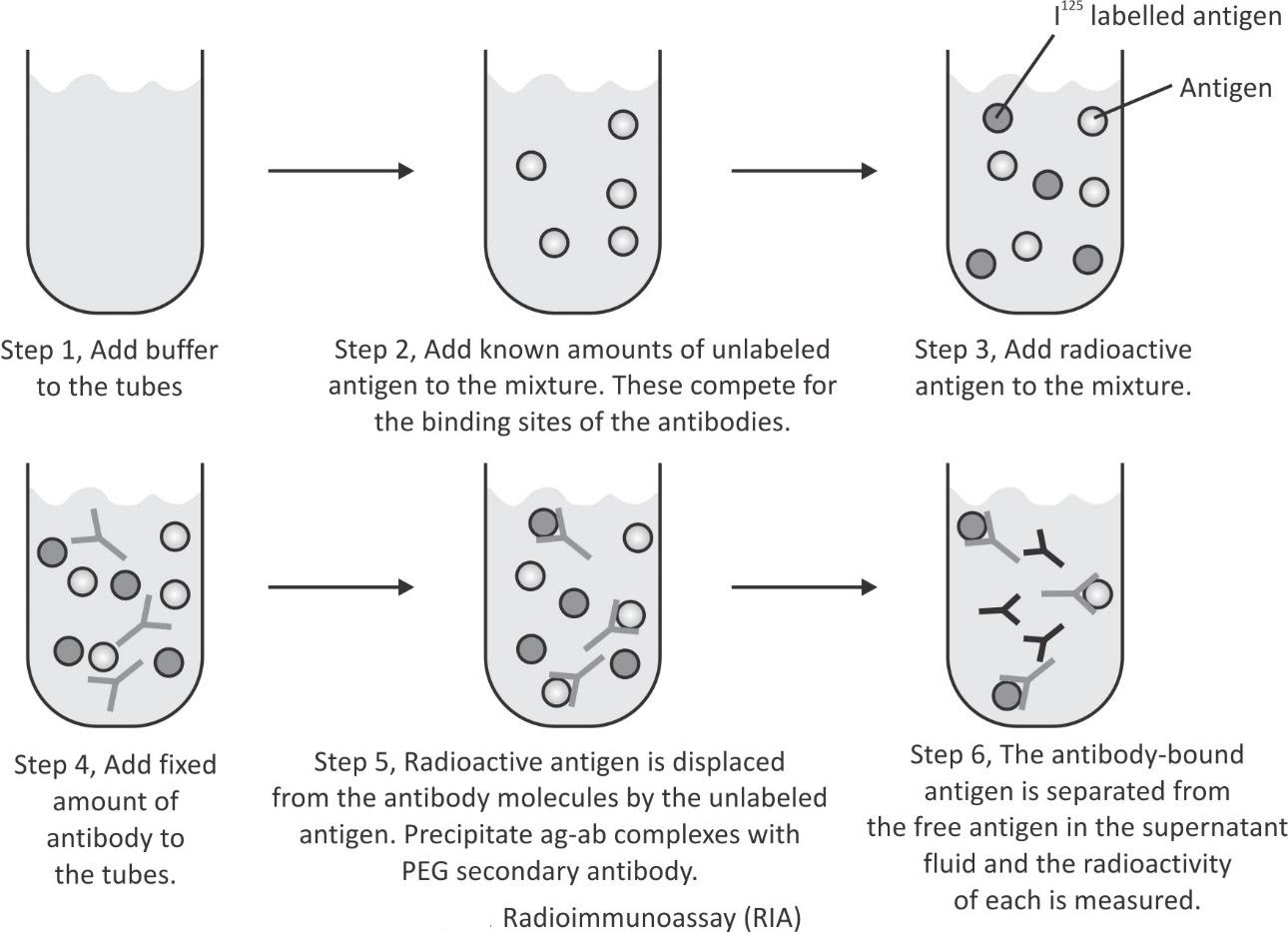
Radioimmunoassay is used to measure hormone levels in blood, use for the antibodies formation and identifying genetic defects. Radioimmunoassay is a very in-vitro technique. The principle of radioimmunoassay is to perform competitive binding, where a radio-active element competes or reacts on a non-radioactive antigen.
In modern times radioimmunoassays are not used frequently but they are useful in measuring nanograms, picograms of antibiotics, hormones and drugs. Radioimmunoassays are also being used in forensics and narcotics.
Advantages of radioimmunoassay is they measure antigen to picogram quantities. It is used in detection of specific antibody-antigen reactions. The most common procedure or the common isotope being used in radioimmunoassay is iodine-\[25\].
Iodine-\[25\] possesses several advantages such as they have high binding affinity, they show hundred percent specific activity with full abundance.
Note:
As we discussed the important functions of RIA, ELISA is another technique used for detecting and measuring defects and in antibody detection. (ELISA stands for enzyme-linked immunosorbent assay). It is a plate-based assay technique. The difference between RIA and ELISA is that RIA is used to detect solid particles and ELISA for soluble substances such as proteins, peptides. EIA is the same as ELISA. ELISA is used also for detecting HIV infection.
Complete answer:
Radioimmunoassay is used to measure hormone levels in blood, use for the antibodies formation and identifying genetic defects. Radioimmunoassay is a very in-vitro technique. The principle of radioimmunoassay is to perform competitive binding, where a radio-active element competes or reacts on a non-radioactive antigen.
In modern times radioimmunoassays are not used frequently but they are useful in measuring nanograms, picograms of antibiotics, hormones and drugs. Radioimmunoassays are also being used in forensics and narcotics.
Advantages of radioimmunoassay is they measure antigen to picogram quantities. It is used in detection of specific antibody-antigen reactions. The most common procedure or the common isotope being used in radioimmunoassay is iodine-\[25\].
Iodine-\[25\] possesses several advantages such as they have high binding affinity, they show hundred percent specific activity with full abundance.
Note:
As we discussed the important functions of RIA, ELISA is another technique used for detecting and measuring defects and in antibody detection. (ELISA stands for enzyme-linked immunosorbent assay). It is a plate-based assay technique. The difference between RIA and ELISA is that RIA is used to detect solid particles and ELISA for soluble substances such as proteins, peptides. EIA is the same as ELISA. ELISA is used also for detecting HIV infection.
Recently Updated Pages
Basicity of sulphurous acid and sulphuric acid are

Master Class 12 Economics: Engaging Questions & Answers for Success
Master Class 12 Biology: Engaging Questions & Answers for Success
Master Class 11 English: Engaging Questions & Answers for Success
Master Class 11 Physics: Engaging Questions & Answers for Success
Master Class 11 Computer Science: Engaging Questions & Answers for Success
Trending doubts
Draw a labelled sketch of the human eye class 12 physics CBSE
The chemical formula of tear gas is A CO Cl 2 B C 10 class 12 chemistry CBSE
Draw ray diagrams each showing i myopic eye and ii class 12 physics CBSE
Which are the Top 10 Largest Countries of the World?
Differentiate between homogeneous and heterogeneous class 12 chemistry CBSE
Which is the correct genotypic ratio of mendel dihybrid class 12 biology CBSE