




How many resonance structures are there for ${\text{N}}{{\text{O}}_{\text{2}}}$?
Answer
 Verified
625.5k+ views
Hint: For calculating the resonance structure of any species, first of all we should know about the number of electrons present in the valence shell and formal charge of each atom present in the species.
Complete Solution :
- Resonance structures are the type of hybrid structures of a single molecule, where different arrangements of electrons can be seen on the atoms present in that molecule.
Resonance structures of Nitrogen dioxide (${\text{N}}{{\text{O}}_{\text{2}}}$) will be predicted as follow:
-First we calculate the number of valence electrons in nitrogen and oxygen atoms. As we know that atomic number of nitrogen is 7 & its electronic configuration is $1{s^2},2{s^2}2{p^3}$, so from this it is clear that 5 valence electrons are present in the nitrogen atom. Similarly we know that atomic number of oxygen is 8 & its electronic configuration is $1{s^2},2{s^2}2{p^4}$, so from this it is clear that 6 valence electrons are present in the oxygen atom.
-Now we form Lewis dot structure for nitrogen dioxide molecule and that is shown as follow:
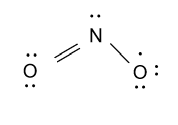
-Now we calculate the formal charge on nitrogen and oxygen atoms and formula to calculate formal charge is as follow:
Formal charge = no. of valence electrons – no. of covalent bond – no. of electrons present in lone pairs
Formal charge of nitrogen atom = $5 - 3 - 2 = 0$
i.e. no charge is present on nitrogen atoms.
Formal charge of single bonded oxygen atom = $6 - 1 - 4 = 1$
i.e. one negative charge is present on a single bonded oxygen atom.
Formal charge of double bonded oxygen atom = $6 - 2 - 4 = 0$
i.e. no charge is present on a double bonded oxygen atom.
-So, resonance structures of ${\text{N}}{{\text{O}}_{\text{2}}}$ is shown as follow:

Hence, there are two resonance structures for ${\text{N}}{{\text{O}}_{\text{2}}}$.
Note: Here some of you may think that why we show six valence electrons in place of five for a single bonded oxygen atom, so the reason is that the negative charge of that atom represents one extra electron from the original number of electrons.
Complete Solution :
- Resonance structures are the type of hybrid structures of a single molecule, where different arrangements of electrons can be seen on the atoms present in that molecule.
Resonance structures of Nitrogen dioxide (${\text{N}}{{\text{O}}_{\text{2}}}$) will be predicted as follow:
-First we calculate the number of valence electrons in nitrogen and oxygen atoms. As we know that atomic number of nitrogen is 7 & its electronic configuration is $1{s^2},2{s^2}2{p^3}$, so from this it is clear that 5 valence electrons are present in the nitrogen atom. Similarly we know that atomic number of oxygen is 8 & its electronic configuration is $1{s^2},2{s^2}2{p^4}$, so from this it is clear that 6 valence electrons are present in the oxygen atom.
-Now we form Lewis dot structure for nitrogen dioxide molecule and that is shown as follow:
-Now we calculate the formal charge on nitrogen and oxygen atoms and formula to calculate formal charge is as follow:
Formal charge = no. of valence electrons – no. of covalent bond – no. of electrons present in lone pairs
Formal charge of nitrogen atom = $5 - 3 - 2 = 0$
i.e. no charge is present on nitrogen atoms.
Formal charge of single bonded oxygen atom = $6 - 1 - 4 = 1$
i.e. one negative charge is present on a single bonded oxygen atom.
Formal charge of double bonded oxygen atom = $6 - 2 - 4 = 0$
i.e. no charge is present on a double bonded oxygen atom.
-So, resonance structures of ${\text{N}}{{\text{O}}_{\text{2}}}$ is shown as follow:
Hence, there are two resonance structures for ${\text{N}}{{\text{O}}_{\text{2}}}$.
Note: Here some of you may think that why we show six valence electrons in place of five for a single bonded oxygen atom, so the reason is that the negative charge of that atom represents one extra electron from the original number of electrons.
Recently Updated Pages
Explain the structure of megasporangium class 12 biology CBSE

Why is chloroform kept in dark coloured bottles class 12 chemistry CBSE
Derive the balancing condition of a Wheatstone bri class 12 physics CBSE
Draw VI characteristics of a pn junction diode Explain class 12 physics CBSE
Is it possible to carry pride in ones language too class 12 english CBSE
In a population at Hardy Weinberg equilibrium the allele class 12 biology CBSE
Trending doubts
Draw a labelled sketch of the human eye class 12 physics CBSE
Which are the Top 10 Largest Countries of the World?
Draw ray diagrams each showing i myopic eye and ii class 12 physics CBSE
Which is the correct genotypic ratio of mendel dihybrid class 12 biology CBSE
Differentiate between homogeneous and heterogeneous class 12 chemistry CBSE
Which animal never drinks water in its entire life class 12 biology CBSE