




Resolving power of a telescope increases with:
Answer
 Verified
573k+ views
Hint: In this question, we will first know what resolving power is. Then we will use the expression for resolving power of a telescope, this will directly give us the required result. Further, we will study the basics of mirror and its type, for our better understanding.
Formula used:
$R.P = \dfrac{a}{{1.22\lambda }}$
Complete answer:
As we know resolving power of a telescope can be termed as the reciprocal of the smallest angular separation between two distant objects whose images can be seen separately.
Now, resolving power of telescope is given by:
$R.P = \dfrac{a}{{1.22\lambda }}$
Here, a is the diameter of the objective lens of the telescope.
Above equation can also be written as:
$R.P \propto a$
So, we can conclude that the resolving power of the telescope can be increased by increasing the diameter of the objective lens of the telescope.
Therefore, we get the required answer.
Additional information:
As we know, a telescope can be defined as an optical instrument which uses lenses, some curved mirrors, or a combination of both lens and mirror. Telescope is used to observe distant objects, by its emission, absorption, or reflection of electromagnetic radiation or light.
As we know a mirror is defined as a device that contains a surface, which is mainly used to reflect light. As mirrors do not usually absorb much light, most of the light is redirected. The mirror and the object's overall quality is generally preserved in the new image.
In the given figure, the shaded portion is not used to reflect light.
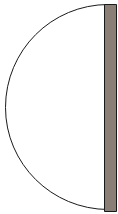
convex mirror.

concave mirror.
Now, as we know that a lens is defined as a transmissive optical device that is used to focus or disperse beams of light by the means of refraction. For example- a lens can focus light to form an image, unlike a prism, which refracts light without focusing.
Note:
We should remember that a mirror will have only one focal point, which is in front of the mirror. We should note that compound lenses are constructed from a combination of different simple lenses. The lens which is used to build a compound lens may have different refractive indices and other properties.
Formula used:
$R.P = \dfrac{a}{{1.22\lambda }}$
Complete answer:
As we know resolving power of a telescope can be termed as the reciprocal of the smallest angular separation between two distant objects whose images can be seen separately.
Now, resolving power of telescope is given by:
$R.P = \dfrac{a}{{1.22\lambda }}$
Here, a is the diameter of the objective lens of the telescope.
Above equation can also be written as:
$R.P \propto a$
So, we can conclude that the resolving power of the telescope can be increased by increasing the diameter of the objective lens of the telescope.
Therefore, we get the required answer.
Additional information:
As we know, a telescope can be defined as an optical instrument which uses lenses, some curved mirrors, or a combination of both lens and mirror. Telescope is used to observe distant objects, by its emission, absorption, or reflection of electromagnetic radiation or light.
As we know a mirror is defined as a device that contains a surface, which is mainly used to reflect light. As mirrors do not usually absorb much light, most of the light is redirected. The mirror and the object's overall quality is generally preserved in the new image.
In the given figure, the shaded portion is not used to reflect light.
convex mirror.
concave mirror.
Now, as we know that a lens is defined as a transmissive optical device that is used to focus or disperse beams of light by the means of refraction. For example- a lens can focus light to form an image, unlike a prism, which refracts light without focusing.
Note:
We should remember that a mirror will have only one focal point, which is in front of the mirror. We should note that compound lenses are constructed from a combination of different simple lenses. The lens which is used to build a compound lens may have different refractive indices and other properties.
Recently Updated Pages
In a plane electromagnetic wave the electric field class 12 physics CBSE

A plane electromagnetic wave travels in vacuum along class 12 physics CBSE
Basicity of sulphurous acid and sulphuric acid are
The magnetic field in a plane electromagnetic wave class 11 physics CBSE
Master Class 12 English: Engaging Questions & Answers for Success
Master Class 12 Social Science: Engaging Questions & Answers for Success
Trending doubts
Which are the Top 10 Largest Countries of the World?
Draw a labelled sketch of the human eye class 12 physics CBSE
Which state in the country is at the forefront in controlling class 12 social science CBSE
Mention the role of cyanobacteria as a biofertiliz class 12 biology ICSE
Where is the largest hydroelectric power station located class 12 biology CBSE
Which country did Danny Casey play for class 12 english CBSE