




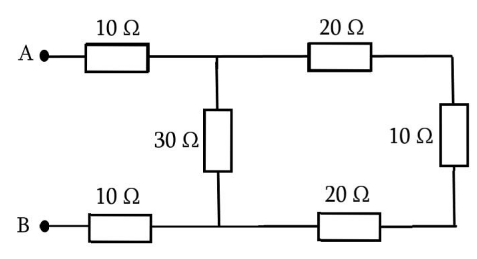
What is the resistance between $A$ and $B$ in the figure given below?
Answer
 Verified
515.1k+ views
Hint: Ohm's law states that the voltage through a conductor is directly proportional to the current flowing through it while all physical conditions and temperature remain unchanged. The equation of Ohm’s law is $V = IR$ . Here $V$ represents the voltage across the conductor, $I$ represents the current flowing inside the conductor and $R$ is the conductor's resistance to the flow of current.
Complete step by step answer:
The movement of current is opposed by resistance. A high resistance means that the current cannot pass through the conductor very easily. A low resistance indicates that the current can pass through the conductor easily. The resistance of a conductor or a circuit is calculated in Ohms.The calculation of the overall resistance of a number of resistors connected in a series can be given by the equation:
${R_{total}} = {R_1} + {R_2} + {R_3} + ...$
The calculation of the overall resistance of a number of resistors connected in the parallel manner can be given by the equation:
${R_{total}} = \dfrac{1}{{{R_1}}} + \dfrac{1}{{{R_2}}} + \dfrac{1}{{{R_3}}} + ...$
Using the two equations given above, the total resistance of a circuit can be calculated.
On the extreme right side, three resistance which are of $20$ $ohms$ , $10$ $ohms$ and $20$ $ohms$ are linked in series.
So, the total of theses resistances can be given by:
${R_{\text{total of series 1}}} = 20 + 20 + 10$ $ = 50$ $ohms$
Now, the above calculated $50$ $ohms$ is connected in a parallel connection with a $30$ $ohm$ resistor. So, the total of theses resistances can be given by:
${R_{parallel}} = \dfrac{1}{{{R_{\text{total of series 1}}}}} + \dfrac{1}{{30}}$
$ \Rightarrow {R_{parallel}} = \dfrac{1}{{50}} + \dfrac{1}{{30}}$ $ = 18.75$ $ohms$
Now it can be seen from the diagram that the resistances of $10$ $ohms$ , $18.75$ $ohms$ and $10$ $ohms$ are linked in series.
So, the total resistance is given by:
$\therefore {R_{total}} = 10 + 18.75 + 10$ $ = 38.75$ $ohms$
Thus, the total resistance between $A$ and $B$ is $38.75$ $ohms$.
Note: A resistor is an electrical device that decreases the amount of current flowing through it. Resistors are used in electrical circuits to minimise current flow, change signal speeds, separate voltages, bias active components, and terminate transmission lines, among other things.
Complete step by step answer:
The movement of current is opposed by resistance. A high resistance means that the current cannot pass through the conductor very easily. A low resistance indicates that the current can pass through the conductor easily. The resistance of a conductor or a circuit is calculated in Ohms.The calculation of the overall resistance of a number of resistors connected in a series can be given by the equation:
${R_{total}} = {R_1} + {R_2} + {R_3} + ...$
The calculation of the overall resistance of a number of resistors connected in the parallel manner can be given by the equation:
${R_{total}} = \dfrac{1}{{{R_1}}} + \dfrac{1}{{{R_2}}} + \dfrac{1}{{{R_3}}} + ...$
Using the two equations given above, the total resistance of a circuit can be calculated.
On the extreme right side, three resistance which are of $20$ $ohms$ , $10$ $ohms$ and $20$ $ohms$ are linked in series.
So, the total of theses resistances can be given by:
${R_{\text{total of series 1}}} = 20 + 20 + 10$ $ = 50$ $ohms$
Now, the above calculated $50$ $ohms$ is connected in a parallel connection with a $30$ $ohm$ resistor. So, the total of theses resistances can be given by:
${R_{parallel}} = \dfrac{1}{{{R_{\text{total of series 1}}}}} + \dfrac{1}{{30}}$
$ \Rightarrow {R_{parallel}} = \dfrac{1}{{50}} + \dfrac{1}{{30}}$ $ = 18.75$ $ohms$
Now it can be seen from the diagram that the resistances of $10$ $ohms$ , $18.75$ $ohms$ and $10$ $ohms$ are linked in series.
So, the total resistance is given by:
$\therefore {R_{total}} = 10 + 18.75 + 10$ $ = 38.75$ $ohms$
Thus, the total resistance between $A$ and $B$ is $38.75$ $ohms$.
Note: A resistor is an electrical device that decreases the amount of current flowing through it. Resistors are used in electrical circuits to minimise current flow, change signal speeds, separate voltages, bias active components, and terminate transmission lines, among other things.
Recently Updated Pages
Complete reduction of benzene diazonium chloride with class 12 chemistry CBSE

How can you identify optical isomers class 12 chemistry CBSE
The coating formed on the metals such as iron silver class 12 chemistry CBSE
Metals are refined by using different methods Which class 12 chemistry CBSE
What do you understand by denaturation of proteins class 12 chemistry CBSE
Assertion Nitrobenzene is used as a solvent in FriedelCrafts class 12 chemistry CBSE
Trending doubts
Which are the Top 10 Largest Countries of the World?
What are the major means of transport Explain each class 12 social science CBSE
Draw a labelled sketch of the human eye class 12 physics CBSE
Differentiate between insitu conservation and exsitu class 12 biology CBSE
Draw a neat and well labeled diagram of TS of ovary class 12 biology CBSE
RNA and DNA are chiral molecules their chirality is class 12 chemistry CBSE