



Residual air mostly occurs in
A) Alveoli
B) Bronchus
C) Nostrils
D) Trachea
Answer
 Verified
540.3k+ views
Hint: Lungs is the organ for respiration. The amount of air that remains in the lungs following a maximal expiration. In some unhealthy conditions like an asthma attack and diffuse obstructive emphysema, the residual volume is higher than the normal one as most air remains obstructed in the lungs.
Complete answer:
The respiratory system comprises tissues and organs through which we breathe. The air we inhale is taken through the nostrils (nose which contains fine hairs and lines with mucous). After the nostrils, it moves through the trachea (cartilaginous rings like tube which is lined with mucous) and reaches the lungs.
The lungs are the main organ for respiration. The air enters the lungs through the bronchus. The Alveoli are the small air sacs like structure which are the main units where exchange of gases takes place. They are the functional unit of the lungs. Once the oxygen is diffused, the carbon dioxide is exhaled from the lungs back to the atmosphere through nostrils.
The structure of the respiratory system is as follows-
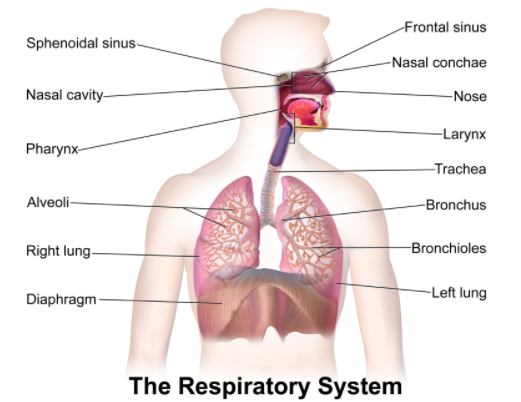
After expiration, some amount of air is left in the alveoli. This is called the residual volume. The residual volume is the amount of air that is left in the alveoli of the lungs after expiratory reserve volume is exhaled. The lungs are not ever completely empty, there is always some air in the lungs after a maximal exhalation. If residual volume didn’t exist and lungs emptied completely then tissues of lungs would stick together.
Thus the correct answer is option A i.e Alveoli.
Note: The residual air is important for following
1) Providing sufficient time for oxygen to be absorbed and for the carbon dioxide to be released.
2) It also helps from collapsing of lung passage
The portion of air contained in the lungs which can not be expelled by the most violent expiratory effort amounts to from 75 to 100 cubic inches. Forced expiratory volume is also decreased during obstructive lung diseases.
Complete answer:
The respiratory system comprises tissues and organs through which we breathe. The air we inhale is taken through the nostrils (nose which contains fine hairs and lines with mucous). After the nostrils, it moves through the trachea (cartilaginous rings like tube which is lined with mucous) and reaches the lungs.
The lungs are the main organ for respiration. The air enters the lungs through the bronchus. The Alveoli are the small air sacs like structure which are the main units where exchange of gases takes place. They are the functional unit of the lungs. Once the oxygen is diffused, the carbon dioxide is exhaled from the lungs back to the atmosphere through nostrils.
The structure of the respiratory system is as follows-
After expiration, some amount of air is left in the alveoli. This is called the residual volume. The residual volume is the amount of air that is left in the alveoli of the lungs after expiratory reserve volume is exhaled. The lungs are not ever completely empty, there is always some air in the lungs after a maximal exhalation. If residual volume didn’t exist and lungs emptied completely then tissues of lungs would stick together.
Thus the correct answer is option A i.e Alveoli.
Note: The residual air is important for following
1) Providing sufficient time for oxygen to be absorbed and for the carbon dioxide to be released.
2) It also helps from collapsing of lung passage
The portion of air contained in the lungs which can not be expelled by the most violent expiratory effort amounts to from 75 to 100 cubic inches. Forced expiratory volume is also decreased during obstructive lung diseases.
Recently Updated Pages
Master Class 12 Business Studies: Engaging Questions & Answers for Success

Master Class 12 Biology: Engaging Questions & Answers for Success
Master Class 12 Chemistry: Engaging Questions & Answers for Success
Class 12 Question and Answer - Your Ultimate Solutions Guide
Master Class 11 Social Science: Engaging Questions & Answers for Success
Master Class 11 English: Engaging Questions & Answers for Success
Trending doubts
What is the Full Form of ICSE / ISC ?
Fill the blanks with the suitable prepositions 1 The class 9 english CBSE
Difference Between Plant Cell and Animal Cell
How many hours before the closure of election must class 9 social science CBSE
What is pollution? How many types of pollution? Define it
Name 10 Living and Non living things class 9 biology CBSE