




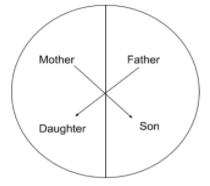
Represented below is the inheritance pattern of a certain type of traits in humans. Which one of the following conditions could be an example of this pattern?
A. Sickle cell anemia
B. Hemophilia
C. Thalassemia
D. Phenylketonuria
Answer
 Verified
605.7k+ views
Hint: There are 23 pairs of chromosomes in every single human cell, for a total of 46 chromosomes. A phenotype is any feature determined by a gene and is often determined by more than one gene. Mutated genes that are inherited or that are the result of a new gene mutation are caused by certain characteristics.
Complete answer:
The pattern suggests that the feature is inherited from mother to son and from dad to daughter. As we know, there are XY sex chromosomes for human males and XX sex chromosomes for human females. The mother's X chromosome is always inherited by a son and the father's Y chromosome, while the father always transfers his X chromosome to his daughters. An X-linked trait is often transmitted from mother to son and from father to daughter; hence, the trend demonstrates X-linked trait inheritance. If it were an autosomal trait, regardless of the child's sex, both parents would have passed it on with equal likelihood to all the offspring.
Phenylketonuria- It is an inborn metabolic error and is caused by a mutation found on chromosome 12 in the PAH gene. In an autosomal recessive form, it is inherited and therefore does not follow the pattern shown.
Sickle cell anaemia- is caused by a point mutation in the haemoglobin beta-globin (Hbb) chain gene found on chromosome 11. It is also inherited in a recessive autosomal manner and therefore does not follow the pattern shown.
Thalassemia- is a group of blood disorders caused by mutations found on chromosome 11 and chromosome 16 in the HbB and HbA genes, respectively. They are thus inherited in a recessive autosomal way.
Haemophilia is a sex-linked condition since there is an X-chromosome that is a human sex chromosome found in the controlling genes. The phenotype is transmitted in a sex-linked manner to offspring.
Hence, the correct answer is option (B).
Note: Hemophilia is a genetic disorder that is hereditary. This disorder is not curable, however to alleviate symptoms and avoid potential health problems, it can be treated. In extremely rare cases, after birth, haemophilia may develop. This is called haemophilia acquired.
Complete answer:
The pattern suggests that the feature is inherited from mother to son and from dad to daughter. As we know, there are XY sex chromosomes for human males and XX sex chromosomes for human females. The mother's X chromosome is always inherited by a son and the father's Y chromosome, while the father always transfers his X chromosome to his daughters. An X-linked trait is often transmitted from mother to son and from father to daughter; hence, the trend demonstrates X-linked trait inheritance. If it were an autosomal trait, regardless of the child's sex, both parents would have passed it on with equal likelihood to all the offspring.
Phenylketonuria- It is an inborn metabolic error and is caused by a mutation found on chromosome 12 in the PAH gene. In an autosomal recessive form, it is inherited and therefore does not follow the pattern shown.
Sickle cell anaemia- is caused by a point mutation in the haemoglobin beta-globin (Hbb) chain gene found on chromosome 11. It is also inherited in a recessive autosomal manner and therefore does not follow the pattern shown.
Thalassemia- is a group of blood disorders caused by mutations found on chromosome 11 and chromosome 16 in the HbB and HbA genes, respectively. They are thus inherited in a recessive autosomal way.
Haemophilia is a sex-linked condition since there is an X-chromosome that is a human sex chromosome found in the controlling genes. The phenotype is transmitted in a sex-linked manner to offspring.
Hence, the correct answer is option (B).
Note: Hemophilia is a genetic disorder that is hereditary. This disorder is not curable, however to alleviate symptoms and avoid potential health problems, it can be treated. In extremely rare cases, after birth, haemophilia may develop. This is called haemophilia acquired.
Recently Updated Pages
Master Class 12 Business Studies: Engaging Questions & Answers for Success

Master Class 12 Chemistry: Engaging Questions & Answers for Success
Master Class 12 Biology: Engaging Questions & Answers for Success
Class 12 Question and Answer - Your Ultimate Solutions Guide
Master Class 11 English: Engaging Questions & Answers for Success
Master Class 11 Social Science: Engaging Questions & Answers for Success
Trending doubts
Which are the Top 10 Largest Countries of the World?
Draw a labelled sketch of the human eye class 12 physics CBSE
The end of compass needle which points towards north class 12 physics CBSE
Differentiate between homogeneous and heterogeneous class 12 chemistry CBSE
In order to find out the different types of gametes class 12 biology NEET_UG
Why is the cell called the structural and functional class 12 biology CBSE