




Represent the complex number $z=1+i$ in polar form.
Answer
 Verified
600.6k+ views
Hint: To convert a complex number into its polar form, we need to calculate the magnitude and the argument of the complex number. Magnitude is calculated by using the formula $r=\sqrt{{{x}^{2}}+{{y}^{2}}}$. We know that the argument is the angle with the positive X-axis, and can be calculated using the formula $\theta ={{\tan }^{-1}}\left( \dfrac{y}{x} \right)$ .
Complete step by step solution:
We know that a complex number is mostly represented in one of the two forms, the standard form and the polar form. Any complex number in standard form is represented as $z=x+iy$ , where x and y are real numbers and $i=\sqrt{-1}$ . We also understand any complex number in the form $z=r\cos \theta +ir\sin \theta $ is said to be in polar form, and the polar coordinates are $\left( r,\theta \right)$ .
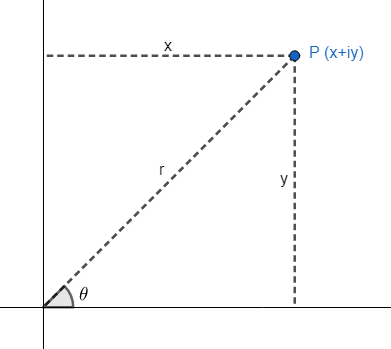
Let us assume a complex point P which represents $z=x+iy$ in the Cartesian plane. To convert this complex number into the polar form, we can see from the following figure, that r is the magnitude of this point P.
We know that the magnitude of the complex number z will be $\sqrt{{{x}^{2}}+{{y}^{2}}}$ .
Thus, we have, $r=\sqrt{{{x}^{2}}+{{y}^{2}}}$ .
We can also see in the figure that $\theta $ is the angle between the magnitude and the X-axis.
Thus, $\tan \theta =\dfrac{y}{x}$ .
Or, $\theta ={{\tan }^{-1}}\left( \dfrac{y}{x} \right)$ .
In our problem, we have $z=1+i$ .
So, we have $x=1\text{ and }y=1$ .
Using these values to calculate the magnitude, we get
$r=\sqrt{{{1}^{2}}+{{1}^{2}}}$
$\Rightarrow r=\sqrt{2}...\left( i \right)$
We can also use the values of x and y to calculate the argument of this complex number.
$\theta ={{\tan }^{-1}}\left( \dfrac{1}{1} \right)$
$\Rightarrow \theta ={{\tan }^{-1}}\left( 1 \right)$
$\Rightarrow \theta ={{45}^{\circ }}...\left( ii \right)$
Now, we can use the values from equation (i) and equation (ii) to convert this complex number into polar form.
$z=r\cos \theta +ir\sin \theta $
$\Rightarrow z=\sqrt{2}\cos \left( {{45}^{\circ }} \right)+i\sqrt{2}\sin \left( {{45}^{\circ }} \right)$
Thus, the polar form of the complex number $z=1+i\text{ is }z=\sqrt{2}\left[ \cos \left( {{45}^{\circ }} \right)+i\sin \left( {{45}^{\circ }} \right) \right]$ .
Note: We must not confuse between the Polar form and the Euler’s form of representation for a complex number. We must also take care that the argument is always calculated with respect to the positive X-axis, and that it is positive for anti-clockwise, and negative for clockwise rotation.
Complete step by step solution:
We know that a complex number is mostly represented in one of the two forms, the standard form and the polar form. Any complex number in standard form is represented as $z=x+iy$ , where x and y are real numbers and $i=\sqrt{-1}$ . We also understand any complex number in the form $z=r\cos \theta +ir\sin \theta $ is said to be in polar form, and the polar coordinates are $\left( r,\theta \right)$ .
Let us assume a complex point P which represents $z=x+iy$ in the Cartesian plane. To convert this complex number into the polar form, we can see from the following figure, that r is the magnitude of this point P.
We know that the magnitude of the complex number z will be $\sqrt{{{x}^{2}}+{{y}^{2}}}$ .
Thus, we have, $r=\sqrt{{{x}^{2}}+{{y}^{2}}}$ .
We can also see in the figure that $\theta $ is the angle between the magnitude and the X-axis.
Thus, $\tan \theta =\dfrac{y}{x}$ .
Or, $\theta ={{\tan }^{-1}}\left( \dfrac{y}{x} \right)$ .
In our problem, we have $z=1+i$ .
So, we have $x=1\text{ and }y=1$ .
Using these values to calculate the magnitude, we get
$r=\sqrt{{{1}^{2}}+{{1}^{2}}}$
$\Rightarrow r=\sqrt{2}...\left( i \right)$
We can also use the values of x and y to calculate the argument of this complex number.
$\theta ={{\tan }^{-1}}\left( \dfrac{1}{1} \right)$
$\Rightarrow \theta ={{\tan }^{-1}}\left( 1 \right)$
$\Rightarrow \theta ={{45}^{\circ }}...\left( ii \right)$
Now, we can use the values from equation (i) and equation (ii) to convert this complex number into polar form.
$z=r\cos \theta +ir\sin \theta $
$\Rightarrow z=\sqrt{2}\cos \left( {{45}^{\circ }} \right)+i\sqrt{2}\sin \left( {{45}^{\circ }} \right)$
Thus, the polar form of the complex number $z=1+i\text{ is }z=\sqrt{2}\left[ \cos \left( {{45}^{\circ }} \right)+i\sin \left( {{45}^{\circ }} \right) \right]$ .
Note: We must not confuse between the Polar form and the Euler’s form of representation for a complex number. We must also take care that the argument is always calculated with respect to the positive X-axis, and that it is positive for anti-clockwise, and negative for clockwise rotation.
Recently Updated Pages
Which of the following graphs shows the variation of class 12 physics CBSE

Draw a labelled diagram of the human male reproductive class 12 biology CBSE
Describe the experiment to compare the emf of two cells class 12 physics CBSE
What is standard hydrogen electrode
What is conventional current and electric current class 12 physics CBSE
2Bromopentane is treated with an alcoholic KOH solution class 12 chemistry CBSE
Trending doubts
Draw a labelled sketch of the human eye class 12 physics CBSE
Which are the Top 10 Largest Countries of the World?
Differentiate between homogeneous and heterogeneous class 12 chemistry CBSE
Draw ray diagrams each showing i myopic eye and ii class 12 physics CBSE
Which is the correct genotypic ratio of mendel dihybrid class 12 biology CBSE
What is the Full Form of PVC, PET, HDPE, LDPE, PP and PS ?