




What is the relationship between 1-butene and cis-2-butene.
A) Enantiomers
B) Diastereomers
C) Identical
D) Constitutional isomers
Answer
 Verified
556.5k+ views
Hint: The given two molecules have the same molecular formula, but have different structures. The properties are also different. An enantiomer is a stereoisomer that's a non-superimposable mirror image of each other, and a diastereomer is a stereoisomer with two or more stereocenters, and the isomers are not mirrored images of each other.
Complete answer:
Enantiomers and Diastereomers are both types of stereoisomers. The structure of the given compound can be shown as:
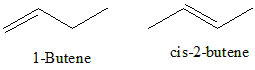
From the structure it can be seen that the two molecules have the same molecular formula of ${C_4}{H_8}$. But differ in the position of the double bond. In $1 - butene$ the double bond is between ${C_1}\& {C_2}$ and in $cis - 2 - butene$ the double bond is between ${C_2}\& {C_3}$. The compounds that have the same molecular formula but differ in their connectivity are known as ‘Constitutional Isomers’.
Hence the correct answer is Option D.
Option A is incorrect because enantiomers are compounds that are mirror images of each other and are nonsuperimposable. Hence option A is wrong.
Option B is also incorrect because diastereomers are those compounds that are neither mirror images nor non-superimposable. But have almost the same structures that differ in their spatial arrangements.
Option C is incorrect because they are not identical.
Note:
Isomers are the compounds that have the same molecular formula but different arrangements of atoms in space (special arrangements). This difference can be brought about by the difference in bonding arrangements, constraint of rotation about a bond or difference in the direction in which the plane polarised light is rotated. The more the number of carbon atoms, in a molecule, the more isomers. Due to the change in arrangement their physical and chemical properties may change.
Complete answer:
Enantiomers and Diastereomers are both types of stereoisomers. The structure of the given compound can be shown as:
From the structure it can be seen that the two molecules have the same molecular formula of ${C_4}{H_8}$. But differ in the position of the double bond. In $1 - butene$ the double bond is between ${C_1}\& {C_2}$ and in $cis - 2 - butene$ the double bond is between ${C_2}\& {C_3}$. The compounds that have the same molecular formula but differ in their connectivity are known as ‘Constitutional Isomers’.
Hence the correct answer is Option D.
Option A is incorrect because enantiomers are compounds that are mirror images of each other and are nonsuperimposable. Hence option A is wrong.
Option B is also incorrect because diastereomers are those compounds that are neither mirror images nor non-superimposable. But have almost the same structures that differ in their spatial arrangements.
Option C is incorrect because they are not identical.
Note:
Isomers are the compounds that have the same molecular formula but different arrangements of atoms in space (special arrangements). This difference can be brought about by the difference in bonding arrangements, constraint of rotation about a bond or difference in the direction in which the plane polarised light is rotated. The more the number of carbon atoms, in a molecule, the more isomers. Due to the change in arrangement their physical and chemical properties may change.
Recently Updated Pages
Master Class 12 Economics: Engaging Questions & Answers for Success

Master Class 12 Social Science: Engaging Questions & Answers for Success
Master Class 12 English: Engaging Questions & Answers for Success
Master Class 12 Maths: Engaging Questions & Answers for Success
Master Class 12 Physics: Engaging Questions & Answers for Success
Master Class 12 Biology: Engaging Questions & Answers for Success
Trending doubts
Draw a labelled sketch of the human eye class 12 physics CBSE
Which are the Top 10 Largest Countries of the World?
Draw ray diagrams each showing i myopic eye and ii class 12 physics CBSE
Which is the correct genotypic ratio of mendel dihybrid class 12 biology CBSE
Differentiate between homogeneous and heterogeneous class 12 chemistry CBSE
Which animal never drinks water in its entire life class 12 biology CBSE