



What is the relation between surface area of sphere and lateral surface area of a right circular cylinder that just encloses the sphere?
Answer
 Verified
580.5k+ views
Hint: First we will write the formulas for the surface area and lateral surface areas of the respective solids mentioned in the question. Then we will find the relation between the dimensions of the solids. We will take the help of ratio to find the relation.
Complete step by step solution:
Given are two solids one is a sphere and the other is a right circular cylinder.
We know that,
Surface area of the sphere is given by \[ = 4\pi {r^2}\]
And the lateral surface area of a right circular cylinder is given by \[ = 2\pi rh\]
Now the cylinder just encloses the sphere.
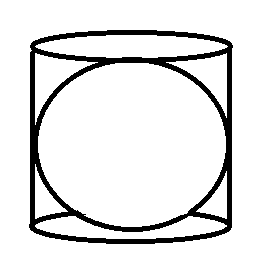
So we can see that the diameter of the sphere is equal to the height of the cylinder such that \[h = r + r\]
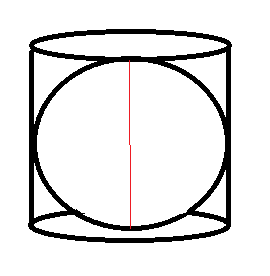
So we can write the ratio of the areas as,
\[\dfrac{{S.A{._{sphere}}}}{{L.A{._{cylinder}}}} = \dfrac{{4\pi {r^2}}}{{2\pi rh}}\]
Replace the value of h with the radius form,
\[ = \dfrac{{4\pi {r^2}}}{{2\pi r\left( {2r} \right)}}\]
On multiplying we get,
\[ = \dfrac{{4\pi {r^2}}}{{4\pi {r^2}}}\]
Thus we can say that the surface area of a sphere that is enclosed in the cylinder is equal to the lateral surface area of the cylinder.
Note:
Note that lateral surface area and total surface area are different concepts. Also a curved surface is one more concept. For a two dimensional figure we have area only whereas above two areas are for three dimensional shapes or solids we can say.
Complete step by step solution:
Given are two solids one is a sphere and the other is a right circular cylinder.
We know that,
Surface area of the sphere is given by \[ = 4\pi {r^2}\]
And the lateral surface area of a right circular cylinder is given by \[ = 2\pi rh\]
Now the cylinder just encloses the sphere.
So we can see that the diameter of the sphere is equal to the height of the cylinder such that \[h = r + r\]
So we can write the ratio of the areas as,
\[\dfrac{{S.A{._{sphere}}}}{{L.A{._{cylinder}}}} = \dfrac{{4\pi {r^2}}}{{2\pi rh}}\]
Replace the value of h with the radius form,
\[ = \dfrac{{4\pi {r^2}}}{{2\pi r\left( {2r} \right)}}\]
On multiplying we get,
\[ = \dfrac{{4\pi {r^2}}}{{4\pi {r^2}}}\]
Thus we can say that the surface area of a sphere that is enclosed in the cylinder is equal to the lateral surface area of the cylinder.
Note:
Note that lateral surface area and total surface area are different concepts. Also a curved surface is one more concept. For a two dimensional figure we have area only whereas above two areas are for three dimensional shapes or solids we can say.
Recently Updated Pages
Master Class 12 Economics: Engaging Questions & Answers for Success

Master Class 12 Social Science: Engaging Questions & Answers for Success
Master Class 12 English: Engaging Questions & Answers for Success
Master Class 12 Maths: Engaging Questions & Answers for Success
Master Class 12 Physics: Engaging Questions & Answers for Success
Master Class 12 Biology: Engaging Questions & Answers for Success
Trending doubts
The common name of Rheo leaf is A Oyster plant B Boat class 9 biology CBSE
Difference Between Plant Cell and Animal Cell
Fill the blanks with the suitable prepositions 1 The class 9 english CBSE
What is the full form of pH?
Any five important events between the years 1930 to class 9 social science CBSE
What is the Full Form of ICSE, CBSE and SSC