




What is the relation between angle of incidence and angle of refraction in the glass?
Answer
 Verified
614.1k+ views
Hint: We have a law which gives relation of incident ray or incident angle and refracted angle with refractive index. Refractive index gives a relation between two pairs of mediums. It is also known as Snell –Descartes law and law of refraction. Using this law we can deduce Brewster angle also.
Complete answer:
The relation between angle of incidence and the angle of refraction was discovered by Dutch physicist Willard Snell in 1621 and is known as Snell’s law of refraction. This law gives important conclusions about refraction which states that:
1. At the point of incidence, the incident ray and refracted ray are on opposite sides of the normal. These three are in the same phase.
2. For a given pair of medium 1 and medium 2, the ratio of the sine of the angle of incidence to the sine of the angle of refraction is constant.
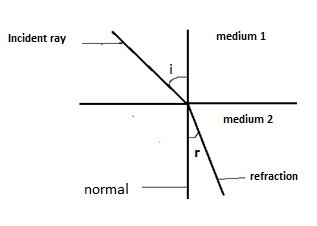
Mathematically, Snell’s law is given as,
$\dfrac{\sin i}{\sin r}=$ constant$=n$; for a given pair of medium $n$ is called a refractive index of the second medium with respect to the first medium. This is known as Snell’s law. The change in direction of a light – ray while entering in different media is a different value of refractive index vary with media.
Therefore Snell’s law gives a relation between angle of incidence $i$ and $r$ in glass.
Note:
Bending of refracted rays depends on density of medium. Refracted ray bends towards the normal, when a light ray that is incident ray passes from a rarer medium to denser medium. If refracted ray bends away from the normal then incident ray must have passed from a denser medium to a rarer medium.
Now if $i=0$ i.e. incident ray incident normally.
Then $\sin r=0$. This implies that refracted rays will also go straight with no deviation.
Complete answer:
The relation between angle of incidence and the angle of refraction was discovered by Dutch physicist Willard Snell in 1621 and is known as Snell’s law of refraction. This law gives important conclusions about refraction which states that:
1. At the point of incidence, the incident ray and refracted ray are on opposite sides of the normal. These three are in the same phase.
2. For a given pair of medium 1 and medium 2, the ratio of the sine of the angle of incidence to the sine of the angle of refraction is constant.
Mathematically, Snell’s law is given as,
$\dfrac{\sin i}{\sin r}=$ constant$=n$; for a given pair of medium $n$ is called a refractive index of the second medium with respect to the first medium. This is known as Snell’s law. The change in direction of a light – ray while entering in different media is a different value of refractive index vary with media.
Therefore Snell’s law gives a relation between angle of incidence $i$ and $r$ in glass.
Note:
Bending of refracted rays depends on density of medium. Refracted ray bends towards the normal, when a light ray that is incident ray passes from a rarer medium to denser medium. If refracted ray bends away from the normal then incident ray must have passed from a denser medium to a rarer medium.
Now if $i=0$ i.e. incident ray incident normally.
Then $\sin r=0$. This implies that refracted rays will also go straight with no deviation.
Recently Updated Pages
Master Class 12 Economics: Engaging Questions & Answers for Success

Master Class 12 English: Engaging Questions & Answers for Success
Master Class 12 Social Science: Engaging Questions & Answers for Success
Master Class 12 Maths: Engaging Questions & Answers for Success
Master Class 12 Physics: Engaging Questions & Answers for Success
Master Class 9 General Knowledge: Engaging Questions & Answers for Success
Trending doubts
Which are the Top 10 Largest Countries of the World?
Draw a labelled sketch of the human eye class 12 physics CBSE
Differentiate between homogeneous and heterogeneous class 12 chemistry CBSE
Why is the cell called the structural and functional class 12 biology CBSE
Draw ray diagrams each showing i myopic eye and ii class 12 physics CBSE
Which is the correct genotypic ratio of mendel dihybrid class 12 biology CBSE