




Refractive index for a material for the infrared light will be,
A. equal to that of ultraviolet rays.
B. less than for ultraviolet rays.
C. equal to that of red colour of light.
D. greater than the ultraviolet rays.
Answer
 Verified
579k+ views
Hint: Refractive Index is calculated by taking the ratio of the speed of light in a vacuum to that of a specific medium. The wavelength of the ultraviolet is less than that of the infrared rays. This will help you in answering the question.
Complete step by step answer:
As we all know, the equation of refractive index is the ratio of the velocity of the light in vacuum to the velocity of the light in the medium. This can be written as,
$\mu =\dfrac{C}{V}$
Where $C$ be the velocity of light in vacuum and it is a constant and $V$ be the velocity of the light in specific mediums. And also we know that the velocity of light is the product of frequency and the wavelength of the light used. Therefore we can write that,
$V=f\lambda $
Where $f$ be the frequency and $\lambda $ be the wavelength of the light. Substituting this in the equation of refractive index,
$\mu =\dfrac{C}{V}=\dfrac{C}{f\lambda }$
From this we can say that,
$\Rightarrow \mu \propto \dfrac{1}{\lambda }$
As we all know the wavelength of the ultraviolet is less than that of the infrared rays, the refractive index will be having the opposite relation. That is the refractive index of the ultraviolet will be higher than that of infrared rays.
So, the correct answer is “Option B”.
Note: The refractive index of an object changes with the wavelength or the frequency of the light. This phenomenon is known as dispersion. By this process, the prisms and rainbows separate white light into its constituent spectral colours. In regions of the spectrum where the substance will not absorb light, the refractive index is getting decreased with the increase in the wavelength, and thus the frequency gets increased. This is known as the "normal dispersion". This is in contrast to “anomalous dispersion". In this the refractive index increases with wavelength. The normal dispersion means that the refractive index is higher for blue light than for red for visible light.
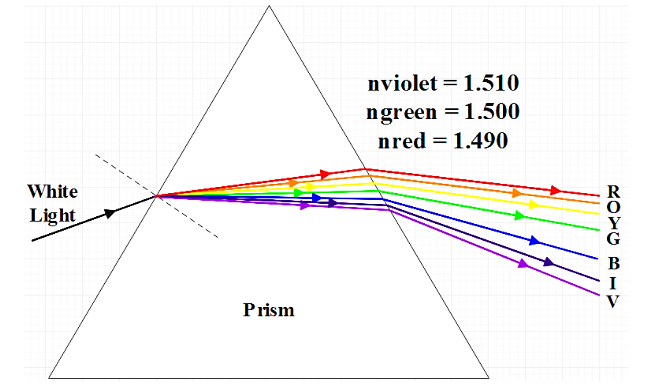
Complete step by step answer:
As we all know, the equation of refractive index is the ratio of the velocity of the light in vacuum to the velocity of the light in the medium. This can be written as,
$\mu =\dfrac{C}{V}$
Where $C$ be the velocity of light in vacuum and it is a constant and $V$ be the velocity of the light in specific mediums. And also we know that the velocity of light is the product of frequency and the wavelength of the light used. Therefore we can write that,
$V=f\lambda $
Where $f$ be the frequency and $\lambda $ be the wavelength of the light. Substituting this in the equation of refractive index,
$\mu =\dfrac{C}{V}=\dfrac{C}{f\lambda }$
From this we can say that,
$\Rightarrow \mu \propto \dfrac{1}{\lambda }$
As we all know the wavelength of the ultraviolet is less than that of the infrared rays, the refractive index will be having the opposite relation. That is the refractive index of the ultraviolet will be higher than that of infrared rays.
So, the correct answer is “Option B”.
Note: The refractive index of an object changes with the wavelength or the frequency of the light. This phenomenon is known as dispersion. By this process, the prisms and rainbows separate white light into its constituent spectral colours. In regions of the spectrum where the substance will not absorb light, the refractive index is getting decreased with the increase in the wavelength, and thus the frequency gets increased. This is known as the "normal dispersion". This is in contrast to “anomalous dispersion". In this the refractive index increases with wavelength. The normal dispersion means that the refractive index is higher for blue light than for red for visible light.
Recently Updated Pages
Master Class 12 Economics: Engaging Questions & Answers for Success

Master Class 12 Physics: Engaging Questions & Answers for Success
Master Class 12 English: Engaging Questions & Answers for Success
Master Class 12 Social Science: Engaging Questions & Answers for Success
Master Class 12 Maths: Engaging Questions & Answers for Success
Master Class 12 Business Studies: Engaging Questions & Answers for Success
Trending doubts
Which are the Top 10 Largest Countries of the World?
What are the major means of transport Explain each class 12 social science CBSE
Draw a labelled sketch of the human eye class 12 physics CBSE
Why cannot DNA pass through cell membranes class 12 biology CBSE
Differentiate between insitu conservation and exsitu class 12 biology CBSE
Draw a neat and well labeled diagram of TS of ovary class 12 biology CBSE