




What is reflex action? Explain it with the help of a diagram.
Answer
 Verified
641.7k+ views
Hint:Very simple, reflexes are involuntary actions made by or bodies in response to some kind of stimulus. Most reflexes are instinctive in nature and many of them serve a protective function, evolutionarily.
Complete answer:
A very simple example of a reflex is when we reach to touch something which is hot, and our hand immediately jerks back. The action is so quick that it happens before our brain has had time to think about it. If we waited to process the information, it is likely that we would get badly burnt before pulling our hands away.
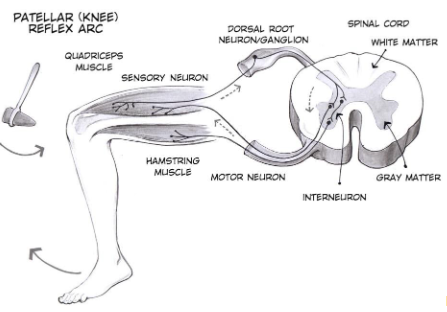
Reflexes are possible because of something called a reflex arc. These are neural connections made between sensory receptors, including the skins, the spinal cord, and the end-organ muscle. When the sensory organ encounters a particular stimulus, a hot pan for instance, the sensory neuron connected to that point is activated and takes the signal down to the dorsal root ganglion of the spinal cord. It then activates an intermediate neuron which transmits the signal to a motor neuron that then takes the message up to the effector organ, in this case the muscles of the hand and arm, causing them to pull back. Reflex arcs are so quick that we can respond in 0.15 seconds to such a touch stimulus.
The dorsal root ganglion also has connections with neurons that travel up to the brain. This way the brain can process and store the information in order to best avoid such a situation in the future.
Note:Some reflexes are used by physicians to test if we have any problems with our nervous system. For example, they may give a sharp tap on our knee, stimulating the sensory neurons that result finally in signal to the quadriceps muscle causing the classic “knee-jerk” response.
Complete answer:
A very simple example of a reflex is when we reach to touch something which is hot, and our hand immediately jerks back. The action is so quick that it happens before our brain has had time to think about it. If we waited to process the information, it is likely that we would get badly burnt before pulling our hands away.
Reflexes are possible because of something called a reflex arc. These are neural connections made between sensory receptors, including the skins, the spinal cord, and the end-organ muscle. When the sensory organ encounters a particular stimulus, a hot pan for instance, the sensory neuron connected to that point is activated and takes the signal down to the dorsal root ganglion of the spinal cord. It then activates an intermediate neuron which transmits the signal to a motor neuron that then takes the message up to the effector organ, in this case the muscles of the hand and arm, causing them to pull back. Reflex arcs are so quick that we can respond in 0.15 seconds to such a touch stimulus.
The dorsal root ganglion also has connections with neurons that travel up to the brain. This way the brain can process and store the information in order to best avoid such a situation in the future.
Note:Some reflexes are used by physicians to test if we have any problems with our nervous system. For example, they may give a sharp tap on our knee, stimulating the sensory neurons that result finally in signal to the quadriceps muscle causing the classic “knee-jerk” response.
Recently Updated Pages
If x a + bt + ct2 where x is in meters and t is in class 11 physics CBSE

A car covers the first half distance between two places class 11 physics CBSE
The resultant of two vectors overrightarrow P and overrightarrow class 11 physics CBSE
Find the value of cos 135 class 11 maths CBSE
A mass M is held in place by an applied force F and class 11 physics CBSE
A solution of glucose in water is labelled as 10 dfracwv class 11 chemistry CBSE
Trending doubts
One Metric ton is equal to kg A 10000 B 1000 C 100 class 11 physics CBSE
Find the value of the expression given below sin 30circ class 11 maths CBSE
What do you mean by retardation What is its SI uni class 11 physics CBSE
Draw a diagram of nephron and explain its structur class 11 biology CBSE
10 examples of friction in our daily life
Difference between physical and chemical change class 11 chemistry CBSE