




What is refining of metals? Explain with diagram the method of electrolysis by
Which copper is purified?
Answer
 Verified
626.7k+ views
Hint: Copper is widely used in electrical industries for making wiring due to its high electrical conductivity. But for this purpose, a purity of more than 99.7% is required. This purification of copper is achieved by electrorefining.
Complete step by step answer:
Refining of metal refers to the process in which impure metals are purified. It is of various types. Electrolysis of copper is an example of electrolytic refining.
When copper is extracted from its sulphide ores, it remains impure. To make it pure, a process called electrolysis is used. In this process, a pure copper sheet/rod and an impure copper/rod sheet is immersed in an electrolytic solution made up of copper (II) sulfate. The impure one acts as anode while the pure on as cathode. When a dc electric current is passed through the solution, copper from the positively charged anode gets deposited on the negatively charged cathode, while the impurities go into the \[CuS{{O}_{4}}\] solution called as anode mud.
Chemical reaction:
At cathode
\[C{{u}^{2+}}\,+\,2e\,\to \,Cu\]
At anode:
\[Cu\,-\,2e\,\to \,C{{u}^{2+}}\]
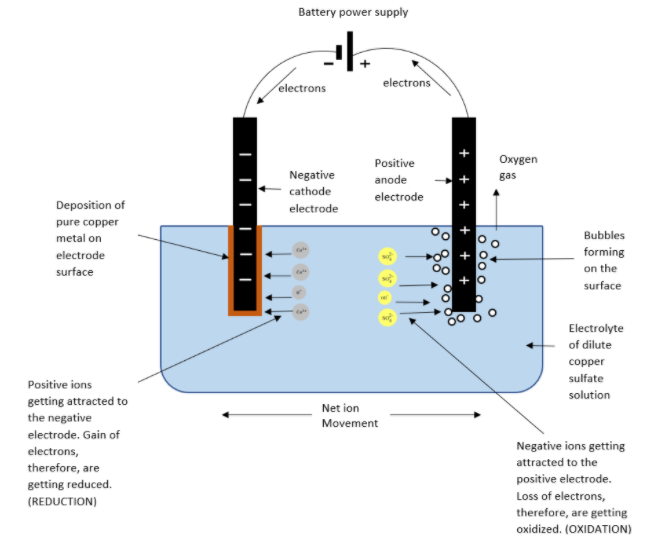
Note: Copper ores occur in different forms and the extraction method of copper depends on the nature of the ore. Sulphide ores such as chalcopyrite are converted to copper by a different method as compared to silicate, carbonate or sulphate ores.
Complete step by step answer:
Refining of metal refers to the process in which impure metals are purified. It is of various types. Electrolysis of copper is an example of electrolytic refining.
When copper is extracted from its sulphide ores, it remains impure. To make it pure, a process called electrolysis is used. In this process, a pure copper sheet/rod and an impure copper/rod sheet is immersed in an electrolytic solution made up of copper (II) sulfate. The impure one acts as anode while the pure on as cathode. When a dc electric current is passed through the solution, copper from the positively charged anode gets deposited on the negatively charged cathode, while the impurities go into the \[CuS{{O}_{4}}\] solution called as anode mud.
Chemical reaction:
At cathode
\[C{{u}^{2+}}\,+\,2e\,\to \,Cu\]
At anode:
\[Cu\,-\,2e\,\to \,C{{u}^{2+}}\]
Note: Copper ores occur in different forms and the extraction method of copper depends on the nature of the ore. Sulphide ores such as chalcopyrite are converted to copper by a different method as compared to silicate, carbonate or sulphate ores.
Recently Updated Pages
Master Class 12 Economics: Engaging Questions & Answers for Success

Master Class 12 English: Engaging Questions & Answers for Success
Master Class 12 Social Science: Engaging Questions & Answers for Success
Master Class 12 Maths: Engaging Questions & Answers for Success
Master Class 12 Physics: Engaging Questions & Answers for Success
Master Class 9 General Knowledge: Engaging Questions & Answers for Success
Trending doubts
Which are the Top 10 Largest Countries of the World?
Draw a labelled sketch of the human eye class 12 physics CBSE
Differentiate between homogeneous and heterogeneous class 12 chemistry CBSE
Sulphuric acid is known as the king of acids State class 12 chemistry CBSE
Why is the cell called the structural and functional class 12 biology CBSE
A dentist uses a small mirror that gives a magnification class 12 physics CBSE