




Reduction of \[cyclohex-2-enone\] with aluminium isopropoxide more than isopropyl alcohol will produce:
A.Cyclohexanol
B.\[Cyclohex-2-enol\]
C.Cyclohexanone
D.Benzene
Answer
 Verified
569.1k+ views
Hint: We know that the oppenauer Oxidation is a chemical conversion process in which, the secondary alcohols that are present in each composition turn to ketones under a controlled atmosphere with the help of selective oxidation.
Complete answer:
As we know that the Meerwein-Ponndorf reaction: In organic chemistry, this reaction is actually named as Meerwein-Ponndorf-Verley or MPV reduction is the reduction of ketones and aldehydes to alcohols using aluminium alkoxide catalysts in the presence of a sacrificial alcohol. This reaction is called MPV (Meerwein–Ponndorf–Verley reduction) reaction; the reverse of it is called oppenauer oxidation reaction. Side product is ketone.
\[2R-C=O\xrightarrow[C{{H}_{3}}-CH(OH)-C{{H}_{3}}]{\underset{Aluminium\text{ }Isopropoxide}{\mathop{{{[C{{H}_{3}}C-O]}_{3}}Al}}\,}\underset{M.P.V.\text{ }Reduction}{\mathop{2R-CH-OH}}\,\]
Oppenauer oxidation is the process where an aluminium alkoxide has catalyzed oxidation of the secondary alcohol that is present over the corresponding ketone. The oppenauer oxidation is the reverse process of Meerwein Ponndorf Verley reduction. The oppenauer oxidation reaction is one of the most reliable methods that help oxidize allylic alcohols to \[\alpha ,\text{ }\beta -\] unsaturated ketones. The oxidation reaction comes as an exact result of the reverse of Meerwein-Ponndorf-Verley reduction. It involves the process of deprotonation of the alcohol by equilibration over the alkoxide, concluded by a hydride transfer.
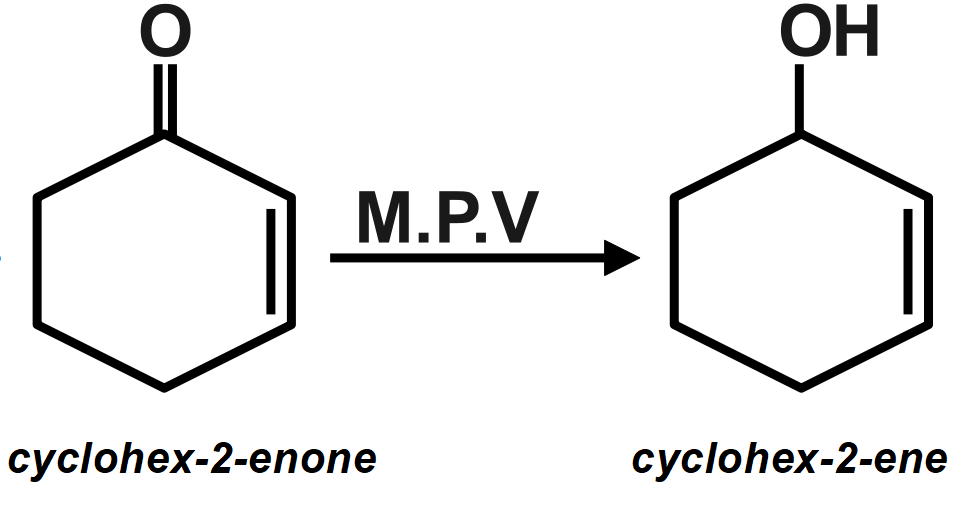
Therefore, the correct answer is option B.
Note:
Remember that the traditional Oppenauer Oxidation is a highly chemo selective oxidation process. However, the reactions and its mechanism do come with their own set of disadvantages. To begin with, the reaction method makes use of high temperatures that is generally achieved using large quantities of ketone hydride acceptors.
Complete answer:
As we know that the Meerwein-Ponndorf reaction: In organic chemistry, this reaction is actually named as Meerwein-Ponndorf-Verley or MPV reduction is the reduction of ketones and aldehydes to alcohols using aluminium alkoxide catalysts in the presence of a sacrificial alcohol. This reaction is called MPV (Meerwein–Ponndorf–Verley reduction) reaction; the reverse of it is called oppenauer oxidation reaction. Side product is ketone.
\[2R-C=O\xrightarrow[C{{H}_{3}}-CH(OH)-C{{H}_{3}}]{\underset{Aluminium\text{ }Isopropoxide}{\mathop{{{[C{{H}_{3}}C-O]}_{3}}Al}}\,}\underset{M.P.V.\text{ }Reduction}{\mathop{2R-CH-OH}}\,\]
Oppenauer oxidation is the process where an aluminium alkoxide has catalyzed oxidation of the secondary alcohol that is present over the corresponding ketone. The oppenauer oxidation is the reverse process of Meerwein Ponndorf Verley reduction. The oppenauer oxidation reaction is one of the most reliable methods that help oxidize allylic alcohols to \[\alpha ,\text{ }\beta -\] unsaturated ketones. The oxidation reaction comes as an exact result of the reverse of Meerwein-Ponndorf-Verley reduction. It involves the process of deprotonation of the alcohol by equilibration over the alkoxide, concluded by a hydride transfer.
Therefore, the correct answer is option B.
Note:
Remember that the traditional Oppenauer Oxidation is a highly chemo selective oxidation process. However, the reactions and its mechanism do come with their own set of disadvantages. To begin with, the reaction method makes use of high temperatures that is generally achieved using large quantities of ketone hydride acceptors.
Recently Updated Pages
Explain the structure of megasporangium class 12 biology CBSE

Why is chloroform kept in dark coloured bottles class 12 chemistry CBSE
Derive the balancing condition of a Wheatstone bri class 12 physics CBSE
Draw VI characteristics of a pn junction diode Explain class 12 physics CBSE
Is it possible to carry pride in ones language too class 12 english CBSE
In a population at Hardy Weinberg equilibrium the allele class 12 biology CBSE
Trending doubts
Draw a labelled sketch of the human eye class 12 physics CBSE
Which are the Top 10 Largest Countries of the World?
Draw ray diagrams each showing i myopic eye and ii class 12 physics CBSE
Which is the correct genotypic ratio of mendel dihybrid class 12 biology CBSE
Differentiate between homogeneous and heterogeneous class 12 chemistry CBSE
Which animal never drinks water in its entire life class 12 biology CBSE