




Recombinant DNA vaccines have proved to be an important tool for the treatment of many diseases. How are these vaccines produced? Explain with examples.
Answer
 Verified
589.5k+ views
Hint:-A recombinant vaccination is a vaccine created through recombinant DNA technology. This includes embedding the DNA encoding an antigen, (for example, a bacterial surface protein) that animates an insusceptible reaction into bacterial or mammalian cells, communicating the antigen in these cells and afterward cleansing it from them.
Complete Answer:-DNA inoculation is a procedure used to secure an organism against illness by infusing it with hereditarily designed DNA to deliver an immunological reaction. Normally vaccines have a possible risk of the vaccine being fatal but in DNA vaccines there is no need of using actual infectious organism.
DNA vaccines provide both cellular and humoral immunity, on the other hand normal vaccines provide only humoral immunity.
Production of recombinant DNA Vaccines
A DNA vaccine is made with a circular double stranded DNA molecule also called plasmid, fabricated with a DNA sequence containing genes encoding one or more proteins of a pathogen. As this DNA is inserted into the cells, it is translated to form antigenic protein. As this protein is foreign to cells, immune response is raised against this protein.
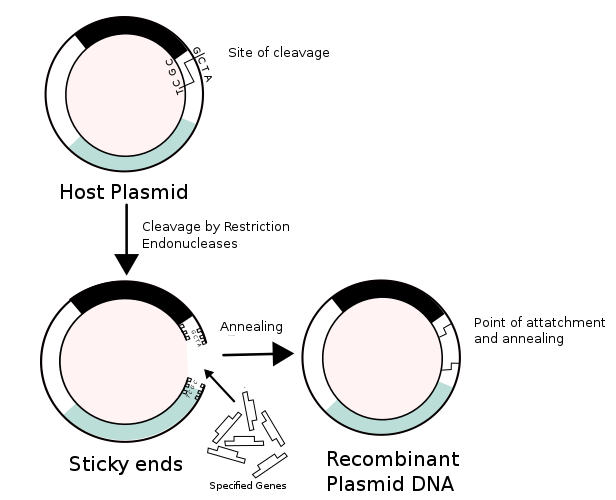
Note:- There is no risk of infection in recombinant DNA vaccination. In earlier times, large scale vaccine production is done by using cell culture. In this technique strains of pathogens were injected into suitable animals and allowed them to proliferate. Then the serum of the animals was collected to extract the antigens. These antigens were used to produce vaccines. There were chances of contamination and also there were chances of some diseases. All these problems are overcome due to recombinant DNA technology.
Complete Answer:-DNA inoculation is a procedure used to secure an organism against illness by infusing it with hereditarily designed DNA to deliver an immunological reaction. Normally vaccines have a possible risk of the vaccine being fatal but in DNA vaccines there is no need of using actual infectious organism.
DNA vaccines provide both cellular and humoral immunity, on the other hand normal vaccines provide only humoral immunity.
Production of recombinant DNA Vaccines
A DNA vaccine is made with a circular double stranded DNA molecule also called plasmid, fabricated with a DNA sequence containing genes encoding one or more proteins of a pathogen. As this DNA is inserted into the cells, it is translated to form antigenic protein. As this protein is foreign to cells, immune response is raised against this protein.
Note:- There is no risk of infection in recombinant DNA vaccination. In earlier times, large scale vaccine production is done by using cell culture. In this technique strains of pathogens were injected into suitable animals and allowed them to proliferate. Then the serum of the animals was collected to extract the antigens. These antigens were used to produce vaccines. There were chances of contamination and also there were chances of some diseases. All these problems are overcome due to recombinant DNA technology.
Recently Updated Pages
Three beakers labelled as A B and C each containing 25 mL of water were taken A small amount of NaOH anhydrous CuSO4 and NaCl were added to the beakers A B and C respectively It was observed that there was an increase in the temperature of the solutions contained in beakers A and B whereas in case of beaker C the temperature of the solution falls Which one of the following statements isarecorrect i In beakers A and B exothermic process has occurred ii In beakers A and B endothermic process has occurred iii In beaker C exothermic process has occurred iv In beaker C endothermic process has occurred

Master Class 12 Social Science: Engaging Questions & Answers for Success
Master Class 12 Physics: Engaging Questions & Answers for Success
Master Class 12 Maths: Engaging Questions & Answers for Success
Master Class 12 Economics: Engaging Questions & Answers for Success
Master Class 12 Chemistry: Engaging Questions & Answers for Success
Three beakers labelled as A B and C each containing 25 mL of water were taken A small amount of NaOH anhydrous CuSO4 and NaCl were added to the beakers A B and C respectively It was observed that there was an increase in the temperature of the solutions contained in beakers A and B whereas in case of beaker C the temperature of the solution falls Which one of the following statements isarecorrect i In beakers A and B exothermic process has occurred ii In beakers A and B endothermic process has occurred iii In beaker C exothermic process has occurred iv In beaker C endothermic process has occurred
Master Class 12 Social Science: Engaging Questions & Answers for Success
Master Class 12 Physics: Engaging Questions & Answers for Success
Trending doubts
Which are the Top 10 Largest Countries of the World?
Draw a labelled sketch of the human eye class 12 physics CBSE
Differentiate between homogeneous and heterogeneous class 12 chemistry CBSE
What are the major means of transport Explain each class 12 social science CBSE
Sulphuric acid is known as the king of acids State class 12 chemistry CBSE
Why should a magnesium ribbon be cleaned before burning class 12 chemistry CBSE