




Recombinant DNA – technology is of great importance in the field of medicine.
With the help of a flow chart, show how this technology has been used in preparing genetically engineered human insulins.
Answer
 Verified
589.8k+ views
Hint: The recombinant DNA – technology has great applications in various fields including nutrition, agriculture, medicine and others. Using this technology, pharmaceutical products such as human insulin, vaccines can be produced to improve the health of individuals.
Complete answer:
Insulin is a hormone that is naturally synthesized by the pancreatic cells of human beings. This hormone is responsible for lowering the levels of glucose in blood when the glucose levels are estimated as higher than required. Therefore, insulin plays a crucial role in regulating blood glucose levels.
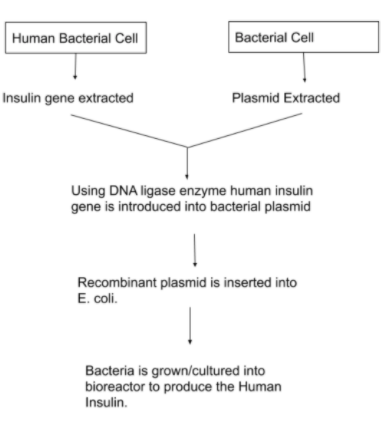
In order to synthesize the genetically engineered human insulin, various steps are involved as depicted in the flow chart above. The human insulin gene is isolated from the pancreatic cells with the help of restriction enzymes that cleaves the DNA (deoxyribonucleic acid) at some specific site. On the other side, the circular plasmid is extracted and cleaved enzymatically at specific sites for the incorporation of the human insulin gene within the plasmid.
With the help of another enzyme called DNA ligase, the human insulin gene is joined to the bacterial plasmid and this is then referred to as recombinant DNA plasmid. It is then introduced into the bacterial (E. coli) cell for production of multiple copies of the plasmid and more importantly the human insulin.
For production of human insulin in large quantities, the bacteria or E. coli is cultured in bioreactors under optimized conditions of pH, temperature or nutrient supply. Furthermore, the genetically engineered human insulin can be isolated using specialized processes.
Note: The level of blood glucose increases in response to the calorie intakes or food consumed. This increase further triggers the pancreatic cells to release insulin for lowering the blood glucose level as per the requirement of the body. An abnormally low level of blood glucose can be increased with another counteracting hormone called glucagon.
Complete answer:
Insulin is a hormone that is naturally synthesized by the pancreatic cells of human beings. This hormone is responsible for lowering the levels of glucose in blood when the glucose levels are estimated as higher than required. Therefore, insulin plays a crucial role in regulating blood glucose levels.
In order to synthesize the genetically engineered human insulin, various steps are involved as depicted in the flow chart above. The human insulin gene is isolated from the pancreatic cells with the help of restriction enzymes that cleaves the DNA (deoxyribonucleic acid) at some specific site. On the other side, the circular plasmid is extracted and cleaved enzymatically at specific sites for the incorporation of the human insulin gene within the plasmid.
With the help of another enzyme called DNA ligase, the human insulin gene is joined to the bacterial plasmid and this is then referred to as recombinant DNA plasmid. It is then introduced into the bacterial (E. coli) cell for production of multiple copies of the plasmid and more importantly the human insulin.
For production of human insulin in large quantities, the bacteria or E. coli is cultured in bioreactors under optimized conditions of pH, temperature or nutrient supply. Furthermore, the genetically engineered human insulin can be isolated using specialized processes.
Note: The level of blood glucose increases in response to the calorie intakes or food consumed. This increase further triggers the pancreatic cells to release insulin for lowering the blood glucose level as per the requirement of the body. An abnormally low level of blood glucose can be increased with another counteracting hormone called glucagon.
Recently Updated Pages
Master Class 12 Business Studies: Engaging Questions & Answers for Success

Master Class 12 Biology: Engaging Questions & Answers for Success
Master Class 12 Chemistry: Engaging Questions & Answers for Success
Class 12 Question and Answer - Your Ultimate Solutions Guide
Master Class 11 Social Science: Engaging Questions & Answers for Success
Master Class 11 English: Engaging Questions & Answers for Success
Trending doubts
Which is more stable and why class 12 chemistry CBSE
Which are the Top 10 Largest Countries of the World?
Draw a labelled sketch of the human eye class 12 physics CBSE
Differentiate between homogeneous and heterogeneous class 12 chemistry CBSE
What are the major means of transport Explain each class 12 social science CBSE
Sulphuric acid is known as the king of acids State class 12 chemistry CBSE