



Reaction of bromine water phenol gives white ppt of:
A. o – bromophenol
B. p – bromophenol
C. 2,4,6 – tribromophenol
D. m – bromophenol
Answer
 Verified
683.7k+ views
Hint: When bromine water is added to a solution of phenol in water, the bromine water is decolourised and a white precipitate is formed which smells of antiseptic.
Complete step-by-step answer:
We know that the reaction of phenol and water with bromine is known as bromination of phenol. Solvent has a great influence on the reaction. In different solvents, different products are obtained.
Bromination of phenol is a substitution reaction. Where the bromine replaces hydrogen present in the benzene ring of phenol. In the water solvent when phenol treated with \[B{{r}_{2}}\] gives a polybromo derivative in which all hydrogen atoms at ortho, meta, and para positions with respect to the \[-OH\] group are replaced by bromine atoms. It is so because in aqueous medium phenol ionizes to form peroxide ion. Due to the presence of negative ions the ring gets highly activated and tri substitution occurs and the formation of 2,4,6 – tribromophenol takes place.
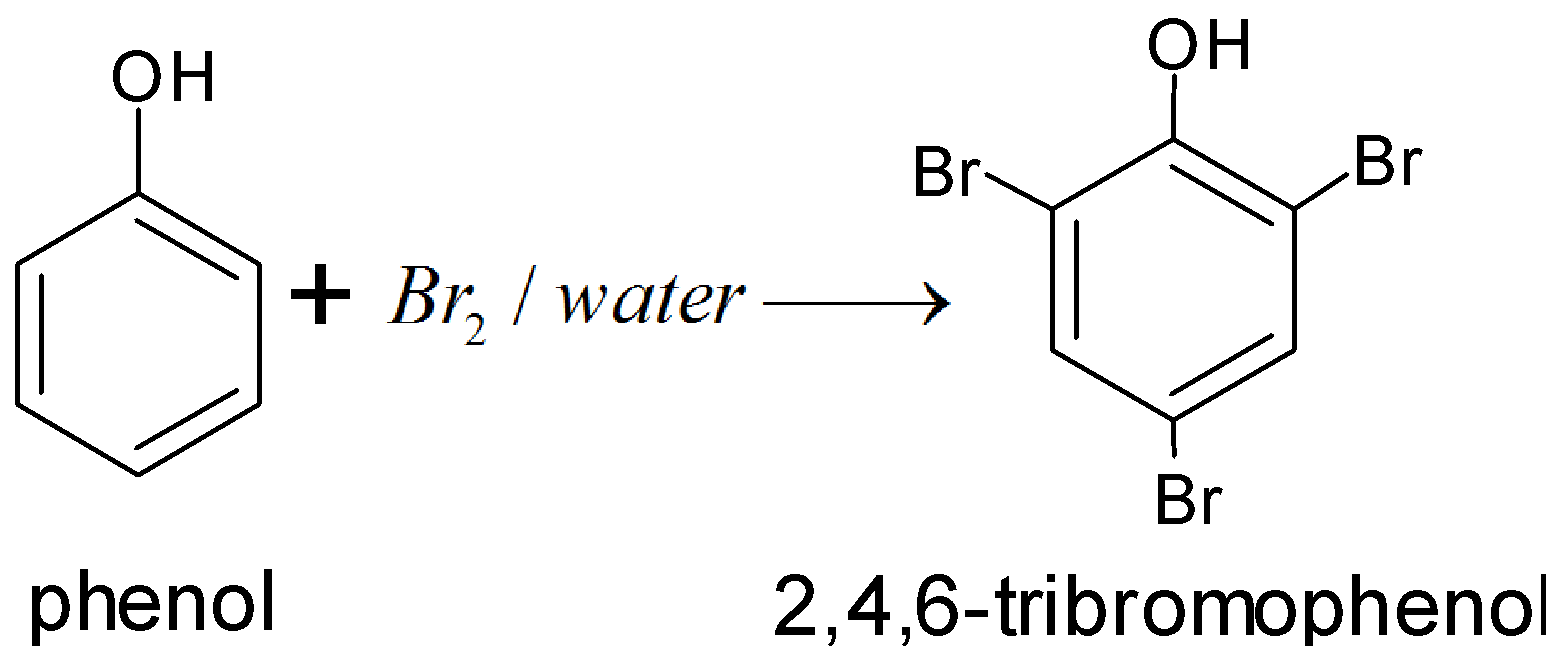
So, the correct answer is “D”.
A, B, C are incorrect because these product formation takes place in non-polar solvents.
Note: In non-polar solvents the ionization of phenol is greatly suppressed. As a result, \[-OH\] group donates electrons to benzene rings to a small extent only which results in slight activation of ring and mono-substitution occurs.
Complete step-by-step answer:
We know that the reaction of phenol and water with bromine is known as bromination of phenol. Solvent has a great influence on the reaction. In different solvents, different products are obtained.
Bromination of phenol is a substitution reaction. Where the bromine replaces hydrogen present in the benzene ring of phenol. In the water solvent when phenol treated with \[B{{r}_{2}}\] gives a polybromo derivative in which all hydrogen atoms at ortho, meta, and para positions with respect to the \[-OH\] group are replaced by bromine atoms. It is so because in aqueous medium phenol ionizes to form peroxide ion. Due to the presence of negative ions the ring gets highly activated and tri substitution occurs and the formation of 2,4,6 – tribromophenol takes place.
So, the correct answer is “D”.
A, B, C are incorrect because these product formation takes place in non-polar solvents.
Note: In non-polar solvents the ionization of phenol is greatly suppressed. As a result, \[-OH\] group donates electrons to benzene rings to a small extent only which results in slight activation of ring and mono-substitution occurs.
Recently Updated Pages
Explain the structure of megasporangium class 12 biology CBSE

Why is chloroform kept in dark coloured bottles class 12 chemistry CBSE
Derive the balancing condition of a Wheatstone bri class 12 physics CBSE
Draw VI characteristics of a pn junction diode Explain class 12 physics CBSE
Is it possible to carry pride in ones language too class 12 english CBSE
In a population at Hardy Weinberg equilibrium the allele class 12 biology CBSE
Trending doubts
Draw a labelled sketch of the human eye class 12 physics CBSE
Which are the Top 10 Largest Countries of the World?
Draw ray diagrams each showing i myopic eye and ii class 12 physics CBSE
One megawatt is equal to how many units of electri class 12 physics CBSE
Which is the correct genotypic ratio of mendel dihybrid class 12 biology CBSE
Give 10 examples of unisexual and bisexual flowers