




Ray diagram for two lenses kept at some distance given in the diagram, which of the following option is correct (\[{f_1},{f_2}\]=focal length; \[d\]=distance between lenses$)$
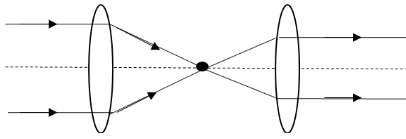
A. \[{f_1} + {f_2} > d\]
B. \[{f_1} + {f_2} < d\]
C. \[{f_1} + {f_2} = d\]
D. combination behaves like converging lens
Answer
 Verified
608.1k+ views
Hint:Recall the concept of focus of a lens and focal length of a lens. Give the definitions of the focus and focal length of a lens. Observe the given ray diagram and determine the focal lengths of the two lenses in the ray diagram. Check the relation between the sum of focal lengths of the two lenses and the separation distance between the two lenses and choose the correct option.
Complete step by step answer:
We have given two lenses having focal lengths \[{f_1}\] and \[{f_2}\] respectively. The distance between the two lenses is \[d\]. We know that the focus of a lens is a point at which all the rays incident on the lens converge after passing through the lens or the point from which all the rays appear to diverge and then these rays are incident of the lens in the form of parallel rays.
We can determine the focal lengths of the two lenses as follows:
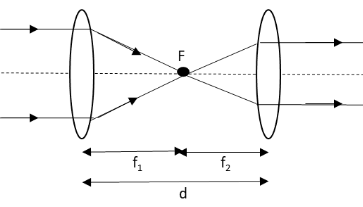
In the above ray diagram, the indent rays from the first lens converge at point F after passing through the first lens. Hence the distance between the centre of the first lens and the point F is the focal length \[{f_1}\] of the first lens.
The rays converged at point F from the first lens diverge from the same point F and are incident on the second lens. Hence, the distance between the point F and the centre of the second lens is the focal length \[{f_2}\] of the second lens.
From the above ray diagram, the sum of the focal lengths \[{f_1}\] and \[{f_2}\] of the two lenses is equal to the separation \[d\] between the two lenses.
\[{f_1} + {f_2} = d\]
Therefore, the relation between the focal lengths of the two lenses and the separation between the two lenses is \[{f_1} + {f_2} = d\].
Hence, the correct option is C.
Note:The students may think that one of the lenses given in the ray diagram is behind the lens and the other lens has the focal point in front of the lens. But an ideal lens has only one focal point. But the lenses we use generally have a focal point in front of the lens and behind the lens and hence have two focal lengths. The distance of both of these focal points is the same from the centre of the lens.
Complete step by step answer:
We have given two lenses having focal lengths \[{f_1}\] and \[{f_2}\] respectively. The distance between the two lenses is \[d\]. We know that the focus of a lens is a point at which all the rays incident on the lens converge after passing through the lens or the point from which all the rays appear to diverge and then these rays are incident of the lens in the form of parallel rays.
We can determine the focal lengths of the two lenses as follows:
In the above ray diagram, the indent rays from the first lens converge at point F after passing through the first lens. Hence the distance between the centre of the first lens and the point F is the focal length \[{f_1}\] of the first lens.
The rays converged at point F from the first lens diverge from the same point F and are incident on the second lens. Hence, the distance between the point F and the centre of the second lens is the focal length \[{f_2}\] of the second lens.
From the above ray diagram, the sum of the focal lengths \[{f_1}\] and \[{f_2}\] of the two lenses is equal to the separation \[d\] between the two lenses.
\[{f_1} + {f_2} = d\]
Therefore, the relation between the focal lengths of the two lenses and the separation between the two lenses is \[{f_1} + {f_2} = d\].
Hence, the correct option is C.
Note:The students may think that one of the lenses given in the ray diagram is behind the lens and the other lens has the focal point in front of the lens. But an ideal lens has only one focal point. But the lenses we use generally have a focal point in front of the lens and behind the lens and hence have two focal lengths. The distance of both of these focal points is the same from the centre of the lens.
Recently Updated Pages
Master Class 12 Business Studies: Engaging Questions & Answers for Success

Master Class 12 Chemistry: Engaging Questions & Answers for Success
Master Class 12 Biology: Engaging Questions & Answers for Success
Class 12 Question and Answer - Your Ultimate Solutions Guide
Master Class 11 English: Engaging Questions & Answers for Success
Master Class 11 Social Science: Engaging Questions & Answers for Success
Trending doubts
Which are the Top 10 Largest Countries of the World?
The total number of vertebrae in man is a30 b31 c32 class 12 biology CBSE
Draw a labelled sketch of the human eye class 12 physics CBSE
The number of cranial nerves in a frog is A 10 pairs class 12 biology CBSE
Differentiate between homogeneous and heterogeneous class 12 chemistry CBSE
Differentiate between Pyramid of energy and pyramid class 12 biology CBSE