




What is the range of the function, $y=\cos \left( x \right)$ ?
Answer
 Verified
528.6k+ views
Hint: The given equation is a ‘cosine’ function. It is one of the most important trigonometric functions and is used in many other areas of math and physics. We will first see the graphical representation of the ‘cosine’ function and then find the range of the cosine function with the help of this graph. We will also see the domain over which a ‘cosine’ function operates.
Complete step by step solution:
The trigonometric function given to us in the problem is: $y=\cos \left( x \right)$. This ‘cosine’ function can be graphically represented as follows:
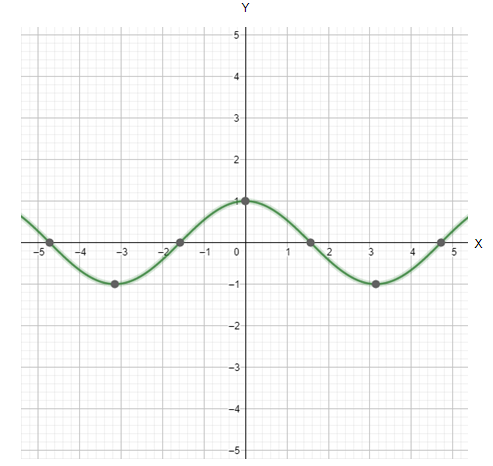
Here, we can first observe that the domain of the ‘cosine’ function starts from negative infinity and goes till positive infinity. Thus, the domain of the cosine function is all the Real numbers.
Additionally, we can observe from the graph that the cosine function gives an output of zero at every odd multiple of $\dfrac{\pi }{2}$.
Now, if we plot the mapping of this ‘cosine’ function, on the Y-axis, that is, collect the projection of all the points of the curve on the Y-axis, we will get its range.
On doing so, we can clearly see that the range of values on the Y-axis varies from -1 to 1, both included.
Thus, the range of our cosine function comes out to be $\left[ -1,1 \right]$.
Hence, the range of the function, $y=\cos \left( x \right)$ comes out to be $\left[ -1,1 \right]$
Note: One should not confuse between the domain and range of any given function. One very simple way to remember the difference between domain and range is, the domain of a function is the set of all the numbers that is acceptable to the function (or, input) and the range of a function is the set of all numbers produced by a function for this domain (or, output).
Complete step by step solution:
The trigonometric function given to us in the problem is: $y=\cos \left( x \right)$. This ‘cosine’ function can be graphically represented as follows:
Here, we can first observe that the domain of the ‘cosine’ function starts from negative infinity and goes till positive infinity. Thus, the domain of the cosine function is all the Real numbers.
Additionally, we can observe from the graph that the cosine function gives an output of zero at every odd multiple of $\dfrac{\pi }{2}$.
Now, if we plot the mapping of this ‘cosine’ function, on the Y-axis, that is, collect the projection of all the points of the curve on the Y-axis, we will get its range.
On doing so, we can clearly see that the range of values on the Y-axis varies from -1 to 1, both included.
Thus, the range of our cosine function comes out to be $\left[ -1,1 \right]$.
Hence, the range of the function, $y=\cos \left( x \right)$ comes out to be $\left[ -1,1 \right]$
Note: One should not confuse between the domain and range of any given function. One very simple way to remember the difference between domain and range is, the domain of a function is the set of all the numbers that is acceptable to the function (or, input) and the range of a function is the set of all numbers produced by a function for this domain (or, output).
Recently Updated Pages
Master Class 11 Computer Science: Engaging Questions & Answers for Success

Master Class 11 Business Studies: Engaging Questions & Answers for Success
Master Class 11 Economics: Engaging Questions & Answers for Success
Master Class 11 English: Engaging Questions & Answers for Success
Master Class 11 Maths: Engaging Questions & Answers for Success
Master Class 11 Biology: Engaging Questions & Answers for Success
Trending doubts
There are 720 permutations of the digits 1 2 3 4 5 class 11 maths CBSE
Discuss the various forms of bacteria class 11 biology CBSE
Draw a diagram of a plant cell and label at least eight class 11 biology CBSE
Explain zero factorial class 11 maths CBSE
What organs are located on the left side of your body class 11 biology CBSE
Draw a diagram of nephron and explain its structur class 11 biology CBSE