




Radial symmetry is seen in flowers of
(a)Cassia
(b)Brassica
(c)Trifolium
(d)Pisum
Answer
 Verified
662.1k+ views
Hint: When the different parts of each whorl are similar, the flower is regular and is called an actinomorphic flower. This means that all members of a whorl are the same in size and shape.
Complete answer:
Brassica has Actinomorphic flowers i.e it is a flower with radial symmetry. All the petals of brassica are similar in size and shape. The flower can be cut into two equal halves from any plane.
Additional information:
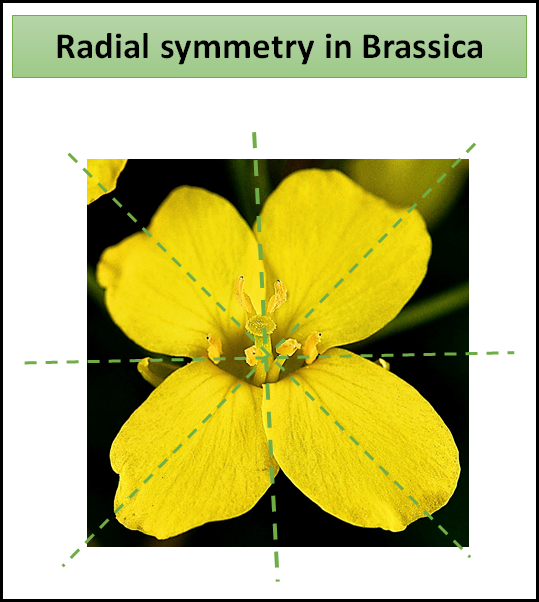
-A flower is supposed to be symmetrical when each whorl comprises an equal number of members or when the members of any one whorl are multiples of that before it.
-Thus, a symmetrical flower may have three sepals, three petals, three stamens, and three carpels, or the quantity of any of these members may be a multiple of three.
-A flower is dimerous in which the parts are in twos; trimerous, tetramerous, or pentamerous, in threes, fours, or fives, respectively.
-When the different parts of each whorl are identical, the flower is regular and is called as an actinomorphic flower or radially symmetrical flower. This is observed in the petunia, buttercup, and wild rose.
-Discrepancies in size or shape of the members of a whorl make the flower irregular such as in the canna and Asiatic dayflower.
-When a flower can be bisected by a single plane into two equal sections, it is a zygomorphic flower or bilaterally symmetrical flower. This is seen in the snapdragon, orchid, and sweet pea.
So, the correct answer is “Brassica”
Note: Trimerous symmetry is the characteristic in the monocotyledons such as maize, rice, coconut, etc. Pentamerous symmetry is the most common symmetry in the dicotyledons, however dimerous and tetramerous flowers are also seen in the dicotyledonous plants.
Complete answer:
Brassica has Actinomorphic flowers i.e it is a flower with radial symmetry. All the petals of brassica are similar in size and shape. The flower can be cut into two equal halves from any plane.
Additional information:
-A flower is supposed to be symmetrical when each whorl comprises an equal number of members or when the members of any one whorl are multiples of that before it.
-Thus, a symmetrical flower may have three sepals, three petals, three stamens, and three carpels, or the quantity of any of these members may be a multiple of three.
-A flower is dimerous in which the parts are in twos; trimerous, tetramerous, or pentamerous, in threes, fours, or fives, respectively.
-When the different parts of each whorl are identical, the flower is regular and is called as an actinomorphic flower or radially symmetrical flower. This is observed in the petunia, buttercup, and wild rose.
-Discrepancies in size or shape of the members of a whorl make the flower irregular such as in the canna and Asiatic dayflower.
-When a flower can be bisected by a single plane into two equal sections, it is a zygomorphic flower or bilaterally symmetrical flower. This is seen in the snapdragon, orchid, and sweet pea.
So, the correct answer is “Brassica”
Note: Trimerous symmetry is the characteristic in the monocotyledons such as maize, rice, coconut, etc. Pentamerous symmetry is the most common symmetry in the dicotyledons, however dimerous and tetramerous flowers are also seen in the dicotyledonous plants.
Recently Updated Pages
If x a + bt + ct2 where x is in meters and t is in class 11 physics CBSE

A car covers the first half distance between two places class 11 physics CBSE
The resultant of two vectors overrightarrow P and overrightarrow class 11 physics CBSE
Find the value of cos 135 class 11 maths CBSE
A mass M is held in place by an applied force F and class 11 physics CBSE
A solution of glucose in water is labelled as 10 dfracwv class 11 chemistry CBSE
Trending doubts
Find the value of the expression given below sin 30circ class 11 maths CBSE
One Metric ton is equal to kg A 10000 B 1000 C 100 class 11 physics CBSE
Draw a diagram of nephron and explain its structur class 11 biology CBSE
10 examples of friction in our daily life
Proton was discovered by A Thomson B Rutherford C Chadwick class 11 chemistry CBSE
Bond order ofO2 O2+ O2 and O22 is in order A O2 langle class 11 chemistry CBSE