




${R_3}SiCl$ on hydrolysis forms
(A) ${R_3}SiOH$
(B) ${R_3}Si - O - Si{R_3}$
(C) ${R_2}Si = O$
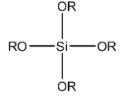
(D)
Answer
 Verified
578.4k+ views
Hint: Hydrolysis is the reaction in which a bond in the substrate is broken by its reaction with water. Generally, hydroxyl groups of water get connected to the electropositive atom of the bond and hydrogen atom of water forms a bond with electronegative atoms of the bond.
Complete step by step solution:
We will know about the hydrolysis reaction.
- Hydrolysis is the reaction by which a bond in the substrate molecule is broken by its reaction with water.
- The given substrate molecule is ${R_3}SiCl$.
- Here, the most polar bond is the Si-Cl bond. This is because Cl is a highly electronegative element because it is a halogen. Silicon has relatively the same electronegativity as carbon. Thus, we can say that chlorine has partial negative charge and silicon has partial positive charge in the bond.
- We know that water has $^ - OH$ as a nucleophilic part and ${H^ + }$ as an electrophilic part. So, the reaction can be shown as below with mechanism.

- Here, we can see that first a cation is formed. Then this cation is attacked by nucleophilic oxygen atoms of water. This leads to the formation of a silicon compound having –OH group. Thus, the final product we obtain is ${R_3}Si - OH$.
- Here, if we further heat the solution, then a condensation reaction would occur and that would lead to the formation of the compound ${R_3}Si - O - Si{R_3}$ and a water molecule.
- Thus, we can say that ${R_3}SiCl$ on hydrolysis forms ${R_3}Si - OH$.
So, the correct answer to this question is (A).
Note: Alkyl or aryl substituted silicon chlorides have the common formula ${R_n}SiC{l_{4 - n}}$ and they are collectively known as silicones. They are used as sealants, electrical insulators and in the manufacture of waterproofing fabrics and grease.
Complete step by step solution:
We will know about the hydrolysis reaction.
- Hydrolysis is the reaction by which a bond in the substrate molecule is broken by its reaction with water.
- The given substrate molecule is ${R_3}SiCl$.
- Here, the most polar bond is the Si-Cl bond. This is because Cl is a highly electronegative element because it is a halogen. Silicon has relatively the same electronegativity as carbon. Thus, we can say that chlorine has partial negative charge and silicon has partial positive charge in the bond.
- We know that water has $^ - OH$ as a nucleophilic part and ${H^ + }$ as an electrophilic part. So, the reaction can be shown as below with mechanism.
- Here, we can see that first a cation is formed. Then this cation is attacked by nucleophilic oxygen atoms of water. This leads to the formation of a silicon compound having –OH group. Thus, the final product we obtain is ${R_3}Si - OH$.
- Here, if we further heat the solution, then a condensation reaction would occur and that would lead to the formation of the compound ${R_3}Si - O - Si{R_3}$ and a water molecule.
- Thus, we can say that ${R_3}SiCl$ on hydrolysis forms ${R_3}Si - OH$.
So, the correct answer to this question is (A).
Note: Alkyl or aryl substituted silicon chlorides have the common formula ${R_n}SiC{l_{4 - n}}$ and they are collectively known as silicones. They are used as sealants, electrical insulators and in the manufacture of waterproofing fabrics and grease.
Recently Updated Pages
Master Class 12 Economics: Engaging Questions & Answers for Success

Master Class 12 Physics: Engaging Questions & Answers for Success
Master Class 12 English: Engaging Questions & Answers for Success
Master Class 12 Social Science: Engaging Questions & Answers for Success
Master Class 12 Maths: Engaging Questions & Answers for Success
Master Class 12 Business Studies: Engaging Questions & Answers for Success
Trending doubts
Which are the Top 10 Largest Countries of the World?
What are the major means of transport Explain each class 12 social science CBSE
Draw a labelled sketch of the human eye class 12 physics CBSE
Why cannot DNA pass through cell membranes class 12 biology CBSE
Differentiate between insitu conservation and exsitu class 12 biology CBSE
Draw a neat and well labeled diagram of TS of ovary class 12 biology CBSE