




Question: With the help of a diagram, explain secondary growth in dicot roots.
Answer
 Verified
420.3k+ views
Hint: Secondary growth increases the plant's thickness or girth due to cell division in the cambia or lateral meristem. Secondary change occurs in the root due to the production of secondary tissues by lateral meristems.
Complete step by step answer:
Secondary growth in a dicot root- Vascular cambium develops secondarily from conjunctive parenchyma cells located immediately below each phloem strand. The number of cambium rings formed is proportional to the phloem present. Outside the protoxylem, pericycle cells become meristematic and become part of cambium strips. These strips of vascular cambium merge with the old cambium to produce a wavy ring. On the inner side of the cambium ring, secondary xylem is made, while on the outer side, secondary phloem is produced. Because there is no seasonal fluctuation under the earth, growth rings in roots are not distinct. The phellogen emerges from the pericycle's outer area, cutting phellem (cork) on the outside and secondary cortex or phelloderm on the inside.
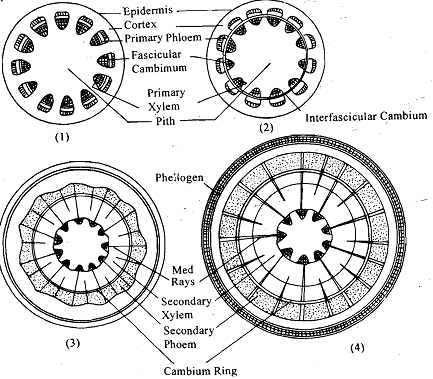
Image: Diagram showing secondary growth in dicot roots.
Note: Secondary growth occurs in all dicotyledonous woody plants, with the root girth increasing due to stellar and extrasolar cambium activity. The vascular bundles seen in dicot roots are radial. Exarch is the xylem. The protoxylems are directed towards the perimeter, whereas the metaxylem is oriented towards the center. The cambium is missing at first but emerges later during secondary development. Outside of the protoxylem, the pericycle cells and conjunctive parenchyma cells on the lateral side of the phloem bundle become meristematic, forming multiple cambial strips.
Complete step by step answer:
Secondary growth in a dicot root- Vascular cambium develops secondarily from conjunctive parenchyma cells located immediately below each phloem strand. The number of cambium rings formed is proportional to the phloem present. Outside the protoxylem, pericycle cells become meristematic and become part of cambium strips. These strips of vascular cambium merge with the old cambium to produce a wavy ring. On the inner side of the cambium ring, secondary xylem is made, while on the outer side, secondary phloem is produced. Because there is no seasonal fluctuation under the earth, growth rings in roots are not distinct. The phellogen emerges from the pericycle's outer area, cutting phellem (cork) on the outside and secondary cortex or phelloderm on the inside.
Image: Diagram showing secondary growth in dicot roots.
Note: Secondary growth occurs in all dicotyledonous woody plants, with the root girth increasing due to stellar and extrasolar cambium activity. The vascular bundles seen in dicot roots are radial. Exarch is the xylem. The protoxylems are directed towards the perimeter, whereas the metaxylem is oriented towards the center. The cambium is missing at first but emerges later during secondary development. Outside of the protoxylem, the pericycle cells and conjunctive parenchyma cells on the lateral side of the phloem bundle become meristematic, forming multiple cambial strips.
Recently Updated Pages
Master Class 12 Economics: Engaging Questions & Answers for Success

Master Class 12 English: Engaging Questions & Answers for Success
Master Class 12 Social Science: Engaging Questions & Answers for Success
Master Class 12 Maths: Engaging Questions & Answers for Success
Master Class 12 Physics: Engaging Questions & Answers for Success
Master Class 9 General Knowledge: Engaging Questions & Answers for Success
Trending doubts
According to phylogenetic classification systems organisms class 11 biology NEET_UG
Which are the Top 10 Largest Countries of the World?
One Metric ton is equal to kg A 10000 B 1000 C 100 class 11 physics CBSE
Explain the Treaty of Vienna of 1815 class 10 social science CBSE
Draw a labelled sketch of the human eye class 12 physics CBSE
What is BLO What is the full form of BLO class 8 social science CBSE