




Pyridine and pyrimidine are both aromatic compounds, how many electrons does each nitrogen atom contribute to the electron cloud of each compound?
Answer
 Verified
571.5k+ views
Hint: When it comes to aromaticity, this question is asking us to consider which of the valence electrons of nitrogen count towards the Huckel's Rule. That is the \[4n+2\] rule. In order to solve this question, we will first start by drawing the structures of both the above compounds and later come to the conclusion from our observations. Nitrogen does not donate its lone pair for resonance.
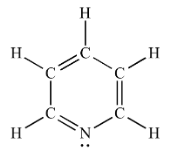
Complete step-by-step answer:The structure of pyridine is as follows:
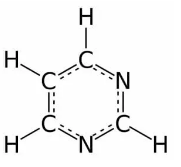
The structure of pyrimidine is as follows:
Within the $\pi$ electron cloud, the only ones delocalized are those in the ring, i.e., not in an orbital perpendicular to the $2 p {z}$ (vertical) orbitals of each carbon in the ring. Around each nitrogen, there are only three electron groups, indicating a trigonal planar geometry of electrons.
The XY-plane is perpendicular to the Z axis, since the \[s{{p}^{2}}\] orbitals are in the same plane as the rest of the molecule, and since the Z axis is vertical and the XY-plane is horizontal, the nitrogen \[s{{p}^{2}}\] orbital is perpendicular to each carbon's \[2pz\].
Therefore, the orbital $s p^{2}$ does not add its lone pair into the ring, and nitrogen only contributes electrons that are already bonded into the ring.
Therefore, each nitrogen contributes around three electrons of $\pi$ to the aromatic ring. If we assume that the carbon and nitrogen electronegativity are sufficiently similar, then there would be three electrons per nitrogen of $\pi$.
Note:Aromatic compounds are chemical compounds which consist of conjugated planar ring systems in place of individual alternating double and single bonds, accompanied by delocalized pi-electron clouds.
Complete step-by-step answer:The structure of pyridine is as follows:
The structure of pyrimidine is as follows:
Within the $\pi$ electron cloud, the only ones delocalized are those in the ring, i.e., not in an orbital perpendicular to the $2 p {z}$ (vertical) orbitals of each carbon in the ring. Around each nitrogen, there are only three electron groups, indicating a trigonal planar geometry of electrons.
The XY-plane is perpendicular to the Z axis, since the \[s{{p}^{2}}\] orbitals are in the same plane as the rest of the molecule, and since the Z axis is vertical and the XY-plane is horizontal, the nitrogen \[s{{p}^{2}}\] orbital is perpendicular to each carbon's \[2pz\].
Therefore, the orbital $s p^{2}$ does not add its lone pair into the ring, and nitrogen only contributes electrons that are already bonded into the ring.
Therefore, each nitrogen contributes around three electrons of $\pi$ to the aromatic ring. If we assume that the carbon and nitrogen electronegativity are sufficiently similar, then there would be three electrons per nitrogen of $\pi$.
Note:Aromatic compounds are chemical compounds which consist of conjugated planar ring systems in place of individual alternating double and single bonds, accompanied by delocalized pi-electron clouds.
Recently Updated Pages
Master Class 12 Business Studies: Engaging Questions & Answers for Success

Master Class 12 Biology: Engaging Questions & Answers for Success
Master Class 12 Chemistry: Engaging Questions & Answers for Success
Class 12 Question and Answer - Your Ultimate Solutions Guide
Master Class 11 Social Science: Engaging Questions & Answers for Success
Master Class 11 English: Engaging Questions & Answers for Success
Trending doubts
Which are the Top 10 Largest Countries of the World?
Draw a labelled sketch of the human eye class 12 physics CBSE
Differentiate between homogeneous and heterogeneous class 12 chemistry CBSE
Sulphuric acid is known as the king of acids State class 12 chemistry CBSE
Why is the cell called the structural and functional class 12 biology CBSE
Which is the correct genotypic ratio of mendel dihybrid class 12 biology CBSE